49 works in this view — arrow keys or swipe to move between them.
Dance in Art
Theatrical portraits
Unknown artist
- Collection:
- Prints depicting dance
- Source:
- New York Public Library
- Rights:
- Public domain — free to use, share and adapt.
- Recorded as:
- Public Domain
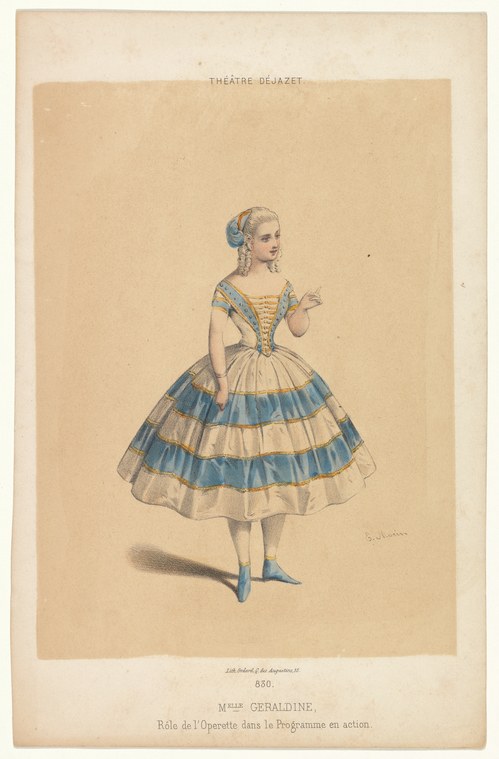
This work documents the appearance, costume, and professional identity of a working dancer in the 19th-century theater at a moment when such images were the primary way that theatrical performers reached a public beyond those who could attend live performances. The detailed rendering of the costume—particularly the construction of the skirt with its horizontal bands of blue trim—provides material evidence of how classical theatrical costumes were engineered and worn. The formality of the pose and the prominence of the printed attribution remind us that dancers in this era, especially women, were marketed as celebrity personalities and desirable images as much as skilled performers.
What you are looking at
A single female dancer stands against a plain cream background, her body angled three-quarters to the viewer's right. She wears a pale yellow or cream-colored ball gown with a fitted bodice trimmed in blue silk and decorated with what appears to be embroidered or applied ornament; the bodice is cut low across the shoulders with short puffed sleeves. The skirt is voluminous, constructed in three or four tiers of pale fabric separated by bands of blue silk ribbon or trim that create horizontal stripes. The skirt extends to mid-calf, revealing pale stockings and flat ballet slippers. Her hair is styled in a center part and pulled back, adorned with what appears to be a blue ribbon or ornament. Her left arm is raised, bent at the elbow with the hand open and fingers extended in a graceful gesture; her right arm hangs at her side. She gazes to the right, her expression serene and her posture upright. The figure casts a soft shadow on the ground. The overall effect is one of stillness and elegance rather than dynamic movement.
The dancing
The dancer's weight appears balanced and centered, with no indication of propulsion or traveling movement. Her raised left arm follows a balletic line—elbow slightly bent, hand open with fingers extended naturally—suggesting a classical frame. The lowered right arm hangs naturally at her side. Her stance is narrow and vertical, the feet positioned close together in what appears to be a neutral or closed position rather than in a wide balletic turnout. Her gaze is lifted and directed away from the viewer, following the line of her raised arm in the manner of classical ballet staging. There is a single figure only, posed rather than dancing.
The dance depicted
This is a theatrical portrait—a celebrity image of a named performer—rather than a depiction of dance in action. The inscription identifies her as 'Mlle Geraldine' in the role of l'Opéra dans le Programme en action (a character role from an opera or operatic ballet). The costume and pose indicate she is a trained classical dancer; the fitted bodice, full skirt, slippers, and formal bearing are consistent with mid-19th-century operatic or theatrical ballet practice. However, the image freezes her in a moment of stillness or a formal presentation rather than showing the actual execution of a step or movement. The raised arm and serene expression suggest a moment of repose or pageantry rather than active dancing.
How it was made
This is a hand-colored engraving or lithograph, likely from a published theatrical series. The technique allowed for mass production and wide circulation among opera and theater enthusiasts in the 19th century. The artist has employed soft color washes—pale yellows, blues, and grays—over a line-printed base, a method that enabled economical reproduction while maintaining the delicacy of the subject. The presence of the printer's or publisher's mark at the top ('THÉÂTRE DÉJAZET') indicates this was a commercial theatrical portrait intended for distribution and consumption by the theater-going public, similar to modern playbills or promotional photographs.
About this work
This is a theatrical portrait engraving of a named dancer, Mlle Geraldine, in a specific operatic or ballet role. It belongs to a 19th-century tradition of celebrity portraiture, wherein performers were memorialized in costume and posed formally for sale to fans and collectors. The work documents the costume, bearing, and professional identity of a stage dancer from the era rather than capturing a moment of choreography in action. It is a record of how classical dancers presented themselves on the theatrical stage—the dress, the composure, the alliance between bodily elegance and formal costuming. Such portraits are invaluable not for what they show of dance technique but for what they reveal about costume practice, body presentation, and the cult of the theatrical performer in the 19th century.
How to look at it
Attend to the costume detail: the way the skirt is constructed in tiers, the placement and texture of the blue trim, the fitted bodice and its low-cut neckline. These elements document the material reality of how dancers dressed on stage in this era. Note also the artist's choice to show the dancer in repose rather than in motion—this was typical of theatrical portraiture, which aimed at elegance and legibility of costume rather than the capture of movement. The raised arm and lifted gaze create a sense of refined bearing and emotional composure, qualities that were valued in 19th-century female performers. The soft, hand-applied color and the fine linear detail of the engraving reflect the labor-intensive craft of theatrical portrait production.
The artist
The artist is not recorded in the catalogue. The work is attributed to the Théâtre Déjazet, a Parisian theater, suggesting either that the theater's house artist produced it or that it was made by a commercial theatrical portrait specialist in Paris. The hand-colored engraving technique was standard practice for such theatrical souvenirs in the 1830s–1850s, a period when numerous such portraits were mass-produced for sale in theater lobbies and through print shops.
The period
The mid-19th century saw an explosion in the production and consumption of theatrical portrait engravings, driven by the rise of the star system in opera and dance. Mlle Geraldine is performing at a time when classical ballet was becoming increasingly aligned with operatic spectacle and when dancers' costumes were growing more elaborate and virtuosic in their construction. The Romantic era's idealization of the ethereal female body is reflected in the soft coloring, the pale fabrics, and the graceful, elongated pose. Such portraits were often collected in sets and bound into volumes, making them precursors to modern theater programs and celebrity photograph collections.
Where it lives
This work is part of the New York Public Library's collection of 'Prints depicting dance.' The Théâtre Déjazet attribution at the top suggests it was produced or distributed by that Paris theater, likely as a souvenir or promotional item sold to audiences.
Dance in this work
Questions about this work
What is Mlle Geraldine dancing?
The inscription indicates she is performing a character role in an opera or operatic ballet, but the image shows her in a static pose rather than in the act of dancing a specific step. The costume and bearing suggest she is a trained classical dancer performing in a staged theatrical production.
Why is the dress so elaborate?
This is a stage costume designed for visibility and elegance in a theater lit by gaslight. The pale, full skirt with horizontal bands of blue trim would have created an eye-catching silhouette from the audience's viewpoint. The fitted bodice and low neckline were typical of mid-19th-century operatic costume and reflected the era's fashions for middle- and upper-class women.
Is this a photograph?
No. This is a hand-colored engraving or lithograph, a printed image that was then selectively painted with watercolor or colored inks. Such techniques allowed for mass production and lower cost than hand-painted portraits or the early photography processes of the time.
Who was Mlle Geraldine?
The catalogue record does not provide biographical information, but the attribution to the Théâtre Déjazet in Paris suggests she was a performer at that venue in the 1830s–1850s. Such theatrical portraits were produced for dancers whose names were recognizable to theater-goers and whose images would sell as souvenirs.
More dance artwork





