49 works in this view — arrow keys or swipe to move between them.
Dance in Art
Theatrical portraits
Unknown artist
- Collection:
- Prints depicting dance
- Source:
- New York Public Library
- Rights:
- Public domain — free to use, share and adapt.
- Recorded as:
- Public Domain
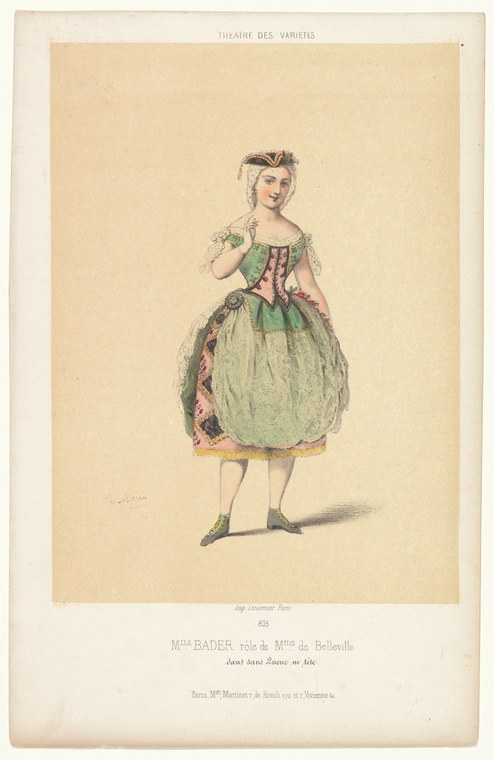
This print preserves a specific dancer's costume and stage identity from an era when most ballet performances are now known only through written records and later lithographed reproductions. It shows the material reality of Romantic ballet dress—the weight and volume of the skirt, the proportion of bodice to leg, the scale of accessories—in a way that no text can convey. For anyone studying how Romantic ballet was actually dressed and presented on stage, this is primary evidence.
What you are looking at
A young woman in theatrical costume stands in a three-quarter pose against a plain cream background, gazing toward the viewer with a slight smile. She wears a pale green full skirt gathered at the waist, with a fitted bodice in contrasting mauve or rose tones decorated with ornamental details. A long scarf or shawl in the same mauve fabric drapes from her shoulders and falls behind her in a graceful curve. Her hair is styled up with what appears to be a decorative headpiece or wreath, and she holds a small nosegay of flowers in one hand. Her feet, in flat dark shoes, are positioned as if pausing mid-movement. The figure occupies the center of the composition with considerable white space around her, a presentation typical of theatrical costume documentation. The hand-coloring in soft greens, pinks, and flesh tones gives the work the character of a mid-nineteenth-century commercial print.
The dancing
A single figure is shown in an upright, relaxed stance with the weight evenly distributed; there is no suggestion of a leap, turn, or dynamic extension. The posture is frontal and presentational rather than caught in action. The raised arm holding flowers is a gesture of display and charm rather than a movement phrase. The overall impression is of a performer posed for the viewer's appraisal, as if stepping out of character to be seen and admired.
The dance depicted
The costume and presentation are consistent with the European theatrical ballet of the 1840s–1860s, particularly the Romantic era in which ballerinas were depicted in sylphs, spirits, and exotic maiden roles. The pale green skirt, fitted bodice, and flower accessory suggest a pastoral or fairy-tale character from the Romantic ballet repertory. However, without a named role or inscription visible in the print, the specific ballet cannot be identified with certainty. The pose and scale suggest this is a costume study made for theatrical circulation and publicity rather than a record of movement.
How it was made
This is a hand-colored lithograph or engraving, likely French, produced in the mid-nineteenth century. The fine linear detail, particularly in the rendering of fabric and the figure's features, is characteristic of lithographic printing. The soft hand-coloring in watercolor or tinted ink, applied after printing, was standard practice for theatrical costume prints distributed as souvenirs and promotional materials. This technique allowed rapid reproduction for a commercial theater audience while preserving the delicate detail necessary to show costume design.
About this work
This is a theatrical costume portrait of a female dancer in Romantic-era ballet dress, presented in the popular format of mid-nineteenth-century French theater prints. The woman identified in the caption—Mlle Bader, in the role of Mlle de Belleville—is documented here in a character costume that reflects the Romantic ballet's fascination with ethereal femininity and exotic or supernatural characters. The work is a document of both costume design and celebrity, made for circulation among theater-goers as a keepsake and advertisement. It belongs in a gallery of dance imagery as evidence of how dancers were marketed, remembered, and idealized in the era before photography became the dominant medium.
How to look at it
Observe how the artist has chosen to present the dancer in repose rather than in motion—a deliberate choice that emphasizes beauty and elegance over the technical demands of performance. Notice the careful rendering of fabric weight and drape, especially in the trailing shawl; this detail matters because it shows what the costume actually looked like on stage. The pose itself—frontal, relaxed, inviting the viewer's gaze—is a convention of theatrical portraiture that served to make the performer accessible and personal to the paying public.
The artist
The artist is not recorded in the catalogue. The print carries the inscription 'Imp. Marchand & Cie lith' and 'Bertauts' at the bottom, indicating it was lithographed by a Paris printing house and likely sold through theatrical print distributors. Such prints were produced by the hundreds in Paris during the 1840s–1860s, often by different hands, and were rarely signed individually. They served as a profitable byproduct of the theater industry, capitalizing on the celebrity of dancers.
The period
The Romantic ballet era (c. 1830–1870) saw an explosion of theatrical commerce and visual culture. Lithographic printing had made colored theatrical prints affordable and portable, creating a mass market for images of celebrated performers. Dancers like Marie Taglioni and Fanny Elssler were as much visual icons as they were artists, and their images circulated widely as prints, playbills, and souvenirs. This democratized access to theater imagery but also reinforced the reduction of dancers to beautiful objects to be admired and consumed. The pale, ethereal aesthetic seen in Mlle Bader's costume was the dominant visual language of Romantic ballet throughout this period.
Where it lives
This print is held in the New York Public Library's collection of prints depicting dance, as a document of theatrical costume and performance history. It is typical of the thousands of such promotional prints produced in Paris and distributed internationally during the nineteenth century.
Dance in this work
Questions about this work
Who was Mlle Bader?
The caption identifies her as performing in the role of 'Mlle de Belleville,' but no further biographical information is recorded in the holding catalogue. She appears to have been a dancer active in the 1840s–1850s, but she is not widely documented in ballet histories. She was prominent enough to merit a costume print, suggesting she held a principal or featured role in a Paris theater.
What ballet is this from?
The specific ballet title is not recorded in the print's visible inscription. The costume—pale green skirt, fitted bodice, flower accessory—is consistent with any number of Romantic-era roles (sylphs, peasant maidens, exotic characters). Without an inscription or other identifying mark, the role cannot be determined from the image alone.
Why are there so many prints like this?
Lithographic printing made theatrical portraits cheap to produce and distribute. Theaters sold them as souvenirs, and print merchants capitalized on dancers' celebrity. A successful dancer might have dozens of different costume prints in circulation. They functioned as both advertising and keepsakes for fans, much like celebrity photographs or trading cards do today.
Why is the dancer not dancing?
Theatrical costume prints typically showed the performer posed elegantly rather than captured mid-movement. This allowed the viewer to see the costume clearly and admire the dancer's beauty and poise. The standing pose was also easier and faster to lithograph than a dynamic action, reducing production costs.
More dance artwork





