49 works in this view — arrow keys or swipe to move between them.
Dance in Art
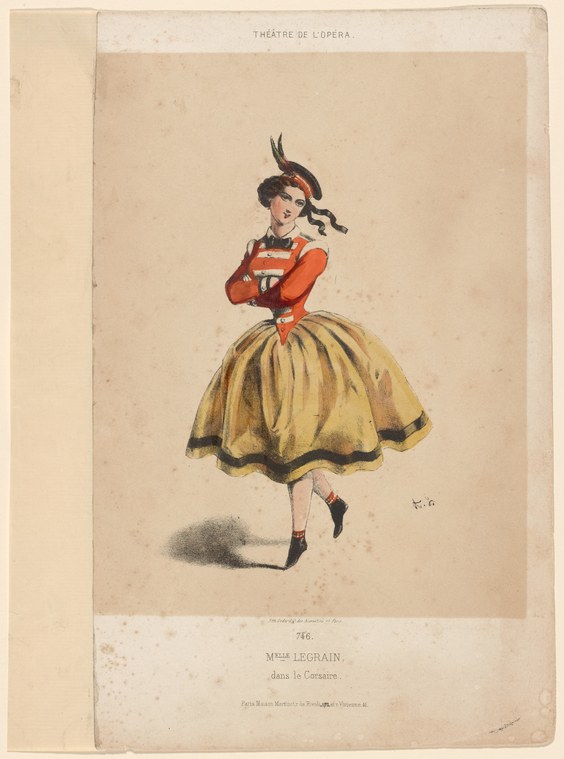
Melle Legrain dans Le corsaire, Théâtre de l'Opéra
Unknown artist
- Collection:
- Prints depicting dance
- Source:
- New York Public Library
- Rights:
- Public domain — free to use, share and adapt.
- Recorded as:
- Public Domain
Theatrical prints like this are among the most accessible primary sources for understanding what Romantic-era ballet looked like: the cut and weight of skirts, the height of the heels, the character of the ornaments, and the way dancers were presented to the public. They also document the specific roles and dancers associated with key works, making them essential for tracking the performance history and repertory development of foundational ballet pieces. This particular example connects to one of the nineteenth century's most durable and internationally successful ballets, a work that shaped the aesthetics of Romantic ballet and remained in circulation long after its premiere.
What you are looking at
A young female dancer in mid-performance costume stands alone against a plain cream background, captured in a three-quarter pose that emphasizes the silhouette and line of her body. She wears a vivid red jacket or bodice with horizontal white stripes across the chest, cropped short at the waist, paired with a full skirt in pale golden yellow that extends to just below the knee. The skirt is caught mid-movement, its hem darkened with shading to suggest volume and fabric weight. She wears dark stockings and heeled shoes, one foot raised slightly as if caught between steps. A feathered ornament or aigrette adorns her dark hair, adding theatrical height and a sense of exotic character. The artist has used careful shading to model her limbs and suggest the weight and three-dimensionality of the costume, while the figure is otherwise set against the bare ground, typical of theatrical costume studies or rehearsal documentation.
The dancing
The dancer stands in a posed, frontal attitude rather than mid-leap or in extended classical alignment. Her shoulders are level and composed, arms held at her sides or with one slightly forward, suggesting either a moment of stillness or the formal presentation required of a costume study. Her weight appears to rest primarily on one leg, with the other foot raised and the knee bent in a way that suggests she is not executing a demanding step but rather demonstrating the silhouette the costume creates in motion. The posture is upright and self-possessed, more portrait than action study.
The dance depicted
This is costume documentation for Mlle Legrain performing in *Le Corsaire*, the three-act romantic ballet choreographed by Joseph Mazilier and premiered at the Paris Opéra in 1856. *Le Corsaire* was a vehicle for the technical display and exotic fantasy typical of mid-nineteenth-century Romantic ballet, and the character costuming here—red striped jacket, full skirt, feathered headdress—suggests a character role, possibly a harem dancer or Eastern European figure within the ballet's adventure narrative. The study format indicates this was created as a record of the production design and performer appearance, likely for the Paris Opéra's archives or for circulation among the theatre community.
How it was made
This is a hand-colored print, most likely a lithograph or engraving on steel or wood, with watercolor or gouache applied by hand to the printed impression. The delicate precision of the line work, the fine cross-hatching used to model form, and the careful registration of color suggest a professional theatrical print house, likely Parisian. The inscription at the foot in print confirms publication credentials. This format—the colored theatrical print—was a standard medium for documenting and promoting ballet performances and dancers in the mid-nineteenth century, serving both as archival record and as a circulating souvenir for the theatre-going public. The hand-coloring allowed for precision in recording the exact hues of expensive stage costumes.
About this work
This is a costume study documenting Mlle Legrain in a character role from Joseph Mazilier's *Le Corsaire*, one of the most popular and frequently revived ballets of the nineteenth century. It is a professional theatrical print made for the Paris Opéra, part of a standard practice of recording and publicizing major productions through hand-colored prints distributed to dancers, critics, and the public. The work is neither a portrait nor a stage action study, but rather a hybrid format—part fashion plate, part archival record—designed to capture and circulate the visual spectacle of the production. For dance historians and costume researchers, such prints are invaluable primary sources documenting not only the dancers themselves but the exact appearance of nineteenth-century stage dress, the organizational practices of major opera houses, and the way ballet was promoted and consumed in its period.
How to look at it
Attend to the construction of the silhouette: the artist has positioned the dancer to show the full profile and volume of the costume, with the skirt caught at a moment when it reads clearly as a theatrical garment rather than everyday dress. Notice the careful balance between the red bodice and the pale skirt—the contrast was essential to the visual impact of the stage picture. The feathered headdress and the slight turning of the head create a sense of personality and character rather than abstract classical form. The shading of the stockings and the definition of the legs underneath the skirt show the artist's attention to the actual form of the dancer's body beneath the costume—a hallmark of serious costume documentation.
The period
This print dates to the 1850s or shortly thereafter, during the height of the Romantic ballet era in Paris. *Le Corsaire* was choreographed in 1856 and became an immediate popular success, frequently revived and adapted. It represented the mature form of Romantic ballet—narrative-driven, rich in character roles and exotic settings, technically demanding, and built around the display of the ballerina. The mid-nineteenth century was the peak of the theatrical print industry in Paris; hand-colored lithographic and engraved portraits of singers, dancers, and actors were mass-produced and widely collected, serving as a form of celebrity documentation and souvenirs of successful productions. The format and style of this print are entirely consistent with Parisian theatrical publishing of the 1850s–1860s.
Where it lives
This print is held in the Dance Division of the New York Public Library, part of its collection of theatrical and dance-related prints and illustrations. The division maintains extensive holdings of nineteenth-century European theatrical prints, particularly from Paris and London, as primary sources for performance history research.
Dance in this work
Questions about this work
What was *Le Corsaire* and why was it important?
*Le Corsaire* was a three-act romantic ballet choreographed by Joseph Mazilier for the Paris Opéra, premiered in 1856. It combined adventure narrative, exotic settings, and opportunities for both classical and character dancing, and became one of the most frequently performed ballets of the nineteenth century. It remained in the repertory worldwide well into the twentieth century and is still performed today.
What can we learn from a costume print like this?
Costume prints are invaluable records of how stage costumes actually looked, how they fit the body, what materials were used, and how dancers moved in them. They also document which dancers performed which roles, how productions changed over time, and what the theater-going public saw and expected. Few actual costumes survive from this period, making prints often the only visual evidence we have.
Was Mlle Legrain a famous dancer?
The print documents that Legrain performed a character role in *Le Corsaire* at the Paris Opéra, one of Europe's most prestigious ballet theaters, but the extent of her career and reputation cannot be established from this image alone. The fact that she appears in an official Opéra print suggests she was a soloist or featured performer rather than an unknown dancer.
More dance artwork





