49 works in this view — arrow keys or swipe to move between them.
Dance in Art
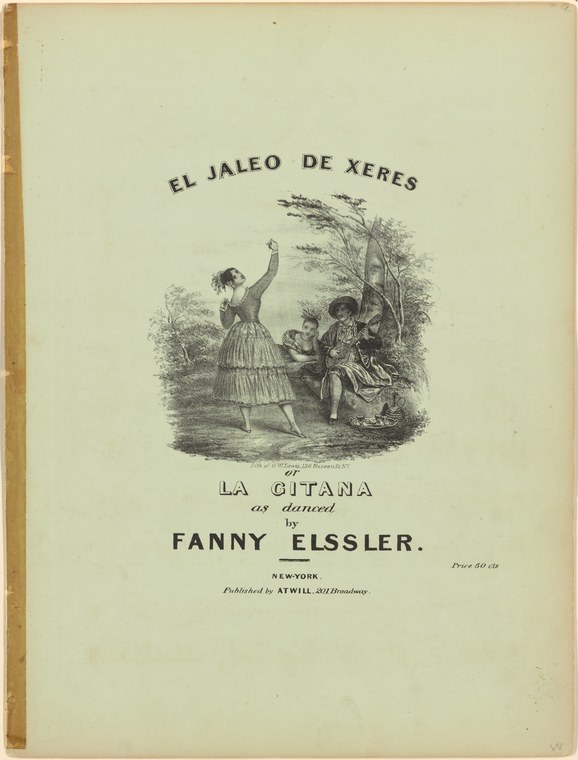
El jaleo de Xeres or La gitana as danced by Fanny Elssler
Unknown artist
- Collection:
- Prints depicting dance
- Source:
- New York Public Library
- Rights:
- Public domain — free to use, share and adapt.
- Recorded as:
- Public Domain
Fanny Elssler was a pivotal figure in expanding the repertoire and reach of theatrical dance beyond classical ballet, and this print documents one of her most successful and frequently performed roles. For dance historians, the image is valuable evidence of how character and national dances were performed in the 1830s–1840s—the posture, dress, energy, and theatrical context all convey information about the aesthetics and ambitions of Romantic-era theater.
What you are looking at
A theatrical scene depicting a young woman in a gathered white dress standing in animated pose, one arm raised, center-left of the composition. She faces a seated male figure in dark period clothing (appears to be early 19th-century costume) who reclines against a tree. The setting is a wooded landscape with windswept trees suggesting movement or drama in the natural world. The woman's posture is energetic and expressive—her body tilted, her raised arm emphatic, her skirts caught in dynamic folds. A third figure, partially visible at right, watches the interaction. The engraving is rendered in fine lines with careful attention to the play of light and shadow, particularly in the foliage and the folds of the woman's dress. The overall mood is one of theatrical spectacle: a solo performance being witnessed.
The dancing
The dancer's weight is thrown forward and to the side; her torso leans away from her supporting leg in a pose that emphasizes extension and energy. Her right arm rises high and outward in a declarative gesture. Her left arm appears to hang or gesture downward. The dress, with its gathered skirt and relatively high waistline, allows clear visibility of the legs and suggests freedom of movement. The pose reads as a moment of intense emotional expression—neither a formal position nor a static tableau, but rather a captured instant of dramatic action. The male figure's seated, recumbent posture makes clear that she is the focus and agent of motion.
The dance depicted
The print is titled as a depiction of *La Gitana* (The Gypsy), described as danced by Fanny Elssler. Elssler (1810–1884) was one of the great European ballet dancers of the Romantic era, famous for her vivacious, technically brilliant style and for roles that departed from the ethereal heroines of classical ballet toward more earthy, national, and character-based figures. *El jaleo de Xeres* and *La gitana* were among her signature character dances—works rooted in Spanish dance traditions and performed in the costume and style shown here. The pose, the Spanish setting implied by the title, and the energetic, turned-out bearing all point to a Romantic-era theatrical dance that drew on or evoked folk and national traditions. This is not classical ballet in the formal sense but rather the character dance or danse nationale that was central to mid-19th-century theatrical practice.
How it was made
This is a steel or copper engraving, rendered in fine lines and cross-hatching to create tone and volume. The technique allowed for mass reproduction and wide distribution—this print would have been sold to theater audiences, collectors, and enthusiasts across Europe and North America, making Elssler's likeness and her signature roles familiar to people who would never see her dance in person. The fineness of line work and the attention to textural detail in fabric and foliage suggest a skilled reproductive engraver, likely working from a drawing or painting. Steel engraving was the dominant medium for theatrical portraiture and dance documentation in the 1830s and 1840s.
About this work
This is a print documenting one of the most celebrated theatrical performances of the Romantic era: Fanny Elssler's interpretation of *La gitana*, a character dance set to Spanish themes. The image captures the vivacity and technical facility that made Elssler famous—a departure from the pale, weightless heroines of classical ballet toward a more grounded, spirited performer. The title references *El jaleo de Xeres*, a Spanish regional dance, suggesting that the work was part of the 19th-century fashion for national and ethnic dances on the European stage, performed by classically trained dancers in costume. As a printed reproduction, it is evidence of how theatrical dance was circulated and consumed in the pre-photographic era: through engravings, lithographs, and prints that made stars visible and roles reproducible across geography and time.
How to look at it
Attend to the moment of maximum expressiveness the engraver has chosen: not the peak of a jump or an extended line, but rather a twisted, off-center pose that conveys dramatic intensity and emotional release. This is characteristic of Romantic-era character dance, which valued animation and personality over the formal perfection of classical positions. Notice too the careful rendering of the dress—the way the gathered skirt is caught mid-motion, the way the high waistline and relatively exposed legs suggest a different body aesthetics from the more corseted silhouettes of non-dancing women of the same period. The presence of the watching figures anchors this as a theatrical moment, a performance being witnessed and documented.
The artist
The engraver is not recorded. The print was published in New York by Atwell, suggesting it was part of the commercial print trade in the United States during the 1830s or 1840s, when Elssler toured North America to great acclaim (1840–1842). American publishers reproduced images of European stars to capitalize on theatrical enthusiasm and to advertise performances.
The period
The 1830s and 1840s were the height of the Romantic ballet era, a period when the ethereal, weightless *ballerina* in a white tutu and on pointe became the dominant image of theatrical dance. Simultaneously, however, there was a growing appetite for character dances, national dances, and roles that showcased different body types, nationalities, and dramatic registers. Fanny Elssler represented this second impulse: she was technically brilliant but known for earthy, spirited roles that drew on or evoked Spanish, Italian, and Polish traditions. Her famous 1840 American tour cemented her status as a rival to the more ethereal Marie Taglioni, and prints like this one documented and promoted her performances to transatlantic audiences.
Where it lives
The print is held in the New York Public Library's collection of prints depicting dance. It was published by Atwell in New York, suggesting circulation as a commercial theatrical souvenir or promotional print in the American market during the era of Elssler's tour and immediate aftermath.
Dance in this work
Questions about this work
Who was Fanny Elssler and why does she matter?
Elssler (1810–1884) was an Austrian-Italian ballet dancer and one of the most famous performers of the 19th century. She was Romantic ballet's answer to the question of what a brilliant dancer could do outside the ethereal, weightless idiom that dominated the era. She excelled at character dances and national dances, bringing technical brilliance and dramatic personality to roles that were considered more earthbound than classical ballet. Her 1840–1842 American tour made her an international celebrity and her image was widely reproduced in prints.
What is *La gitana* and why did Elssler dance it?
*La gitana* (The Gypsy) was a character dance set to Spanish themes, one of Elssler's signature roles. It played to her strengths: technical facility, dramatic expressiveness, and the ability to embody a spirited, non-classical character. The role was part of a broader 19th-century fashion for national and ethnic dances on European and American stages, performances that drew on or evoked folk traditions and non-European aesthetics.
How do we know what 19th-century dance looked like?
Before photography became reliable for capturing motion (late 19th century), dance was documented through engravings, lithographs, paintings, and written descriptions. Prints like this one were commercial products—sold to theater audiences and collectors—and they provide evidence of costume, posture, gesture, and the moments performers chose to emphasize. They are not recordings, but they are primary sources for how dancers moved and how their movement was understood and marketed.
Why is this work titled with both Spanish place names?
*El jaleo de Xeres* refers to a Spanish regional dance tradition from Jerez (Xeres), a city famous for flamenco. *La gitana* means 'the gypsy,' and in 19th-century European theater, 'gitano' (gypsy) imagery was strongly associated with Spanish and Andalusian culture. The dual title suggests the work drew on or evoked authentic Spanish dance while being adapted for the European stage and a classical ballet dancer.
More dance artwork





