49 works in this view — arrow keys or swipe to move between them.
Dance in Art
Pose Silfidée
Unknown artist
- Collection:
- Prints depicting dance
- Source:
- New York Public Library
- Rights:
- Public domain — free to use, share and adapt.
- Recorded as:
- Public Domain
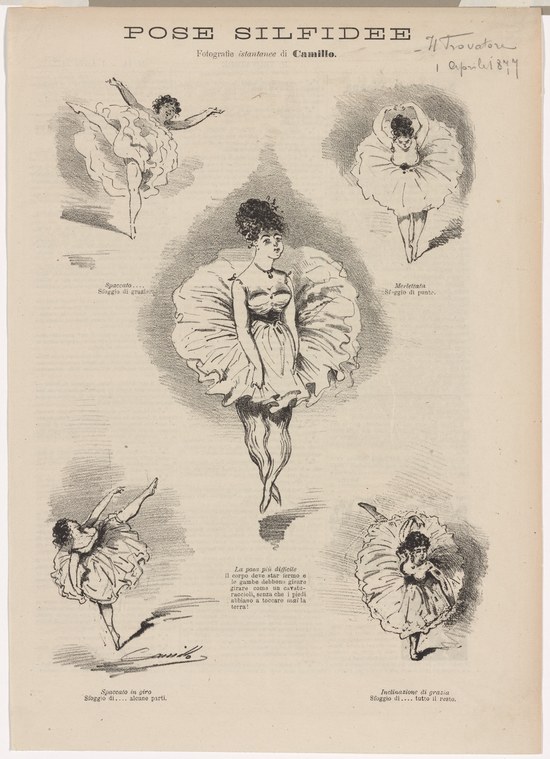
For dancers and historians, this sheet documents the exact visual language of Romantic ballet at its height—not as a narrative or a performance, but as pure movement technique. It shows how the extended leg, the lifted torso, and the specific quality of épaulement created the illusion of weightlessness and otherworldliness that defined the style. The multiple studies also reveal how 19th-century artists thought about dance: as a repeatable, teachable form that could be analyzed and transmitted through visual reference.
What you are looking at
This is a study sheet of five female dancers in tutus, arranged around a central full-length figure. The composition is typical of 19th-century dance documentation—a pedagogical or theatrical reference showing variations of a single pose or movement. The central dancer stands in profile, her body pitched slightly forward, one leg extended behind her in a graceful line, arms raised and spread asymmetrically. Her skirt is voluminous and bell-shaped, rendered with careful attention to its sculptural folds. Four smaller studies surround her: two at top (one in mid-leap, one with arms raised and skirt splayed), two at bottom (one in rapid movement with skirt flying, one in a grounded pose). All figures wear the characteristic costumes of Romantic ballet—fitted bodies, short tutus, and pointe shoes. The composition is rendered in black ink with fine cross-hatching for shadow and volume, suggesting an engraving or lithographic print. The title "Pose Silfidée" (Sylph Pose) appears at the top, with a credit to "Camille" as the originating artist or publication.
The dancing
All figures are female and dance in the vocabulary of classical ballet. The central figure shows the characteristic turnout and extension of academic technique, with the free leg lifted high behind the body in what appears to be an arabesque or extended développé. Her arms are held in a soft, épaulement frame typical of the period. The surrounding studies show the same body in different moments: ascending, rotating, accelerating. The artists has precisely rendered the tension in the dancers' legs, the arch of the foot, and the ethereal quality of the lifted torso—all elements essential to Romantic ballet technique.
The dance depicted
This is unambiguously a study of Romantic ballet, almost certainly depicting the 'Sylph' pose from *La Sylphide* (1832), the foundational work of the Romantic ballet tradition. The title makes this explicit. The multiple studies suggest an attempt to capture the essence of the sylph's movement—weightless, elevated, otherworldly. The extended leg work, the turned-out positions, and the bell-shaped tutu are all signatures of this tradition. This kind of reference sheet would have circulated among dancers, teachers, and choreographers as a visual record of canonical movement.
How it was made
The work is a lithographic or engraved print, rendered in black ink on paper with fine linear hatching used to model form and create tonal gradation. The technique allows for precise anatomical detail while maintaining the lightness and grace essential to the subject. The regularity of the line work and the way shadow is built through parallel strokes suggest professional printing rather than a sketch. This is a reproductive work, likely published in a dance journal or as a teaching aid, which means it was produced in multiples and circulated fairly widely among the ballet community.
About this work
This is a 19th-century study sheet documenting the 'Sylph Pose'—the iconic extended arabesque that became the visual emblem of Romantic ballet after the premiere of *La Sylphide* in 1832. The five studies show the same movement from different angles and moments, a pedagogical approach meant to help dancers understand and practice the pose. It is both a technical diagram and an aesthetic statement: the repeated image reinforces the ethereal, weightless quality that the Romantic ballet dancer was meant to embody. As a printed work that circulated among professional dancers and students, it represents the infrastructure of ballet training and the codification of the Romantic style.
How to look at it
Focus on the repeated pose itself: the angle of the extended leg, the position of the torso, the reach of the arms. Notice how the artist has deliberately shown the same movement from different viewpoints to help the viewer understand its three-dimensionality. Watch how the central figure's weight is distributed—entirely on the supporting leg, with the free leg extended without apparent effort. The surrounding studies animate the pose: you can almost see the dancer arriving at this position and leaving it. The regularity of the hatching and the precision of the line work express the formal, codified nature of the technique.
The artist
The work is credited to "Camille" in the inscription, likely a French artist or lithographer active in the mid-19th century. Without further documentation, the individual identity cannot be confirmed. The work appears to be part of a series of dance studies, possibly published as a journal or educational print series. Such studies were a standard product of the period, combining artistic skill with pedagogical purpose.
The period
This print dates to the height of Romantic ballet, when the ethereal female dancer—the sylph, the spirit, the dream—became the dominant ideal in European dance. *La Sylphide* and works inspired by it created a new technical and aesthetic standard: the extended leg, the use of pointe work for elevation and weightlessness, and a body trained to suggest otherworldly grace. At the same time, lithography and engraving were the primary media for reproducing and circulating images of dancers to a wider public. Dance prints were a significant commercial category, sold to the ballet-going public and used as teaching aids. This sheet belongs to that culture: part art, part instruction, part fan material.
Where it lives
This print is held in the New York Public Library's collection of prints depicting dance. It appears to be a lithographic or engraved reproduction, likely published in France in the mid-19th century. The exact date and publisher are not recorded.
Dance in this work
Questions about this work
What is a 'Sylph Pose' and why does it matter?
The Sylph Pose is the extended arabesque that became the visual icon of Romantic ballet after *La Sylphide* (1832). It represents the ideal of weightless, ethereal femininity that dominated 19th-century ballet. The pose required significant extension and turn-out, and the appearance of ease masked technical difficulty. For a Romantic ballet dancer, mastering this pose was essential.
Why are there five versions of the same pose?
The multiple studies show the pose from different angles and moments in the movement. This compositional strategy—common in 19th-century dance prints—helped dancers and students understand the pose's three-dimensionality and the quality of movement required. It functioned as both artistic documentation and technical instruction.
How do I read the technique from this image?
Look at the leg position: fully extended behind the body, turned out from the hip, with a pointed foot. The supporting leg is straight and also turned out. The torso is lifted and slightly forward, creating the line of 'arabesque.' The arms are soft but controlled, placed to balance and frame the body. This combination of extension, turnout, and apparent weightlessness defines classical ballet technique.
Is this a famous work?
The work documents an iconic pose from *La Sylphide*, the most important ballet of its era, but the print itself is a reference tool rather than a celebrated artwork. Many such sheets were produced; this one has been preserved in the NYPL collection because of its historical significance to dance.
More dance artwork





