49 works in this view — arrow keys or swipe to move between them.
Dance in Art
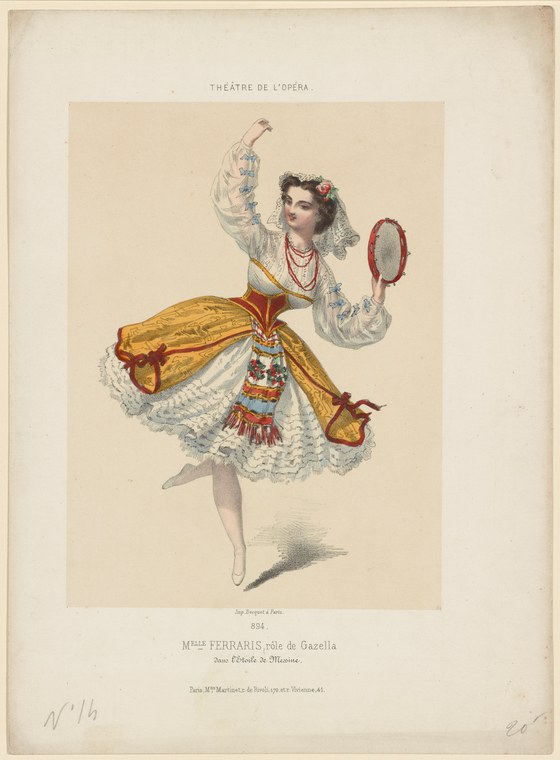
Melle Ferraris, rôle de Gazella dans l'Etoile de Messine. Théâtre de l'opéra
Unknown artist
- Collection:
- Prints depicting dance
- Source:
- New York Public Library
- Rights:
- Public domain — free to use, share and adapt.
- Recorded as:
- Public Domain
This print documents a specific named performer and role at a major European theatre, preserving visual evidence of how romantic-era opera dancers embodied character through costume and pose. For historians of ballet and opera, such prints are primary sources for understanding the visual culture, the status of dance within operatic entertainment, and the celebrities who commanded audiences in mid-nineteenth-century Paris.
What you are looking at
A solo female dancer in theatrical costume stands in a classical pose against a plain background. She wears a white lace skirt of moderate length over white tights and a fitted bodice decorated with red ornamental trim and beading across the chest and waist. A gold silk cape or cloak drapes from her shoulders, lined in deep crimson. Her hair is dark and styled up, adorned with red flowers or a jeweled ornament. She holds a hand mirror aloft in her right hand, her arm extended upward with the palm facing outward in a graceful, expressive gesture. Her left arm is raised behind her, and her body is angled in a refined, balletic stance. The pose suggests a moment of vanity or self-regard—the character admiring herself—rendered with the theatrical artifice and elegance of mid-nineteenth-century opera costume. The colour work is selective and refined: gold, red, and flesh tones stand out against the cream background.
The dancing
A single female figure in a refined classical stance with weight centered and posture upright. Her right arm is raised to shoulder height with the mirror held vertically, palm outward; her left arm curves behind her torso in a graceful arc. The pose is symmetrical and composed, with no suggestion of rapid movement—this is a held, presentational moment rather than a caught gesture. The body alignment and arm extension suggest training in classical theatrical dance, with emphasis on line and noble carriage rather than vigorous action.
The dance depicted
This is a theatrical dance pose from a nineteenth-century opera or ballet-opera production. The work title identifies the subject as 'Melle Ferraris, rôle de Gazella' in *L'Étoile de Messine* (The Star of Messina), performed at the Théâtre de l'Opéra in Paris. The pose and costume suggest a character role in a romantic opera-ballet, where the narrative often included spectacular solo moments showcasing the dancer's beauty and grace. The mirror and the gesture of self-admiration indicate a specific narrative moment—likely a scene in which the character Gazella regards herself, a common dramatic device in romantic and comic opera. The refined posture and the absence of rapid footwork or partnering suggest this is a moments of repose or vanity rather than virtuosic display.
How it was made
This is a hand-colored lithograph or engraving, created for theatrical publicity and archival documentation. The technique allowed for rapid, economical production of costume and pose records that could be distributed to opera houses, critics, and theatregoers. The selective application of color—limited to the costume elements and the performer's complexion—is typical of nineteenth-century theatre prints, where colored inks highlighted the visual spectacle without the expense of full-color printing. Such prints functioned as both publicity and historical record, preserving the appearance of celebrated performers and their most famous roles.
About this work
This is a theatrical portrait of a celebrated nineteenth-century dancer performing a named character role in a Parisian opera-ballet production. The image documents both the performer's identity and the visual spectacle of Romantic-era dance costume and pose. It belongs to a large body of theatre documentation from the period—prints that recorded the fashionable dances and dancers of Paris at the height of the romantic ballet era. Such works are invaluable for understanding how dancers of the period presented themselves, how characters were costumed, and what visual codes and gestures conveyed narrative and character on the operatic stage.
How to look at it
Attend to the precision of the pose and the narrative clarity of the gesture. The mirror held aloft is not a prop but a narrative signal—it tells the story without words. Note also the refined alignment of the body: the dancer's weight is centered and her line is unbroken from the crown of her head through her extended arm. This vertical elegance was the Romantic-era ideal of beauty and nobility. The gold cape and the white lace skirt create a visual hierarchy that emphasizes the dancer's silhouette and the theatrical spectacle of her costume. The image is a study in how nineteenth-century theatrical dance was presented to the public: not as action or athletics, but as a posed revelation of beauty, costume, and character.
The artist
The engraver is not recorded in the catalogue, but the print bears the credit 'Imp. Martinet & Cie, Rue Vivienne 25.' The Martinet printing house was a major Parisian publisher of theatrical prints and lithographs throughout the nineteenth century, specializing in costume and pose documentation for opera and ballet. Such prints were typically drawn by theatre-trained illustrators and printed in quantities for distribution to theatres, collectors, and the press.
The period
This print dates from the era of Romantic ballet and opera, when Paris was the center of European dance and theatrical spectacle. The 1840s–1860s saw the apotheosis of the ballerina as celebrity and the integration of ballet into operatic production as essential entertainment. Dancers were increasingly celebrated in the press and through lithographic portraiture, and their costumes—elaborate combinations of classical and exotic motifs—became objects of fascination. The mirror, the pose of self-admiration, and the narrative gesture are consistent with the conventions of Romantic opera, in which character and emotion were conveyed through tableau and expressive stillness as much as through movement.
Where it lives
The print is held in the *Prints depicting dance* collection of the New York Public Library. It is part of the Library's extensive holdings of nineteenth-century theatrical ephemera and costume documentation, which preserve the visual record of stage performance across Europe during the Romantic era.
Dance in this work
Questions about this work
Who was Melle Ferraris?
The catalogue does not record biographical information about this performer. The title indicates she was a celebrated dancer at the Théâtre de l'Opéra in Paris and that she was known for the role of Gazella in *L'Étoile de Messine*. Such prints were commissioned to commemorate celebrated performers, suggesting she held significant status in Parisian theatrical circles.
What is *L'Étoile de Messine*?
The work is a nineteenth-century opera or opera-ballet, performed at the Théâtre de l'Opéra in Paris. Beyond the title and this print, little is recorded in the catalogue about the work itself. The print documents one celebrated moment—the character Gazella's scene of self-regard—but does not provide context for the narrative or the full production.
Why hold a mirror in a dance pose?
The mirror is a narrative device signaling the character's vanity or self-admiration. In Romantic opera and ballet, such props and gestures conveyed plot and character without dialogue. The pose itself—facing the audience while regarding herself—creates a theatrical paradox that engages the spectator in the character's act of self-regard.
Is this a costume design or a portrait?
It is both. The print functions as a theatrical portrait of the performer Ferraris, a costume record, and a piece of publicity for the production. The combination of the named performer and the named role indicates the print was created to preserve and promote both the celebrated dancer and the celebrated production.
More dance artwork





