49 works in this view — arrow keys or swipe to move between them.
Dance in Art
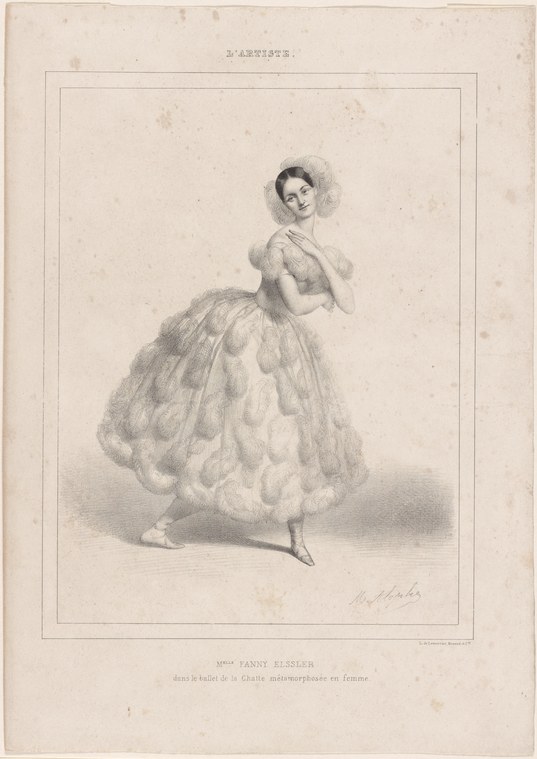
Melle Fanny Elssler dans le ballet de La chatte métamorphosée en femme
Unknown artist
- Collection:
- Prints depicting dance
- Source:
- New York Public Library
- Rights:
- Public domain — free to use, share and adapt.
- Recorded as:
- Public Domain
Fanny Elssler was one of the two dominant ballet stars of her era, rival to Marie Taglioni, and her roles and costumes set the standard for Romantic ballet across Europe. This print is a primary document of how that aesthetic was realized and promoted—what the audience actually saw, and how the image of the dancer was packaged and sold. Without such prints, we would know Romantic ballet only through descriptions and music; with them, we can understand the visual culture of one of dance's most influential periods.
What you are looking at
A young woman in a voluminous white tulle skirt stands in three-quarter profile, gazing back over her shoulder with a gentle smile. The skirt, gathered and layered with pronounced fullness, dominates the composition—its billowing folds suggest movement caught mid-gesture, as if she has just turned or is about to step forward. She wears a fitted bodice and short puffed sleeves, with her arms held delicately at her sides and slightly forward. A decorative bonnet or headdress frames her face. The figure is rendered in careful graphite and light wash against a plain background, with subtle shadow work giving the skirt sculptural volume. The pose is entirely frontal to the viewer's gaze despite the slight turn of the torso, inviting admiration of the costume and silhouette. The technique and style—particularly the tight linear control of the face against the softer, almost vaporous rendering of the textile—suggests this is a fashion plate or costume study rather than a narrative scene.
The dancing
A single standing female figure in a relaxed, presentational pose. Her weight appears evenly distributed, her body upright and composed rather than engaged in active movement. Her arms hang loosely at her sides with hands held softly in front of her body. The head turns slightly in profile, creating a gentle counter-rotation to the hips and shoulders. There is no indication of jump, rotation, or the dynamic strain that would characterize stage movement. The entire bearing is one of display and stillness, appropriate to a portrait or costume study.
The dance depicted
The print is titled with reference to Fanny Elssler and *La chatte métamorphosée en femme* (The Cat Transformed into a Woman), a Romantic-era ballet created for her around 1839–1841. Elssler, an Austrian dancer, was one of the great stars of Romantic ballet and performed this role extensively across Europe. The image appears to document her costume for the ballet—specifically, the human female form that emerges from the transformation. Elssler's execution of this role was celebrated for its blend of technical brilliance with character interpretation, though this particular image captures the costume rather than the movement itself.
How it was made
This is a lithograph or engraved print, rendered in graphite with light tonal washes, likely a hand-colored or tinted lithograph. The technique allows for rapid reproduction and distribution, making it a commercial fashion and theatrical print circulated among the theater-going public and press of mid-19th-century Europe. The fine linear work on the face and the softer, more painterly treatment of the tulle skirt show the printmaker's skill in rendering both human portraiture and the expensive, complex fabrics that were central to Romantic ballet's visual spectacle. Such prints were collected as mementos of celebrated performances and as fashion references.
About this work
This print documents the costume worn by Fanny Elssler in one of her signature roles during the height of the Romantic ballet era. It is not a representation of dance in action but rather a theatrical costume study—a genre that occupied an important space between fashion illustration, theatrical promotion, and historical record. The voluminous white tulle skirt, the fitted bodice, and the delicate headdress exemplify the aesthetic priorities of mid-19th-century ballet: ethereality, lightness, and the emphasis on the female body as a beautiful object displayed for admiration. The work belongs in a dance gallery both as evidence of what Romantic ballet looked like on stage and as an artifact of how the period circulated images of its greatest dancers.
How to look at it
Attend to the costume as the primary subject: the weight and volume of the skirt, the precision of the fitted bodice, the delicate details of the headdress and sleeves. These elements define what Romantic ballet looked like. Notice also the pose—formal, composed, almost heraldic—which tells us that this is a *portrait* of the dancer in costume rather than a capture of movement. The artist has chosen to show Elssler in profile enough to display the costume fully while also turning her head toward the viewer to maintain the intimacy of a portrait. This blending of profile (to show off the skirt) and frontal engagement (to show the face of the celebrated dancer) is a signature device of theatrical costume prints.
The artist
The artist is not recorded in the catalogue. The print bears a signature or mark (visible in the lower right of the image) that may identify the lithographer or engraver, but it is not clearly legible in reproduction. Mid-19th-century theatrical prints of this quality were typically produced by established Paris or London print houses, often with multiple makers involved—a lithographer, a colorist, and a publisher. Many such prints were issued without clear attribution to the original artist.
The period
This print dates to the 1830s–1840s, the peak of Romantic ballet. The ballet world was dominated by the cult of the ballerina, celebrated for technical virtuosity, ethereality, and the illusion of weightlessness. Elssler represented a rival aesthetic to the reigning Marie Taglioni: she was known for sharper attack, more complex footwork, and a more theatrical personality. *La chatte métamorphosée en femme* was a character role that allowed her to display both technical skill and dramatic presence. At this moment, lithographic printing was revolutionizing theatrical promotion and fashion dissemination, making celebrity images accessible to a wide urban public.
Where it lives
The print is held in the New York Public Library's collection of prints depicting dance, part of their broad holdings documenting theatrical and social history. Such prints were commercial products, circulated through print shops, theaters, and periodicals, making them widely available to 19th-century audiences and explaining why many survive in institutional collections.
Dance in this work
Questions about this work
Was Fanny Elssler a real dancer, and how important was she?
Yes. Elssler was one of the two greatest ballerinas of the Romantic era (c. 1830–1850), the other being Marie Taglioni. She was celebrated across Europe and America for her technical facility, theatrical presence, and distinctive style. She created and danced many famous roles and was a major celebrity of her day.
What was 'La chatte métamorphosée en femme' about?
The ballet told the story of a cat who is transformed into a beautiful woman. It was created as a starring vehicle for Elssler and allowed her to display both her virtuosity and her acting ability in a character role that blended comedy and spectacle. The role became famous partly through theatrical prints like this one.
Why is the skirt so full, and was it designed to show dancing?
The voluminous tulle skirt is the signature visual element of Romantic ballet. It served multiple purposes: it concealed the mechanics of footwork (which paradoxically made the dancer appear lighter and more weightless), it allowed for dramatic visual effects as the dancer moved, and it was simply fashionable and beautiful. However, this particular image is a costume portrait, not an action shot, so we cannot tell from it alone what the skirt looked like in motion.
How do we know this print shows Elssler and not a later dancer?
The title printed below the image identifies her explicitly: 'Melle Fanny Elssler / dans le ballet de La chatte métamorphosée en femme.' This is the primary evidence. The print is also consistent in style and quality with other mid-19th-century ballet prints of Elssler from the same period.
More dance artwork





