49 works in this view — arrow keys or swipe to move between them.
Dance in Art
Elssler quadrilles
Unknown artist
- Collection:
- Prints depicting dance
- Source:
- New York Public Library
- Rights:
- Public domain — free to use, share and adapt.
- Recorded as:
- Public Domain
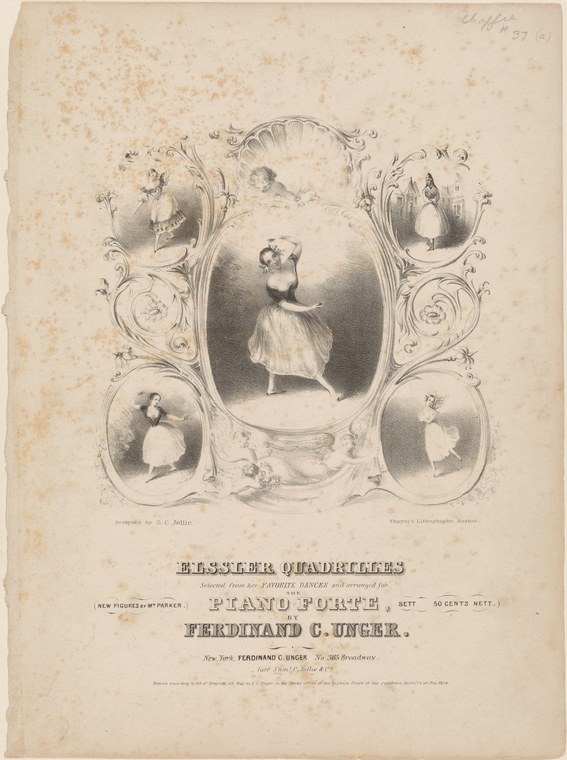
Fanny Elssler was one of the most celebrated ballerinas of the romantic era, and sheet music covers like this one document her fame and the quadrille's central role in nineteenth-century dance culture. As a printed object, it shows how dance was commodified, circulated, and taught to the amateur public through visual imagery and popular media.
What you are looking at
This is a lithographic sheet music cover for the *Elssler Quadrilles*, organized as an ornamental frame within which five vignettes of dancers appear. The central oval contains a single female dancer in a long white tulle skirt, caught mid-movement with her body in a graceful arabesque or attitude position. She wears a fitted bodice and her arms are raised. Around this central figure, four smaller oval frames show paired dancers in similar costumes — women in white tutus with men in dark formal dress — each pair engaged in different moments of the quadrille. The ornamental border is rococo in style, with scrollwork, floral motifs, and decorative flourishes. The entire composition has the soft, tonal quality of a lithographic print, with delicate shading that suggests the translucent quality of the tutus and the grace of the poses. At the foot of the page, printed text identifies this as music arranged by Ferdinand C. Unger, published in New York.
The dancing
The central dancer stands en relevé or en pointe, her body elongated and weightless, with one leg extended behind her in arabesque while her arms frame her head and shoulders. The surrounding couples show the characteristic frame of the quadrille: the man and woman stand in closed or semi-closed position, their bodies upright and formal, with the man slightly offset to guide his partner. The women's legs are hidden beneath full skirts, but their upper bodies show the controlled, elegant carriage of the romantic-era ballroom. All the dancers demonstrate the vertical alignment and lifted quality expected in mid-nineteenth-century theatrical and social dance.
The dance depicted
This is sheet music cover for the Elssler Quadrilles, a dance form that was at its height of popularity in European ballrooms and theaters during the 1830s–1850s. The quadrille is a social dance for four couples arranged in a square, typically performed to a sequence of five figures, each with its own musical phrase. The central solo figure depicted here — with the dancer in an extended attitude or arabesque — suggests that this particular arrangement either stylized the quadrille with theatrical arabesques, or that this music cover commemorated a stage performance by the famous dancer Fanny Elssler, who was celebrated for her technical brilliance and dramatic interpretations. The surrounding vignettes show the standard paired progression of the dance as it would be performed in a ballroom or on stage, with the quadrille's formal geometric structure implied by the composition.
How it was made
This is a lithograph, recognizable from its soft tonal gradations, fine detail work, and the characteristic way light and shadow model the figures. Lithography allowed for the rapid and economical production of illustrated sheet music covers, which were commercial objects designed to advertise both the composer and the performer or occasion. The technique could reproduce fine line work and subtle shading, making it ideal for depicting the delicate folds of tulle and the grace of the dancers' poses. As printed sheet music, this object circulated widely among amateur musicians and dancers in the nineteenth century, reaching a broad middle-class audience in America.
About this work
This sheet music cover presents the Elssler Quadrilles as both a social dance instruction and a theatrical memento. The quadrille was the dominant ballroom dance of the middle nineteenth century, and sheet music covers of this kind served as souvenirs, advertisements, and practical guides for musicians and dancers. The romantic-era ballet aesthetic evident in the central figure — the extended arabesque, the ethereal tutus, the soft lighting — suggests that this particular arrangement either commemorated a theatrical performance or attempted to elevate a social dance by giving it balletic grace. The work captures a moment when theatrical and ballroom dance were closely intertwined, and when dance imagery was a staple of popular commercial culture.
How to look at it
Notice how the central figure is the focal point of the composition — she is isolated in the largest oval frame and posed in an extended arabesque, suggesting elevation and grace. The four surrounding couples show the progression of the quadrille's geometric figures, with each pair in a different relation (facing, side-by-side, advancing, retreating). The ornamental frame itself — with its scrollwork and floral motifs — is drawn from the rococo tradition, lending the quadrille a sense of courtly elegance and historical prestige. The soft lithographic tonality suggests the translucency of the tulle and the lightness of the dancers' movements, a key aesthetic goal of romantic ballet.
The artist
The cover is credited to Ferdinand C. Unger as arranger. No artist is recorded for the lithographic design. Sheet music cover illustration was often unsigned or credited only to the publisher or composer, and the lithographer's name frequently does not appear. The work emerges from a tradition of commercial music publishing in New York in the mid-nineteenth century, when illustrated covers became an important sales tool and artistic medium in their own right.
The period
The quadrille dominated European and American ballrooms from the 1820s through the 1860s, and was often featured in theatrical performances and benefit galas. Fanny Elssler (1810–1884) was at the height of her fame in the 1830s–1840s, celebrated across Europe and America for her technical brilliance and dramatic interpretation, in contrast to her rival Marie Taglioni, who represented the ethereal romantic ideal. The romantic ballet aesthetic visible in this cover — the emphasis on lightness, the tulle skirts, the arabesque — reflects the period's fascination with the ethereal and transcendent qualities of dance, qualities that were being applied to social dances as well as theatrical ones. Sheet music covers of this kind became increasingly sophisticated as commercial art throughout the nineteenth century.
Where it lives
This sheet music cover is held in the New York Public Library's collection of prints depicting dance. It is a commercial, mass-produced object, one of many dance-related sheet music covers issued in nineteenth-century America.
Dance in this work
Questions about this work
Who was Fanny Elssler?
Fanny Elssler (1810–1884) was one of the most celebrated ballerinas of the romantic era, known for her technical virtuosity and dramatic interpretation. She was the rival of Marie Taglioni and was celebrated across Europe and America. She performed both in theatrical ballets and in stylized social dances, and her fame was documented in countless prints, sheet music covers, and popular images of the period.
What is the quadrille?
The quadrille is a social dance for four couples (eight people) arranged in a square. It typically consists of five figures or movements, each with its own musical phrase, and was the dominant ballroom dance of the nineteenth century. It appears in both ballroom and theatrical contexts, and was often performed at balls, galas, and public entertainments.
Why does a ballroom dance appear on sheet music cover art?
Sheet music covers were advertising and instructional objects. They promoted the composer, the arranger, and often the occasion or performer (in this case, Elssler). For amateur musicians and dancers, the cover illustration served as a visual guide to the character and style of the music, helping buyers decide whether they wanted to purchase it.
What is a lithograph?
Lithography is a printing technique based on the principle that oil and water repel each other. An image is drawn on a flat stone or metal plate using a greasy crayon or ink, the surface is dampened, and then printing ink is applied — it adheres only to the drawn image. Lithography allowed for rapid, economical production of complex images and was the primary method for illustrating sheet music and popular prints in the nineteenth century.
More dance artwork





