49 works in this view — arrow keys or swipe to move between them.
Dance in Art
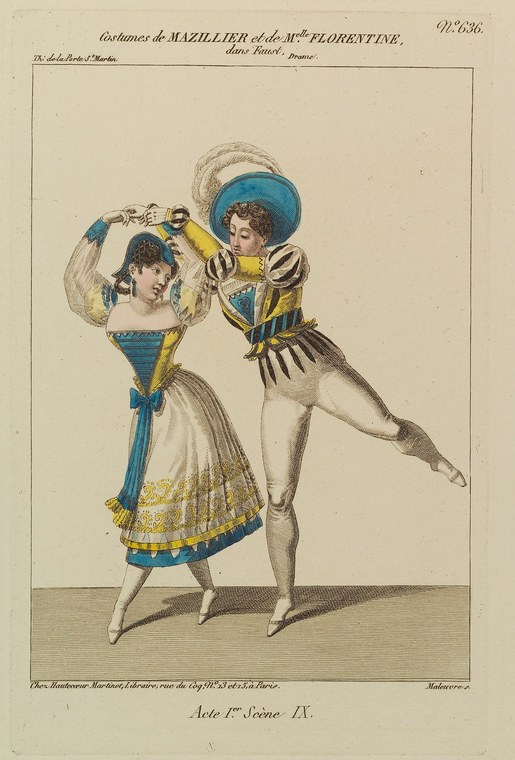
Costumes de Mazillier et de Melle. Florentine dans Faust, drame, acte Ier, scène IX, Th. de la Porte St. Martin
Unknown artist
- Collection:
- Prints depicting dance
- Source:
- New York Public Library
- Rights:
- Public domain — free to use, share and adapt.
- Recorded as:
- Public Domain
This print documents the precise costume and theatrical partnering of named professional dancers at a major Parisian theatre, making it evidence of how Romantic-era dance actually looked on stage. The extreme back-bend and the woman's supportive frame reveal physical vocabularies now rarely seen, and the print's survival tells us which moments choreographers and dancers considered worth recording and selling to the public.
What you are looking at
A hand-colored engraving depicting a dramatic moment from a theatrical production. Two figures occupy the composition: a male dancer in elaborate costume—a tunic with blue and yellow panels, striped sleeves, and a large plumed headdress—leans back in a deep arch, his weight supported on one leg in a pose of extreme tension. A female dancer in a pale muslin skirt trimmed with blue and yellow braid, also wearing a blue plumed hat, bends toward him with her arms raised, one hand touching his shoulder. The man's body forms an exaggerated curve of near-horizontal extension; the woman's posture mirrors his arc, creating a visual rhyme of mutual dependence. The figures are set against a neutral ground with a simple lined border; the print's fine detail and hand-applied color suggest a work of high production value intended for a cultured audience.
The dancing
The male dancer is in an extreme back-bend or cambré position, with his supporting leg nearly straight and his body inverted almost to horizontal; the female dancer is bent forward to meet him, their bodies in complementary arcs. The man's arms are extended with control; the woman's frame is open and reaching. This is a moment of supported partnered movement in which both dancers bear responsibility for balance and line. The composition emphasizes the visual drama of the pose over the mechanics of weight transfer—a theatrical freeze-frame rather than a captured moment of locomotion.
The dance depicted
The style and costume suggest this is from a theatrical dance spectacle of the early 19th century, likely a pantomime or ballet divertissement rather than pure ballet. The elaborate plumed headdresses, the tunic with striped sleeves, and the decorative muslin skirt point to a theatrical fantasy or mythological theme rather than classical technique. The extreme back-bend with supported partner work was characteristic of Romantic-era theatrical dancing, though the acrobatic pitch of the male dancer's arch suggests an elasticity and daring beyond strict ballet convention. This may represent a moment of seduction, enchantment, or dramatic tension between two characters rather than classical abstract movement.
How it was made
This is a hand-colored engraving, visible from the fine linear hatching that defines form and shadow, the crisp contours of the figures, and the careful registration of color applied after printing. The technique allowed for precise detail in costume and the dramatic interplay of light and dark, and the hand-coloring—visible in the varied saturation of the blue, yellow, and flesh tones—suggests this was a luxury object, printed in a limited edition for subscribers to theatrical illustration collections. Engravings of this quality were typically sold individually or collected as series documenting celebrated performances.
About this work
This is a theatrical dance print documenting a moment from Faust, a dramatic spectacle performed at the Théâtre de la Porte Saint-Martin in Paris. It records the costumes and partnering of two dancers—identified in the inscription as Mazillier and Mademoiselle Florentine—in Act I, Scene 9, preserving a specific pose that audiences would have recognized and admired. The work sits at the intersection of theatrical documentation, fashion record, and dance criticism: it was made not to replace the experience of seeing the performance but to commemorate it for those who had, and to advertise it to those considering attendance.
How to look at it
Notice the precision of the engraved line describing the male dancer's musculature and the exact angle of his arch: this is a record of a specific technical feat, frozen at its climax. The woman's gesture is equally precise—not a casual lean but a controlled descent into his space. The plumed headdresses, though ornamental, frame the heads clearly so an audience member could recognize the named performers. The print's careful attention to costume detail tells us that these elaborate tunics and brightly colored panels were central to the spectacle's appeal.
The artist
The engraver is not recorded in the catalogue, but the inscription credits a publisher (Martinet or similar, partially visible) and records that the print was made from a drawing "rue de la Porte St. Martin"—the theatre's address. This was a commercial theatrical print shop producing affordable colour engravings of celebrated roles and moments, following a long tradition of documenting opera and ballet for a subscription audience. The unsigned engraver was a workshop artisan rather than a named artist.
The period
This print dates to the early 19th century when theatrical dance in Paris was undergoing rapid transformation: the Romantic ballet was emerging, male dancers were performing increasingly acrobatic feats, and theatre prints had become a primary means of advertising performers and preserving memorable moments. Faust spectacles were immensely popular on the popular theatre circuit, distinct from the Opéra's classical ballet productions. The fashion for such prints peaked in the 1830s–1840s, when lithography and hand-coloring had become economical enough to make theatre portraiture a mass medium.
Where it lives
This print is held in the New York Public Library's collection of prints depicting dance, part of a larger archive of theatrical illustration and performance documentation. Such prints were sold as individual loose sheets or collected into bound volumes, often by theatre subscribers.
Dance in this work
Questions about this work
Who were Mazillier and Mademoiselle Florentine?
Mazillier (Joseph Mazilier, 1801–1868) was a celebrated French ballet dancer and choreographer who worked at the Opéra and the boulevard theatres. Mademoiselle Florentine was a professional dancer whose full name and biographical details are not recorded in readily available sources, but her appearance in a named role in a Théâtre de la Porte Saint-Martin production indicates she was a recognized stage performer of the period. This print is evidence of her work.
What is Faust and why is it important to dance history?
Faust was one of the most popular spectacles of early 19th-century French theatre, performed in many versions at different houses from popular boulevard theatres to the Opéra. The Faust story—the scholar's pact with the devil—provided a framework for elaborate scenic effects, dance divertissements, and acrobatic displays. This particular production at the Porte Saint-Martin was a melodrama or pantomime with dancing, distinct from the more famous Romantic ballet Giselle or La Sylphide, but equally influential in shaping how dance was staged and advertised to the public.
Why does the male dancer arch so extremely?
This extreme back-bend demonstrates the physical demands placed on male dancers in the early 19th century and the premium placed on flexibility and daring. Unlike later Classical or Romantic ballet which emphasized verticality and control, theatrical spectacle dancing prized elasticity, acrobatic display, and partnering feats. The woman's support is essential to this pose—it is a display of both dancers' strength and confidence.
Is this ballet?
Not in the strict sense. This is theatrical dance from a melodrama or spectacle at a popular theatre, not the court or state-subsidized ballet of the Opéra. The costumes, the emphasis on acrobatic partnering, and the narrative context suggest this is closer to pantomime with dancing, or what we might call theatrical divertissement dance. It is a reminder that 'dance' in this period meant many things beyond classical ballet.
More dance artwork





