49 works in this view — arrow keys or swipe to move between them.
Dance in Art
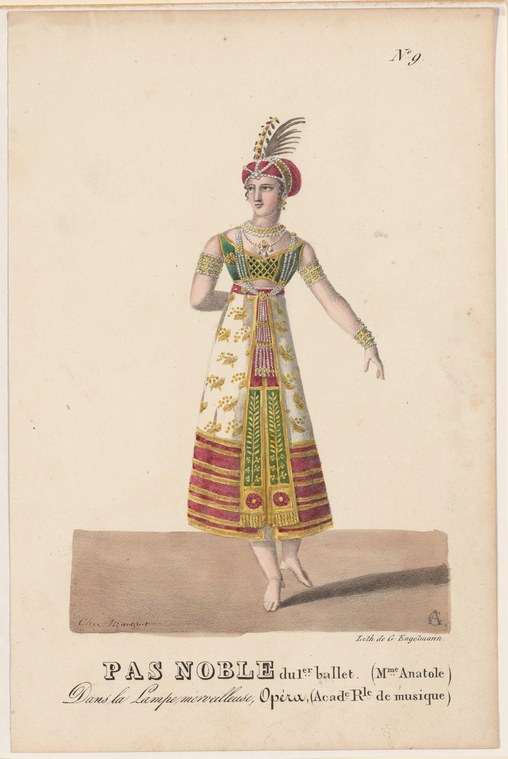
Pas noble du 1er ballet.: Mme. Anatole dans La lampe merveilleuse, opéra (Acade. Rle. de musique)
Unknown artist
- Collection:
- Prints depicting dance
- Source:
- New York Public Library
- Rights:
- Public domain — free to use, share and adapt.
- Recorded as:
- Public Domain
This print captures a named dancer in a specific ballet at a precise moment in French theatrical history, providing concrete evidence of how the *pas noble* was embodied and costumed on the professional stage. For historians of ballet and the opera-ballet genre, it is a primary document of performance practice and the visual culture of dance celebrity that emerged in the early 1800s.
What you are looking at
A single female dancer stands in profile against a plain tan background, posed in a moment of stillness rather than action. She wears an elaborate costume of neoclassical inspiration: a short-sleeved tunic in cream with gold embroidery across the bodice and sleeves, paired with a long skirt of deep crimson and green horizontal stripes, bound at the waist with a jeweled sash. Her left arm extends gracefully downward with fingers delicately spread; her right arm rests at her side. She stands barefoot on a narrow tan platform, her weight evenly distributed. A tall feathered headdress in shades of burgundy and cream rises from her head, and she wears a jeweled collar and arm bracelets. The figure is rendered in hand-colored engraving or lithograph, with precise linear detail and careful color separation.
The dancing
The dancer is alone and stationary, caught in what appears to be a formal presentational pose rather than active choreography. Her frame is upright and dignified, with both arms extended but not in a partnered hold. The extended left hand and downward gaze suggest a classical noble bearing. Her bare feet and the flatness of the stance offer no clear evidence of the footwork that would distinguish one dance style from another; this is a portrait pose of a dancer in character, not a capture of movement.
The dance depicted
The title identifies this as the 'Pas noble' (noble step or dance) from a ballet, performed by Mme. Anatole in *La lampe merveilleuse* (The Marvellous Lamp), an opera-ballet at the Académie Royale de Musique in Paris. The 'pas noble' was a formal, dignified movement vocabulary of French court dance and its theatrical descendants, characterized by upright carriage, controlled arm port, and restrained movement—visible here in the dancer's composed stance and classical costume. The work appears to document a principal dancer in a specific role, presenting the character and costume rather than capturing the kinetic moment of the dance itself.
How it was made
This is a hand-colored engraving or aquatint, a reproductive print technique that allowed wide circulation of theatrical imagery to audiences who could not attend performances. The technique is evident in the fine linear hatching visible in the background and shading, combined with careful watercolor or gouache hand-coloring applied to define the costume's rich materials and colors. Such prints were standard documentation of Paris Opera productions in the early 19th century, serving both as souvenirs for theatregoers and as records of celebrated performers and their roles. The signature visible in the lower left—though too small to read with certainty—identifies the printmaker or publisher.
About this work
This is a theatrical document of early 19th-century French ballet, recording a named performer in a named role from a specific production. It belongs to a tradition of printed theatrical portraiture that made the opera-ballet and its stars visible to the public beyond the theatre walls. The *pas noble*—a fundamental vocabulary of courtly and classical dance—is presented here not as an action but as a formal, dignified character and costume, suggesting that the viewer's interest is in recognizing the performer and the role rather than understanding the step itself. The work sits at the intersection of dance history and print culture, documenting both a moment in the evolution of French theatrical dance and the practices by which that dance was circulated and remembered.
How to look at it
The print captures the dancer in a formal, still pose that emphasizes her costume and character rather than the kinetics of the dance. Notice the careful symmetry of the composition, the upright carriage of the body, and the grace of the extended arm—these are the visual markers of nobility and dignity that the *pas noble* vocabulary was designed to convey. The absence of movement or narrative action is itself informative: this is a portrait of a dancer as a character, not a record of choreography in motion, reflecting the theatrical conventions of the period in which printed images of performers typically showed them in costume and character rather than captured mid-step.
The artist
The artist is not recorded in the catalogue. The work bears a signature in the lower left, but it is too small to read with confidence. Hand-colored prints of this kind were produced by specialized printmaking workshops in Paris, often crediting both the artist who designed the image and the engraver who executed the plate. The style suggests a professional theatre print house, likely associated with the Paris Opera.
The period
The early 19th century saw the rise of the professional ballet as a form distinct from court dance, with the opera-ballet—a hybrid genre combining sung drama and danced interludes—as one of the dominant theatrical forms in France. The *pas noble* and related vocabularies of courtly movement remained central to ballet training and professional performance even as Romantic ballet was beginning to emerge. Printed theatrical portraiture of dancers became a significant cultural product in this period, making the stars of the Opera visible to the wider public and establishing the visual conventions by which dancers were known and remembered.
Where it lives
The work is held in the New York Public Library's collection of prints depicting dance. It is a single-sheet theatrical print, likely issued by a Paris Opera print publisher in the early 19th century and subsequently dispersed through print collections and dealers.
Dance in this work
Questions about this work
What is a 'pas noble'?
The *pas noble* (noble step) is a foundational vocabulary of French court dance and its theatrical heirs, characterized by upright posture, controlled and graceful arm movement, and a restrained, dignified bearing. It remained central to ballet training and performance throughout the 19th century and beyond. In the theatre, a *pas noble* was typically a solo or small-group movement set performed by a principal dancer to display skill and beauty within a formally refined aesthetic.
What was the Académie Royale de Musique?
The Académie Royale de Musique (Royal Academy of Music) was the official state theatre for opera and ballet in Paris, founded in the 17th century and remaining the principal venue for these arts through the 19th century. It is now known as the Palais Garnier Opera.
Why are so many early 19th-century prints of dancers in static poses?
Hand-colored engraving and lithography were slow, expensive processes. Printers typically produced images of celebrated performers in character and costume rather than attempting to capture choreography in motion, which was difficult to render clearly. These prints served as theatrical souvenirs and records of stars, not as documentation of dance steps.
Who was Mme. Anatole?
The catalogue does not identify Mme. Anatole beyond her performance in this role. She was evidently a principal dancer at the Paris Opera in the early 19th century, celebrated enough to warrant a printed portrait, but further details of her career are not available here.
More dance artwork





