49 works in this view — arrow keys or swipe to move between them.
Dance in Art
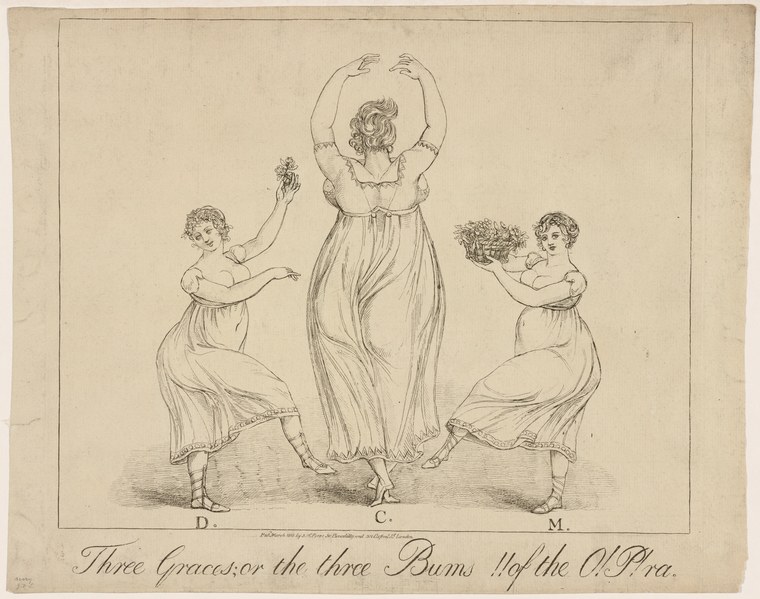
Three Graces; or The three Bums of the Op!ra
Unknown artist
- Collection:
- Prints depicting dance
- Source:
- New York Public Library
- Rights:
- Public domain — free to use, share and adapt.
- Recorded as:
- Public Domain
This print is a primary source for understanding how stage dancers were portrayed and satirized in popular culture, and how neoclassical ballet aesthetics (elevated poses, classical drapery, allegorical framing) were translated into printmaking and comedy. It also documents the celebrity status of opera dancers and the public appetite for theatrical gossip and parody in the early 19th century.
What you are looking at
Three female figures in classical drapery occupy a shallow stage space defined by a rectangular frame. The central figure, viewed from behind, raises both arms overhead in an attitude of triumph or invocation, her body weight settled and her flowing garment creating deep vertical folds. She is flanked by two smaller figures—likely putti or younger dancers—who face inward toward her, each holding a wreath or garland. The figure on the left extends her right arm toward the central dancer in a gesture of offering or support, while the one on the right mirrors this action. The composition is symmetrical and frontal; all three figures are arranged on a flat ground plane with minimal modeling of space. The line work is delicate and the tonal range narrow, suggesting a print technique designed for rapid circulation.
The dancing
The central dancer's pose—arms raised and open, body centered and stable—resembles the classical *orante* attitude found in neoclassical dance and pantomime. Her companions stand at her sides in subsidiary positions, their smaller scale emphasizing her status as the focal point. All three figures wear high-waisted classical tunics without corsetry, and their posture is upright and dignified. The gestures are symbolic rather than balletic: the raised arms speak to nobility or divine favor, while the flanking figures' offerings suggest a ceremonial or allegorical context rather than social dance.
The dance depicted
The print is captioned as *Three Graces; or The three Bums of the Op!ra*, a satirical or parodic title that plays on the classical allusion (the Three Graces of ancient mythology) and contemporary opera culture. The central figure's pose and the symmetrical arrangement of attendants suggest allegorical or pantomime dance rather than ballroom or folk forms. The neoclassical costume and the formality of the composition point to theatrical ballet or opera ballet of the late 18th or early 19th century, when such iconography was common. The exclamation and colloquial language in the title suggest this is a satirical print mocking or celebrating operatic dancers of its era.
How it was made
This is an engraving or etching on paper, rendered in fine black line work with minimal cross-hatching or tonal variation. The technique is characteristic of late-18th-century satirical and theatrical prints, which were made for broad public circulation at low cost. The precision of the line and the lack of hand-coloring indicate a mass-produced work intended for theater-goers, collectors of satirical prints, or the general public interested in stage gossip and celebrity. The style of engraving and the printing conventions visible in the frame and lettering date the work to the early 19th century at latest.
About this work
This is a satirical theatrical print depicting three female dancers in neoclassical dress arranged in a symmetrical, allegorical composition. The central figure strikes an attitude of power or invocation while two smaller attendants—presented almost as putti or acolytes—flank her with offerings of wreaths. The print is part of a long tradition of satirical commentary on opera and ballet dancers, using classical mythology and costume to mock or celebrate stage celebrities. The title's wordplay ("Three Graces" versus "Three Bums") suggests the print was meant to be both admiring and irreverent, a common tone in theatrical satire of the era. It belongs in a dance gallery as evidence of how ballet and opera dancers were perceived, caricatured, and consumed as public figures in the early 19th century.
How to look at it
Notice the pose of the central figure: her raised arms and centered stance are not balletic in the modern sense (no turnout, no lift), but rather classical and pantomimic—a pose meant to signify power, blessing, or glory in the language of neoclassical art. Observe how the smaller figures are subordinated by their size and positioning; they are not dancers in their own right but attendants or allegorical presences. The symmetry and frontality of the composition, and the precision of the line work, are characteristic of prints meant to be studied closely and circulated widely.
The period
In the early 19th century, theatrical prints—especially satirical ones—were a major form of popular entertainment and social commentary. Dancers, particularly women, were public figures of high visibility and some notoriety, and printmakers regularly caricatured them, celebrated them, or both at once. The neoclassical vocabulary of gesture and dress reflects the dominant aesthetic of ballet d'action and pantomime of the era, when mythology and classical allusion were standard frames for stage narratives. The print's tone and technique are consistent with the output of London and Paris printmakers who specialized in theatrical satire.
Where it lives
The work is held in the NYPL's collection of prints depicting dance. It is one of many satirical theatrical prints from the early 19th century, and its survival in a major research collection indicates its significance to the history of theatrical celebrity and dance imagery.
Dance in this work
Questions about this work
What does the title mean?
The title plays on the classical myth of the Three Graces (goddesses of beauty and grace) but adds a colloquial or mocking suffix ("Bums") that suggests a satirical commentary on three opera dancers of the era. The exclamation mark and familiar language indicate the print is meant to be amusing, irreverent, or gossipy rather than purely reverential.
What kind of dance is this?
This is theatrical dance, most likely opera ballet or pantomime of the neoclassical school. The pose and allegorical framing are not social dances but stage spectacle. The raised arms and symmetrical arrangement are conventions of neoclassical ballet and pantomime, not ballroom or folk forms.
Who were these dancers?
The catalogue record does not identify them, and the print itself does not name them. The satirical title and style suggest they were well-known opera dancers of the early 19th century, but without additional research or sources, they cannot be identified from the image alone.
More dance artwork





