49 works in this view — arrow keys or swipe to move between them.
Dance in Art
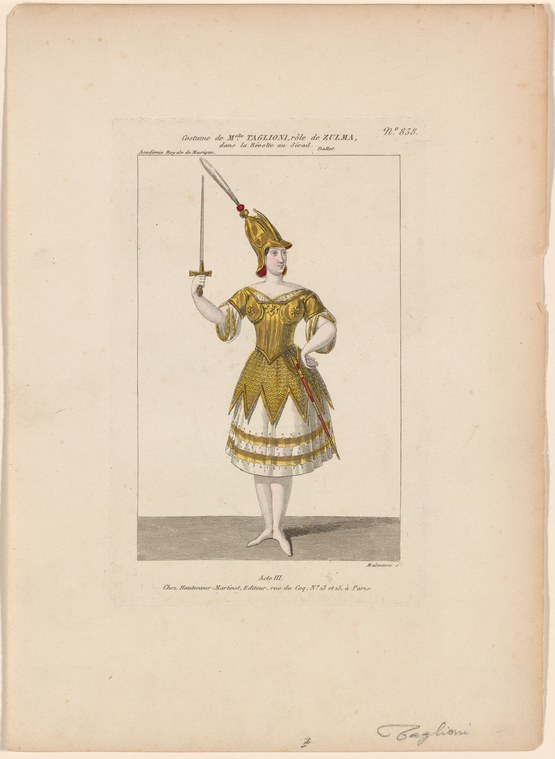
Costume de Melle. Taglioni, rôle de Zulma, dans La révolte au sérail, ballet, acte III, Académie royale de musique
Unknown artist
- Collection:
- Prints depicting dance
- Source:
- New York Public Library
- Rights:
- Public domain — free to use, share and adapt.
- Recorded as:
- Public Domain
Costume plates like this are among the only visual records of Romantic ballet in performance; they show us the actual silhouettes, materials, and character details of the period's most celebrated works and dancers. The image documents not just a costume but the cultural role of the prima ballerina in 19th-century Paris and the European obsession with Oriental subjects and sensuality in theater.
What you are looking at
A single female dancer stands in a formal three-quarter pose against a plain background, wearing an ornate costume of golden-yellow silk decorated with white banding and trim. Her dress features a fitted bodice with short puffed sleeves, a nipped waist, and a skirt that falls to mid-calf with distinctive scalloped white flounces at the hem—a silhouette characteristic of early-19th-century Romantic ballet. She wears a tall conical headdress or hat adorned with red ornament and a white feather plume, and holds a curved scimitar aloft in her right hand. Her left hand rests against her hip in a classical pose. The figure is rendered in hand-colored engraving or aquatint, with careful attention to the texture and fold of the fabric and the play of light on the costume. The image includes a French inscription identifying this as Mlle. Taglioni in the role of Zulma from the ballet *La Révolte au Sérail*, Act III.
The dancing
The dancer is shown standing in a stationary, composed pose rather than in active movement—a common convention for theatrical costume plates. Her posture is upright and poised, with one foot placed forward, presenting the silhouette of her costume to best advantage. The lifted arm holding the scimitar suggests alertness and authority befitting a harem character in revolt, while her expression is calm and aristocratic. This is a single-figure study designed to document a costume and role, not to capture a moment of choreographic action.
The dance depicted
This is a theatrical costume study of the Romantic ballet era, documenting Marie Taglioni's appearance in *La Révolte au Sérail* (The Revolt in the Seraglio), a multi-act ballet performed at the Académie Royale de Musique (the Paris Opéra) in the early 19th century. Taglioni was the dominant ballerina of the Romantic period, and Zulma was a dramatic role in her repertory. The Oriental-inflected costume—the harem silhouette, the Eastern headpiece, the curved sword—reflects the European fascination with "Turkish" and Islamic subjects in early-Romantic art and entertainment. The image tells us that even dramatic and character roles in this period maintained the Romantic ballet's core silhouette: the fitted bodice, the mid-calf skirt allowing visible footwork, and the pointe-shoe aesthetic.
How it was made
This is a hand-colored engraving or aquatint print, a medium that dominated European theater documentation in the 18th and 19th centuries. The technique allowed rapid, relatively inexpensive production and wide circulation among audiences, critics, and fellow dancers—making it the primary visual record of historical performance. The careful tonal modeling in the background and the precise rendering of the costume's drape and ornamentation were achieved through skilled hand-coloring over a printed base. Such prints were often sold individually at the theater or through print shops and circulated as mementos of celebrated dancers and roles.
About this work
This is a Romantic-era costume plate documenting a specific dancer, role, and ballet on a specific date at a specific institution. Taglioni was the defining ballerina of early European Romanticism, and Zulma from *La Révolte au Sérail* exemplifies the period's taste for dramatic character roles with Oriental settings. The print is valuable not as a record of choreography or movement (it shows neither) but as documentation of how Romantic ballet dancers were dressed, marketed, and memorialized—and as evidence of Taglioni's international fame and the European appetite for images of celebrated performers. It sits at the intersection of theater history, costume history, and the early development of dance as a subject for commercial visual art.
How to look at it
Observe the careful construction of the costume: the way the white trim defines the bodice and emphasizes the waistline, and how the scalloped flounces at the hem are designed to be visible and to move during performance. Note the tall headdress and the scimitar—markers of the "Turkish" setting that would have signaled the role's character and dramatic stakes to a contemporary audience. The formal, composed pose is typical of costume documentation; no actual ballet photograph or movement study could have been made in this era, so this static view was how dancers and roles were visually preserved and circulated.
The artist
The artist is not recorded in the catalogue. However, this is a professional theatrical print produced for the Paris theater market in the early 19th century—likely by a specialist in costume documentation working from a sketch or live observation at the Opéra. Such prints were often created quickly after a premiere or significant performance to capitalize on public interest in a celebrated dancer or role.
The period
This print dates to the height of the Romantic ballet era (roughly 1830–1850), when Marie Taglioni was the most famous dancer in Europe and the Romantic ballet's aesthetic—the ethereal, pointe-shoed sylph; the exotic, Oriental subject; the emphasis on female beauty and ethereal movement—was at its cultural peak. European theaters competed fiercely to commission new ballets with exotic settings, and the image of the celebrated ballerina in a dramatic role was a marketable commodity. The hand-colored engraving was the standard medium for circulating images of performers and was as essential to a dancer's fame as reviews in the press.
Where it lives
This print is held in the New York Public Library's collection of prints depicting dance, a major research resource for the history of theatrical dance imagery. Such costume plates were produced in quantity for distribution to the theater-going public and to dancers themselves, making them a primary source for understanding the visual culture of 19th-century performance.
Dance in this work
Questions about this work
Who was Marie Taglioni?
Taglioni (1804–1884) was a Swedish-born dancer who became the most celebrated ballerina in Europe during the Romantic era. She was known for her technical precision, emotional depth, and ethereal stage presence, and she dominated the Paris Opéra and European ballet companies for decades. Her fame was documented extensively in prints, engravings, and literary accounts.
What was *La Révolte au Sérail*?
A multi-act ballet performed at the Paris Opéra featuring exotic Oriental settings and dramatic narrative. The title translates as "The Revolt in the Seraglio," and the plot involved harem intrigues—a common subject in early-Romantic theater that reflected European fascination with the Islamic world.
Why is the dancer shown standing still?
This is a costume study designed to display the dress and role clearly rather than to document actual choreography. Prints like this served as mementos for audiences, records for other dancers and theaters, and advertisements for the performer. Movement studies and photographs of dancers were not technically possible in this era.
What does the scimitar tell us?
The curved sword is a visual signifier of the role's Oriental or Turkish setting and the character's dramatic agency—she is a woman in revolt, armed and commanding. Such costume elements were essential to conveying narrative and character to contemporary audiences.
More dance artwork





