49 works in this view — arrow keys or swipe to move between them.
Dance in Art
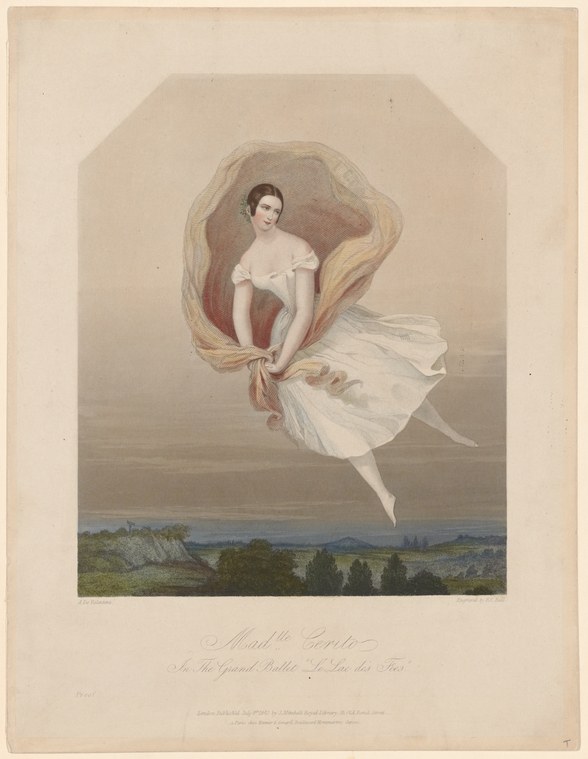
Madlle Cerito in the grand ballet Le lac des fées
Unknown artist
- Collection:
- Prints depicting dance
- Source:
- New York Public Library
- Rights:
- Public domain — free to use, share and adapt.
- Recorded as:
- Public Domain
This print documents one of the most celebrated special effects in nineteenth-century ballet and preserves a record of a major Romantic ballerina in a role that exploited both her technical skill and the theatrical technologies of her era. It reveals how dancers, choreographers, and scene designers worked together to create the visual grammar of the Romantic stage, where the dancer's body was positioned as almost supernatural.
What you are looking at
A woman in a white Romantic-era tutu and off-shoulder corsage flies or floats upward through a golden-brown cloud or vaporous form that suggests a supernatural realm. Below her stretches a landscape of fields, water, and distant hills rendered in cool greens and blues, establishing a sharp division between the earthly world and the ethereal space she inhabits. The composition is vertically oriented, with the dancer positioned centrally in the upper half against a warm, swirling atmospheric envelope. The entire image is framed within an octagonal border, giving it the formal presentation of a mid-nineteenth-century theatrical print or dance memorabilia. Her body is captured in an attitude of lightness and elevation characteristic of the Romantic ballet aesthetic.
The dancing
The dancer is captured mid-flight or suspension with her body inclined forward at approximately 45 degrees, one leg extended behind in a position suggesting the balletic *attitude* or *arabesque*. Her arms are held softly at her sides and slightly forward, without the taut, angular geometry of later styles. Her torso is upright and elongated, emphasizing the otherworldly buoyancy the image conveys. The pose suggests a single dancer rather than a partnered work, though the composition implies she is being borne upward by the supernatural forces the title invokes.
The dance depicted
This is Romantic ballet, most likely the famous aerial scene from *Le Lac des Fées* (The Lake of Fairies), a mid-nineteenth-century French ballet. Mlle Cerito—identified in the inscription as the dancer—was one of the major ballerinas of her generation and celebrated for her technical brilliance and ethereal quality. The image documents one of the signature visual effects of Romantic ballet: the illusion of weightlessness achieved through the dancer's elevation and the scenic machinery that created the appearance of flight. The pose and the landscape setting below are consistent with the *apotheosis* scene typical of fairy-tale ballets of the period, where the mortal dancer is transported to a supernatural realm.
How it was made
This is a hand-colored lithograph or possibly a hand-colored engraving, as evidenced by the fine linear work defining the figure, the subtle tonal gradations in the landscape, and the evidence of watercolor or tinted wash in the atmospheric effects. The technique allows for the soft, luminous rendering of the cloud forms and the careful articulation of the dancer's anatomy and costume. The hand-coloring gives it the character of a deluxe theatrical souvenir, intended for a cultivated audience. Such prints were produced and distributed widely in Paris and London during the 1830s–1860s as memorabilia of celebrated performances.
About this work
This is a record of Mlle Cerito in a celebrated moment of Romantic ballet spectacle—the supernatural flight that was central to *Le Lac des Fées*. It is both a document of a specific historical performance and an artifact of how the Romantic ballet aesthetic was circulated to the public through theatrical prints. The image captures the central preoccupation of Romantic choreography: the representation of the dancer as a weightless, ethereal being, suspended between the earthly and the divine. For dance historians, it is evidence of how machinery, lighting, and the dancer's own technique combined to create the illusion of flight—an effect that defined the visual and emotional impact of the Romantic stage.
How to look at it
Attend to the moment the artist chose: the dancer is not rising or descending, but suspended at the apex of her flight, weightless and detached from gravity. Notice how the landscape below anchors the supernatural geography—it is a real place, but the dancer inhabits a different realm. The golden atmospheric envelope surrounding her is not mere background; it is an active element suggesting the magical forces at work. The octagonal frame and formal inscription position this as a high-status object—not a casual theatrical notice, but a keepsake worthy of framing.
The artist
The artist is not recorded, but the work bears the formal and stylistic hallmarks of mid-nineteenth-century Parisian theatrical printmaking. Such prints were typically produced as commercial editions by publishing houses specializing in dance and theatrical memorabilia, often with hand-colored lithography or engraving. The inscription and framing suggest a professional theatrical print shop, likely Parisian, producing high-quality keepsakes for wealthy collectors and dancers' admirers.
The period
This print dates to the height of the Romantic ballet era, approximately the 1830s–1860s, when fairy-tale narratives, supernatural characters, and effects-driven choreography dominated European stages. *Le Lac des Fées* was one of several ballets that capitalized on the public appetite for ethereal imagery and the illusion of weightlessness. Lithography had recently become a dominant medium for theatrical memorabilia, allowing for mass production of colored prints that could be purchased and displayed. Such prints served as a primary means of circulating knowledge of celebrated performances to audiences who had not seen them live, and as souvenirs for those who had.
Where it lives
This work is held in the New York Public Library's Prints Depicting Dance collection, a significant repository of theatrical and dance iconography from the eighteenth through twentieth centuries. As a hand-colored theatrical print, it was produced as a commercial article for distribution and sale to the theater-going public and collectors of dance memorabilia.
Dance in this work
Questions about this work
What is the 'Lake of Fairies' and why was it important?
*Le Lac des Fées* was a popular Romantic-era ballet featuring supernatural beings and magical transformations. It exemplified the genre's obsession with fairies, spirits, and weightless bodies, and provided a vehicle for female dancers to be presented as ethereal and otherworldly. Cerito's role in the ballet made it one of the signature performances of her career.
How did dancers appear to fly in nineteenth-century ballet?
A combination of technique and machinery: the dancer executed jumps and relevé work to maximize elevation; scenery and lighting were designed to isolate the figure against a dark or cloud-like background; and the artist's composition—framing the dancer above a landscape—reinforced the illusion. Later ballets added wires and harnesses, but Romantic ballet prided itself on creating the effect through the dancer's body and visual composition alone.
Who was Mlle Cerito?
Fanny Cerito (1817–1909) was an Italian-French ballerina renowned for her technical prowess, musicality, and ability to create the ethereal quality audiences demanded of Romantic ballet. She was a major star in Paris and London and created roles in many important ballets of the era.
Why were these prints made and who bought them?
Theatrical prints served as souvenirs for wealthy patrons and fans of celebrated dancers, and as advertisements for upcoming performances. They were commercial products, hand-colored and relatively expensive, bought by collectors, performers, and the affluent theater-going public as evidence of taste and connection to fashionable culture.
More dance artwork





