49 works in this view — arrow keys or swipe to move between them.
Dance in Art
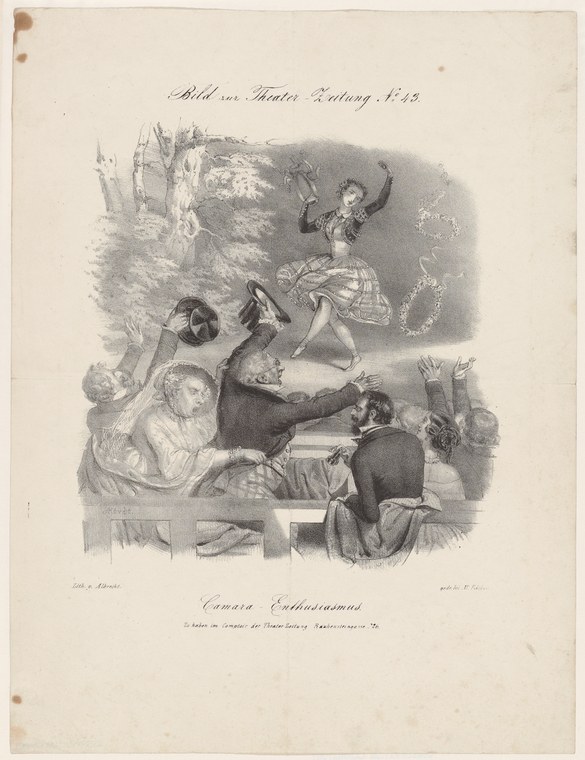
Camara - Enthusiasmus
Unknown artist
- Collection:
- Prints depicting dance
- Source:
- New York Public Library
- Rights:
- Public domain — free to use, share and adapt.
- Recorded as:
- Public Domain
This work demonstrates how nineteenth-century audiences perceived and fetishized the Romantic ballerina, and how popular printmaking encoded and amplified that fantasy. The exaggerated weightlessness and the emphasis on spectator rapture reveal the cultural mythology surrounding ballet in this period—it was not merely entertainment but a form of ecstatic release.
What you are looking at
A theatrical tableau of exuberant fantasy dominates this engraving. In the upper portion, a young woman in a short, gossamer dress leaps or floats through the air with arms raised and legs extended, her body caught in a moment of weightless abandon. Below her, seated figures watch from what appears to be a theatre box or balcony: a woman in an elaborate feathered headdress and a bearded man in dark coat and waistcoat lean forward in rapt attention. The lower foreground contains additional spectators, and the entire composition is suffused with a dreamy, romantic atmosphere created by soft shading and the delicate line work characteristic of mid-nineteenth-century theatrical printmaking. The title "Camera - Enthusiasmus" (Camera of Enthusiasm) suggests this is a Romantic-era commentary on theatre-going and the intoxicating effect of performance on audiences.
The dancing
The central leaping figure exhibits an exaggerated, almost balletic verticality: legs extended in a split-like attitude, torso arched backward, both arms raised overhead. This is not naturalistic movement but a stylised, ethereal pose suggesting weightlessness or trance-like ecstasy. The seated spectators below display contrasting body language—the woman's forward lean and raised hand convey excitement, while the man's reclined posture suggests relaxed pleasure. The composition emphasizes the gap between performer and audience, with the dancer's body as the focal point toward which all gazes are directed.
The dance depicted
This does not depict a specific named dance but rather a theatrical fantasy on the theme of dance and spectacle. The leaping figure suggests the vocabulary of Romantic ballet—the ethereal verticality, the leg extension, the weightless quality—but in an exaggerated, dreamlike register. The work appears to satirise or celebrate the enthusiasm audiences brought to Romantic theatre in the mid-nineteenth century, particularly the cult of the ballerina. The title emphasizes the spectator's emotional state rather than the choreography itself, framing dance as a vehicle for collective excitement and fantasy.
How it was made
This is an engraving, likely steel or copper, employing fine parallel lines and stippled shading to create tonal variation and depth. The technique allows for precise delineation of fabric texture and facial expression while creating an overall softness through accumulated line work. Engravings of this quality were produced for serial publication or albums of theatrical prints, suggesting a middle-class urban audience interested in theatre criticism and cultural commentary. The medium's capacity for fine detail and reproducibility made it ideal for distributing theatrical satire or homage to urban audiences.
About this work
This engraving captures the aesthetic fever of Romantic-era theatre-going, particularly the adoration of the ethereal ballerina. The composition stages a fantasy of performance itself—a leaping, weightless dancer suspended above a theatre box of enthralled spectators. The title and composition together suggest this is not documentation of an actual dance but rather a satirical or celebratory commentary on the enthusiasm audiences brought to theatrical performance, and the almost supernatural allure attributed to the ballet dancer in popular imagination. The print circulated among the urban middle classes as a witty or affectionate comment on contemporary taste.
How to look at it
Observe the impossibility of the central figure's pose—no dancer in any actual performance achieved this degree of weightlessness. The artist has distilled the Romantic ideal into pure fantasy, exaggerating the ethereal qualities that made Romantic ballet so seductive. The arrangement of spectators below emphasizes the theatrical frame: we are invited to watch not just the dancer but the audience watching the dancer, making the work a commentary on spectatorship itself. The title guides us toward reading this as satire or affectionate mockery of the 'enthusiasm' audiences brought to the theatre.
The period
This print belongs to the mid-nineteenth century, the height of Romantic ballet's cultural dominance. The 1840s–1850s saw the apotheosis of the ethereal, otherworldly ballerina—figures like Maria Taglioni epitomized the Romantic ideal of weightlessness and transcendence. Printmaking was a crucial medium for disseminating and satirising theatre culture; theatres, performers, and audiences were constant subjects for popular engravers. This work sits within a large corpus of theatrical prints that both celebrated and gently mocked the enthusiasms of contemporary ballet audiences, offering social commentary wrapped in aesthetic admiration.
Where it lives
Held in the New York Public Library's prints collection documenting dance in art. The work is catalogued as a print from an unknown date and artist, though stylistic evidence suggests mid-nineteenth-century German or Central European origin, based on the script and engraving technique.
Dance in this work
Questions about this work
Is this depicting a real ballet or choreography?
No. The leaping figure is stylised and impossible—no actual ballerina could achieve this pose. The work is a Romantic-era fantasy about dance and spectatorship, using ballet vocabulary to express the ecstatic, almost supernatural quality audiences attributed to the ethereal ballerina. It is satire or celebration of theatre enthusiasm, not documentation.
What does 'Camera - Enthusiasmus' mean?
'Camera' in German can mean 'chamber' or 'intimate space,' while 'Enthusiasmus' is enthusiasm or ecstasy. The title suggests this is a scene in a theatre box or dressing room, and the subject is the fever-pitched enthusiasm audiences brought to Romantic ballet. It is a witty comment on how the sight of a weightless ballerina could transport spectators into rapture.
Why is the audience shown if the dancer is the subject?
The composition deliberately stages both. The title emphasises not the dance but the viewers' emotional state, suggesting the work is as much about the psychology of theatrical spectatorship as about the performance itself. By showing enthralled, enraptured faces gazing upward, the artist comments on the cult of the ballerina and the intoxicating effect of Romantic theatre.
More dance artwork





