49 works in this view — arrow keys or swipe to move between them.
Dance in Art
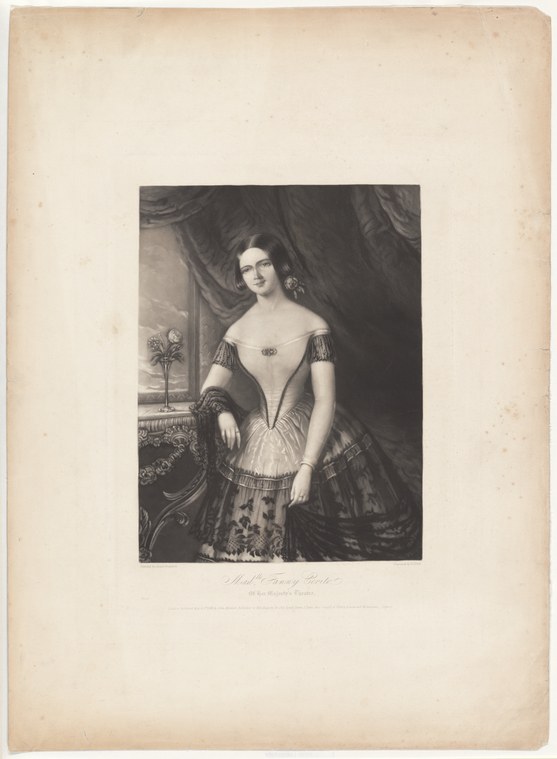
Mad'lle Fanny Cerito, of Her Majesty's Theatre
Unknown artist
- Collection:
- Prints depicting dance
- Source:
- New York Public Library
- Rights:
- Public domain — free to use, share and adapt.
- Recorded as:
- Public Domain
Fanny Cerrito was an innovator and a rival to Marie Taglioni, and this engraving is evidence of how dancers of her rank were marketed and mythologized. The image shows the material reality of Romantic ballet costume and the conventions of theatrical portraiture that shaped how audiences understood and remembered the greatest dancers of their time.
What you are looking at
A three-quarter-length portrait of a young woman in mid-nineteenth-century dress, set against dark drapery. She stands in a composed pose with her weight on one leg, her body angled slightly to the left. Her dress is the focal point: a pale silk bodice with short puffed sleeves and a deep décolletage, fastened at the center front with a brooch. Below, a full skirt of gauze or tulle with ornate embroidered or patterned panels falls to the ankle. Her dark hair is parted in the center and pulled back smoothly. In the background, a classical interior is suggested: a curtain, and a small potted flower on what appears to be a window ledge or table. The lighting is soft and directional, modeling her face and shoulders with particular care. The composition and her costume identify her as a ballerina of the Romantic era.
The dancing
The dancer stands with her right leg supporting her weight, her left leg slightly relaxed with the foot turned outward—a position of repose rather than active movement. Her arms hang naturally at her sides, the left arm resting lightly near her body. Her posture is upright and her gaze direct, composed and dignified rather than dynamic. Her body is aligned in a gentle contraposto, with her torso turned fractionally toward the viewer. The overall frame is one of stillness and presentation, not mid-performance: this is a formal portrait pose.
The dance depicted
Fanny Cerrito was one of the most celebrated ballerinas of the 1840s and 1850s, known for her technical virtuosity and dramatic presence. This print documents her as she would have been recognizable to her audience: in the costume of a principal ballerina, with the characteristic silhouette of Romantic ballet—the pale, ethereal tutu, the short sleeve, the delicate bodice. The pose is not a movement captured mid-phrase, but a presentation of the dancer as public figure. The costume and date (mid-nineteenth century) confirm this as theatrical-ballet of the Romantic period, though the image itself is a formal portrait rather than a scene of dance.
How it was made
This is an engraving or steel engraving, as evidenced by the fine parallel line work visible throughout, the subtlety of tonal gradation, and the crisp definition of contours and texture. The technique has allowed the artist to render the intricate detail of the embroidered skirt and the lustrous quality of silk and gauze with considerable delicacy. The print exists as part of a series of theatrical portraits—a common and economical form of celebrity distribution in the nineteenth century, made for purchase by admirers and theatergoers. The engraved line work is characteristic of high-quality theatrical portraiture aimed at a middle- and upper-class market.
About this work
This is a formal engraved portrait of Fanny Cerrito, one of the most celebrated ballerinas of the Romantic era, presented in her stage costume. The print documents not a moment of choreography but the public image of the dancer herself—the silhouette, dress, and bearing that defined her celebrity and her art. It belongs in a gallery of dance in art because it represents how dance was circulated, celebrated, and consumed in the nineteenth century: not through images of movement, but through the glamorized portrait of the dancer as star.
How to look at it
This is a formal portrait, not a action scene, but the costume tells you everything about how ballet was danced and how it was understood. Notice the delicate embroidery on the skirt—a practical impossibility for a dancer actually performing, which reveals that this represents an idealized image rather than documentary fact. The pose itself is characteristic of Romantic portraiture: composed, dignified, and turned three-quarters to the viewer. The dark background isolates the figure and emphasizes the pale, luminous costume, a deliberate visual strategy that reinforced the ballet aesthetic of weightlessness and otherworldliness.
The artist
The artist is not recorded. The print was likely produced by a professional theatrical engraver in London or Paris, working from a painted portrait or a live study. Such prints were often created without attribution to the engraver, particularly when they served a commercial function.
The period
This engraving dates to the height of the Romantic ballet era (1840s–1850s), when ballerinas became international celebrities and their likenesses were widely circulated in prints, lithographs, and paintings. Fanny Cerrito danced at Her Majesty's Theatre in London and was celebrated across Europe for her technical virtuosity and dramatic intensity. In the same period, the ballet tutu evolved into the shorter, fuller silhouette visible here—a costume designed to display the dancer's legs and footwork while maintaining an ethereal, otherworldly impression. The fashion for dancer portraits reflects both the rise of celebrity culture and the growing importance of visual documentation in an era before photography could easily capture movement.
Where it lives
This print is held in the New York Public Library's collection of prints depicting dance, catalogued as part of its visual documentation of theatrical history. It represents a common nineteenth-century object: a mass-produced engraved portrait of a celebrated performer, intended for sale and distribution to theatergoers and admirers.
Dance in this work
Questions about this work
Who was Fanny Cerrito?
Fanny Cerrito (1817–1909) was an Italian-born ballerina who became one of the most celebrated dancers of the Romantic era. Based primarily in London and Paris, she was known for her technical brilliance, dramatic range, and competitive rivalry with Marie Taglioni. She danced in major roles across Europe and was celebrated for both classical and dramatic roles, and she later became a choreographer.
What does her costume tell us about Romantic ballet?
The tutu, pointe-like stance, and pale silk bodice are all hallmarks of Romantic ballet aesthetic. The shorter tutu and exposed legs allowed dancers to display their technical skill—turns, jumps, footwork—while the ethereal tulle and pale colors created an impression of weightlessness and otherworldliness that was central to the Romantic ideal of the ballerina as a supernatural or idealized being.
Why is this a portrait rather than a dance scene?
This engraving was created as a celebrity portrait for sale to the public, similar to modern theatrical promotional photography. It represents Cerrito as a public figure and star, not as a moment captured from performance. Such portraits were economical to produce and distribute, and they served both admirers and the theater industry's need for publicity.
Where would people have seen this print?
Engraved theatrical portraits like this were sold in print shops, at theaters, and through mail order to admirers and collectors. They were affordable enough for middle-class theatergoers to own and were often collected in albums or framed for display. They served as both souvenirs and advertising.
More dance artwork





