49 works in this view — arrow keys or swipe to move between them.
Dance in Art
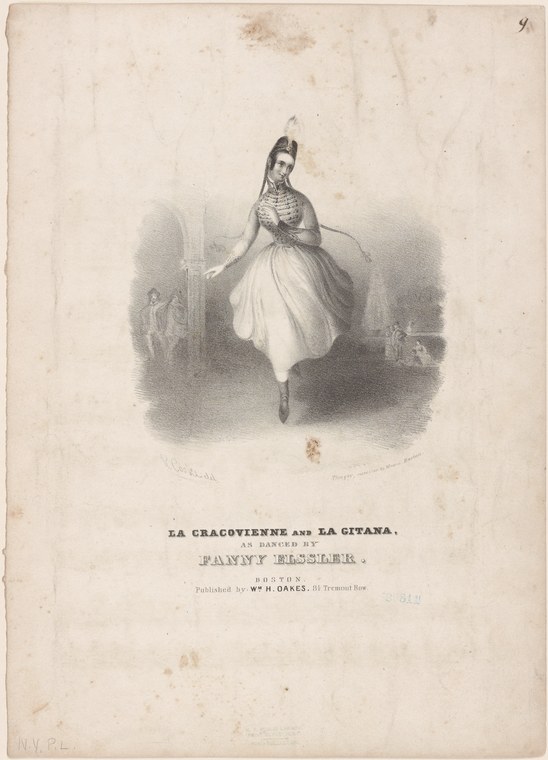
La cracovienne and La gitana, as danced by Fanny Elssler
Unknown artist
- Collection:
- Prints depicting dance
- Source:
- New York Public Library
- Rights:
- Public domain — free to use, share and adapt.
- Recorded as:
- Public Domain
Fanny Elssler was one of the most influential ballet dancers of her century and remains historically significant for pioneering character dance as a major choreographic and performance mode. This portrait is evidence of how Romantic-era ballet dancers were marketed and how their images shaped public understanding of the repertory. For historians, it documents the costume, posture, and gestural language of early-19th-century classical ballet at the height of its theatrical power.
What you are looking at
A young woman in Romantic-era theatrical dress stands alone against a softly shadowed background, caught mid-performance. She wears a white corseted bodice with horizontal pleating or banding across the chest, and a voluminous white skirt that falls to mid-calf, caught in an arrested moment of motion. A dark decorative headpiece or headdress sits atop her head. Her left arm is raised and bent, the hand near her face in a gesture of emotion or reverie; her right arm extends downward. Her posture is upright but animated, the body twisted slightly as though mid-turn. The lithographic technique renders the figure with soft gradations of gray and black around the edges, creating an intimate spotlight effect that isolates the dancer from any specific stage setting. The composition is a three-quarter-length portrait focused entirely on the soloist.
The dancing
A single female dancer stands in a turned-out position with weight seemingly on her back leg, suggesting classical ballet training. Her raised left arm and hand-to-face gesture convey introspection or yearning—a hallmark of Romantic ballet vocabulary. The body is elongated and graceful, with the visible leg extended in a way consistent with ballet's aesthetic. There is no visible partner or ensemble; she performs alone, and her frame suggests the upright carriage and ethereal quality valued in mid-19th-century classical technique.
The dance depicted
This is a portrait of Fanny Elssler, one of the most celebrated ballet dancers of the 19th century, depicted in or as one of two roles: either *La Cracovienne* (a Polish folk-inspired dance) or *La Gitana* (a Spanish gypsy dance). Both were among Elssler's famous character dances, performed during her career in Europe and America. The image captures the Romantic era's fascination with exotic, nationalistic, and character dance forms—a departure from the purely classical vocabulary. The theatrical presentation and costume suggest this is a stage portrait commemorating a specific virtuoso performance rather than a naturalistic scene.
How it was made
This is a lithograph, a process that allowed for softer tonal gradations and broader circulation than hand-engraving. The technique is evident in the delicate shading and the way the figure emerges from gray wash; the stones permitted easy mass production and made such dance portraits affordable for the public and collectors. The print was published by W. H. Oakes of Picadilly Row, London, which situates it within a commercial market for theatrical celebrity imagery. Lithography's accessibility made it the dominant medium for theatrical portraiture and promotion in the 19th century.
About this work
This is a lithographic stage portrait of Fanny Elssler, the Austrian-Italian Romantic-era prima ballerina, presented in one of her signature character dances. The work captures the height of the Romantic ballet era, when classical technique was increasingly blended with folk, national, and exotic themes to create a repertory of character pieces. Elssler was famous for her dramatic intensity, technical brilliance, and the vivacity of her character work—which stood in contrast to the ethereal, otherworldly aesthetic of her rival Marie Taglioni. This image circulated as a souvenir and advertisement of her performances, allowing audiences who had not seen her dance to encounter her likeness and repertory. The print is a primary document of 19th-century celebrity culture and the commercialization of ballet.
How to look at it
The viewer should note the moment chosen: the dancer is captured not in a static pose but in the midst of an emotional or narrative gesture—the hand near the face, the twisted torso, the sense of momentum. This is not a coldly technical display but a theatrical moment designed to convey character and feeling. The soft gray background and isolated composition signal that this is a stage portrait, not a naturalistic scene; the emphasis is on the soloist's body and expressive presence. The headpiece and dress, though simplified compared to what would be worn onstage, are recognizably theatrical costume. The pose and carriage make clear that this woman is trained in classical ballet, even though she is performing a character dance.
The artist
The artist is not recorded. The print was published by W. H. Oakes, a London print seller active in the mid-19th century. Such theatrical portraits were often produced after paintings or sketches by known theatrical artists, but the original source is not documented here. The lithographic process meant that the designer, lithographer, and publisher could be different people; the work is a commercial product rather than a signed artwork.
The period
This lithograph was made during the height of the Romantic ballet era (c. 1830–1850s), when ballet had become a major public entertainment and dancers achieved celebrity status rivaling that of opera singers. The period saw the rise of pointe work, longer tutus, and an aesthetic of weightlessness and otherworldliness, but also—as this portrait shows—a parallel interest in character dances based on national and folk traditions. Elssler's career (1821–1884) spans this transition; she was famous not only for classical roles but for character dances like *La Cachucha*, *La Tarantule*, and the roles shown here. The 1830s–1840s were also the era of theatrical lithography's dominance: thousands of such portraits were printed and sold to audiences, making them the photograph equivalents of their time.
Where it lives
The print is held in the New York Public Library's collection of prints depicting dance. It is a commercial lithographic print published in London by W. H. Oakes, Picadilly Row, and dates to the mid-19th century (exact date unknown). Such prints were mass-produced theatrical souvenirs and were circulated widely among theatergoing public and collectors.
Dance in this work
Questions about this work
Who was Fanny Elssler?
Fanny Elssler (1821–1884) was an Austrian-Italian prima ballerina who dominated European and American stages from the 1830s through the 1850s. She was celebrated for both her classical technique and her dramatic character dances, which often drew on folk, Spanish, and Eastern European traditions. She was a rival to Marie Taglioni and represented a different aesthetic: Taglioni embodied ethereal, weightless romanticism; Elssler embodied passion, virtuosity, and earthiness.
What is *La Cracovienne* and *La Gitana*?
*La Cracovienne* (The Polish Woman) is a character dance based on Polish folk traditions, while *La Gitana* (The Gypsy) is inspired by Spanish gypsy culture. Both were solo character pieces in which Elssler demonstrated her gifts for storytelling, technical display, and dramatic intensity. They were part of the Romantic era's fascination with national and exotic dances, and both became signature roles for her.
How was this print made and why is it important?
This is a lithograph, a printmaking process that allowed for soft tonal effects and affordable mass production. It was published as a commercial product to circulate the image of a celebrated performer to audiences. Such prints were the 19th-century equivalent of celebrity photographs or posters; they documented what famous dancers looked like and how they dressed, and they helped build and sustain public demand for their performances.
What does the pose tell us about how Romantic-era ballet was performed?
The raised arm, the turned-out stance, the upright carriage, and the expressive hand gesture are all hallmarks of Romantic ballet vocabulary. Even in a character dance based on folk tradition, the classical ballet frame—the elongation, the turnout, the arm positions—remains evident. This reflects how Romantic choreographers adapted national dances into the classical ballet vocabulary rather than performing them as pure folk forms.
More dance artwork





