49 works in this view — arrow keys or swipe to move between them.
Dance in Art
L'Aragoneza. Pepita de Oliva (fac.sig.)
Unknown artist
- Collection:
- Prints depicting dance
- Source:
- New York Public Library
- Rights:
- Public domain — free to use, share and adapt.
- Recorded as:
- Public Domain
This work is an invaluable document of Romantic-era Spanish character dancing and of the techniques, costuming, and theatrical presentation that defined the period's ballet. It records a named dancer in a named role, allowing historians to trace both the lineage of the dance and the circulation of Spanish themes through European theatrical culture. The technical execution of the lithograph itself—the rendering of movement, drapery, and the dancer's bodily control—demonstrates how 19th-century theatrical art media preserved and disseminated knowledge of dance practice.
What you are looking at
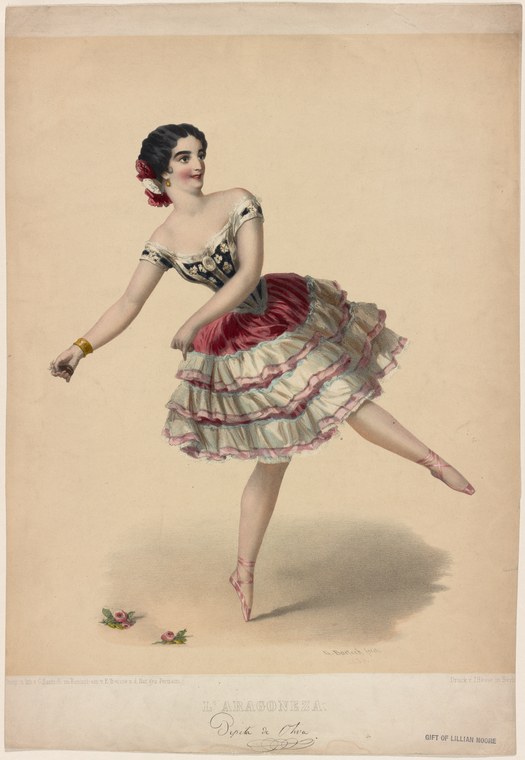
A solo female dancer is captured mid-arabesque against a pale cream background, her body angled elegantly to the right. She wears a fitted, off-shoulder bodice decorated with a plaid or checkered pattern, and a voluminous skirt composed of multiple layers of ruffled tulle in deep red, cream, and dark accents, each layer precisely gathered. Her dark hair is styled in ringlets adorned with red ribbons at the nape. She balances en pointe on her right foot, her left leg extended long behind her, her supporting arm reaching forward with the other arm positioned behind. Two small bouquets of flowers appear on the ground beneath her, suggesting admiration or theatrical presentation. The figure is rendered with refined attention to the texture and shimmer of fabric, particularly the intricate pleating and layering of the skirt. The composition presents the dancer as both technically accomplished and intensely graceful—a moment of suspended balance frozen in space.
The dancing
The dancer stands in a classical arabesque position, the supporting leg straight and turned out beneath her, the working leg extended horizontally behind her at hip height. Her torso is held upright and composed, her port de bras refined—one arm extends gently forward while the other curves behind. The weight is entirely supported on the ball of the right foot en pointe, a technical requirement that demands significant ankle strength and control. Her head is held erect and turned in profile, her gaze directed to the right, giving her an aspect of calm focus. The overall frame and posture express classical balletic training and control.
The dance depicted
This is a Romantic-era theatrical ballet dancer, almost certainly performing a Spanish or Iberian-inflected character dance—the title *L'Aragoneza* names a specific regional Spanish dance associated with Aragon. The image likely documents a celebrated performance piece or a role from a ballet production, given the professional presentation and the signed attribution to 'Pepita de Oliva.' The costume, footwork, and arabesque position are entirely consistent with mid-19th-century ballet vocabulary applied to a character role. The flowers on the ground suggest this may record a moment after the performance or a particularly celebrated variation.
How it was made
This is a hand-colored lithograph or color lithograph, executed with considerable technical refinement. The technique allowed the precise rendering of the tulle skirt's layered transparency and the subtle gradations of color in the fabric, as well as the tonal modeling of the figure's skin and the delicacy of the hair ornaments. The flatness of the background and the fine linear work suggest lithographic drawing. Color lithography was a dominant medium for theatrical and celebrity portraiture in the mid-19th century, allowing wide circulation to audiences and dancers across Europe. The inscription at the base and the signed attribution indicate this was a commercial theatrical souvenir or promotional image.
About this work
This is a hand-colored lithographic portrait of a celebrated Romantic-era ballet dancer identified as Pepita de Oliva, performing or posed in a moment from *L'Aragoneza*, a character role based on the Spanish regional dance of Aragon. The work documents both the technical language of mid-19th-century ballet—the arabesque position, the pointe work, the refined port de bras—and the elaborate visual spectacle of the era's theatrical costume, with its multi-layered tulle skirt and regional styling. The image belongs to the tradition of theatrical portraiture that celebrated individual dancers and their signature roles, a tradition sustained through commercial color lithography. It offers a precise record of how a specific dance was costumed and performed at a particular moment, and how that performance was marketed to its contemporary audience.
How to look at it
The artist has chosen to present the dancer in a moment of perfect balance and composure—the arabesque fully extended, the body held with controlled grace. This is not a moment of effort or strain but of achieved beauty, the arabesque presented as a goal rather than a step in progress. The attention to the costume is as refined as the attention to the body: the multiple layers of the skirt are rendered with careful observation of how tulle folds and catches light, how each layer creates a distinct plane of color and texture. A viewer should attend to the relationship between technical achievement (the pointe work, the line of the extended leg) and visual spectacle (the elaborate skirt, the ornamental hair)—Romantic ballet derived much of its power from this synthesis.
The period
This work dates to the height of the Romantic ballet era (approximately 1830s–1860s), when interest in exotic, regional, and folk dances as subject matter for theatrical ballet reached its peak. Spanish regional dances, particularly from Andalusia and Aragon, were absorbed into ballet vocabulary and performed by European dancers in staged versions that blended authentic folk practice with classical technique. This was the era of touring ballet companies and celebrated individual dancers—figures like Fanny Elssler—who became international celebrities through performances of character roles and national dances. Color lithography was the dominant medium for theatrical portraiture and promotion, allowing images of celebrated dancers to circulate widely among audiences and fellow performers. The image reflects both the aesthetic values of Romanticism and the commercial theatrical apparatus that sustained them.
Where it lives
This work belongs to the New York Public Library's collection of prints depicting dance. It is a commercial theatrical souvenir or promotional lithograph, typical of 19th-century theatrical culture and circulation. The inscription identifying the performer and the title of the role suggests it was created for public sale and distribution to theater audiences and collectors of theatrical memorabilia.
Dance in this work
Questions about this work
Was Pepita de Oliva a real dancer?
The signature and identification on this print indicate she was a recognized performer of the Romantic era, though little else is documented. She is known primarily through theatrical imagery like this one. Many dancers of the 19th century are now known only through such prints and occasional playbills.
What is an arabesque and why is it important?
An arabesque is a fundamental ballet position in which one leg is extended behind the body while the dancer balances on the supporting leg, typically en pointe as shown here. It became a signature pose of Romantic ballet and remains essential to classical ballet vocabulary. The extended line and balance required demonstrate technical control and the kind of elongated elegance that defined the period's aesthetic.
What does L'Aragoneza mean?
The title refers to a regional dance or dance-like style from Aragon in northeastern Spain. Romantic-era ballet frequently incorporated regional and national dances, often performed by European dancers in stylized theatrical versions. The costume and the arabesque position show how these source materials were absorbed into classical ballet technique.
How was this image made and distributed?
This is a hand-colored lithograph, a technique that allowed rapid, relatively inexpensive production of images with color. Such prints were sold as theatrical souvenirs and promotional images, allowing audiences to take home images of celebrated performances and dancers. This form of theatrical memorabilia was a major driver of both artistic production and celebrity culture in the 19th century.
More dance artwork





