49 works in this view — arrow keys or swipe to move between them.
Dance in Art
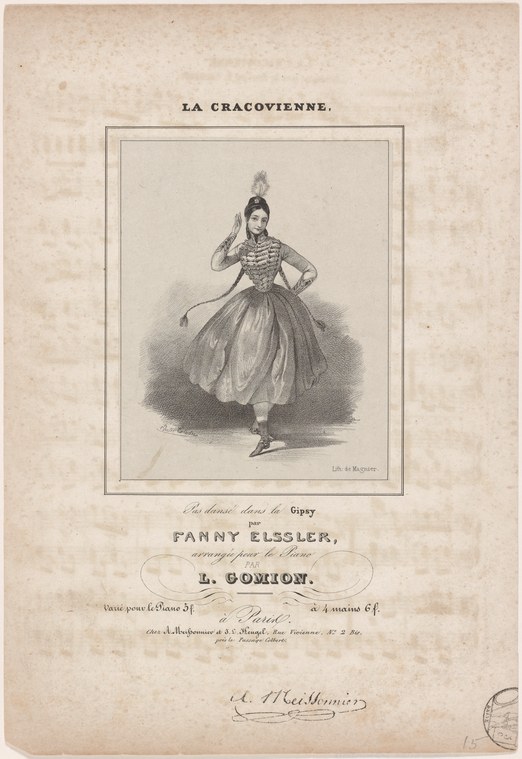
La cracovienne, pas dansé dans La gipsy par Fanny Elssler
Unknown artist
- Collection:
- Prints depicting dance
- Source:
- New York Public Library
- Rights:
- Public domain — free to use, share and adapt.
- Recorded as:
- Public Domain
Fanny Elssler was a major figure in romantic-era ballet and a rival to the more ethereal style of Marie Taglioni; her strength lay in rapid, grounded, characterful dancing, and the Cracovienne was one of her signature vehicles. This engraving is both a record of that performance tradition and an artifact of how ballet was consumed as popular theatre—through prints that celebrated the dancer's body and presence. For dancers today, it offers a rare visual document of how a famous historical step was actually performed and presented.
What you are looking at
A single female dancer stands in three-quarter view against a plain background, captured in a moment of dynamic movement. She wears a short, pale tulle skirt caught mid-swirl around her legs, exposing her lower limbs and the line of her body in motion. Her bodice is a darker, ornate garment with what appears to be military-style braiding or frogging across the front, and she wears a tall, feathered headdress. Her right arm is raised to the level of her head, her left arm extended lower, and her posture shows the upright carriage and controlled lift characteristic of early 19th-century theatrical dance. The figure is rendered in fine engraving technique with careful shading that gives sculptural volume to the form. The title below identifies this as the Cracovienne pas danced in the ballet *La Gipsy* by Fanny Elssler.
The dancing
The dancer stands in a single supported pose—likely a moment of balance or preparation rather than a traveling step. Her weight appears engaged and lifted through the torso; the raised right arm and extended left arm create an open upper body frame. The pose suggests a moment of repose or presentation within a fast, traveling step, a typical moment for a *pas* of this period to pause for effect. Her legs are in a closed or nearly closed position, with the weight carried in the characteristic turned-out stance of academic dance, though the swirling skirt suggests the immediate previous moment was one of rapid rotation.
The dance depicted
The Cracovienne (also Krakowiak) is a Polish national dance in quick duple time, rapid and energetic, with characteristic hop-steps and traveling patterns. It was a favorite solo vehicle for romantic-era ballerinas, and Fanny Elssler, one of the period's most celebrated dancers, performed this particular version in the 1840 ballet *La Gipsy* (choreographed by Joseph Mazilier). The costume—the feathered headdress, the military-style braiding, the short skirt—is in keeping with theatrical conventions for national or character dances of the romantic period, which often adopted or stylized elements of folk costume to signal geographical and ethnic content. The engraving captures the moment of display within the dance, showing the dancer's control and presence rather than the rapid footwork that defines the step.
How it was made
This is a finely executed engraving, likely produced from a drawing or painting made during or after a performance. The technique allows for the careful rendering of fabric texture—the translucence of the tulle, the detail of the bodice trimming—and the sculptural modeling of the figure through fine parallel lines (hatching). Engravings of this kind were made for publication as sheet-music covers, souvenirs, or illustrations for dance periodicals and gift books, allowing a wide audience to see celebrated performers in iconic roles. The inscription at the bottom (printed in French) and the professional quality of the engraving suggest this was a commercial theatrical souvenir, distributed to audiences or sold in the lobbies of opera houses.
About this work
This is a theatrical souvenir engraving of Fanny Elssler, one of the 19th century's greatest dancers, performing the Cracovienne (a Polish character dance) in the ballet *La Gipsy*. The print captures a single moment of poise and presentation within a fast, traveling step, showing the dancer's lifted carriage, open arm frame, and the characteristic short tulle skirt of romantic-era ballet. As a commercial engraving, it served to immortalize a celebrated performance and circulate the image of a star dancer across Europe, making it an important record both of the dance itself and of how ballet was consumed and celebrated in the early 19th century.
The work sits at the intersection of dance documentation and theatrical marketing. It shows not a frozen snapshot of a single movement but a carefully chosen moment of repose within a dynamic whole—a convention that shaped how audiences understood and remembered dancing. For historians and dancers, it offers evidence of the Cracovienne's place in the romantic ballet repertoire and of Elssler's dominance as a performer of character and national dances.
How to look at it
Look at the moment the engraver chose to freeze: not mid-step, but a moment of arrival or presentation. The raised arm and open frame suggest the dancer is about to move or has just landed, poised for effect. The swirling skirt—rendered in flowing lines—captures the momentum of rapid turning just before this instant of repose. Notice the care taken with the face and headdress (facing the viewer, confident, serene) and the way the bodice is rendered with fine detail, emphasizing the dancer's strength and control. The blank background throws all attention onto the body; there is no theatrical setting, no partner, no narrative—only the dancing body as spectacle.
The artist
The engraver is not identified in the catalogue record. However, prints of this kind were typically produced by commercial theatrical print shops in Paris or London in the 1840s–1850s, working from drawings or paintings by theatrical artists and made available to audiences as souvenirs. The signature at the bottom (if legible in the original) might identify the engraver or the shop; the inscription credits Fanny Elssler as the performer and typically names the ballet and the choreographer. These prints formed a major industry in 19th-century theatrical culture.
The period
This engraving dates to the height of romantic-era ballet, roughly 1840–1850. The romantic period (c. 1830–1870) was dominated by ethereal, otherworldly heroines in tulle skirts, often portraying sylphs or spirits. However, the period also saw a parallel tradition of character and national dances—Spanish, Italian, Polish, Russian—performed by dancers like Elssler who specialized in rapid, grounded, virtuosic footwork and a more sensual or earthly presence. The Cracovienne, with its quick hopping steps and military-tinged costume, represented this national-dance tradition within ballet. Engraved prints of dancers became ubiquitous in this period; they were sold as sheet-music covers, pasted into albums, and distributed by the thousands, making ballet a form of mass-produced popular culture as well as high art.
Where it lives
This engraving is held in the NYPL's Prints Depicting Dance collection, a major resource for theatrical dance imagery. It was likely created as a commercial souvenir during or shortly after the 1840 premiere of *La Gipsy* at the Opéra in Paris, and would have been available for purchase by audiences or subscribers to ballet periodicals.
Dance in this work
Questions about this work
Who was Fanny Elssler?
Fanny Elssler (1810–1884) was an Austrian dancer and one of the most celebrated ballerinas of the romantic era. Unlike her rival Marie Taglioni, Elssler was known for rapid, brilliant footwork and a warmer, more sensual style; she specialized in character and national dances. She performed across Europe and the Americas and was a major box-office draw. The Cracovienne was one of her signature roles.
What is La Gipsy?
*La Gipsy* (1840) is a ballet choreographed by Joseph Mazilier for the Opéra in Paris. It tells the story of a gypsy woman and features Fanny Elssler in the lead role. The ballet is known less for its plot than for its showcase of character dances, including the famous Cachucha and the Cracovienne. It was a massive success and remained in the repertoire for decades.
What is a Cracovienne?
The Cracovienne (or Krakowiak) is a Polish national dance in fast duple time, characterized by rapid hopping steps, traveling patterns, and a joyful, energetic character. In romantic-era ballet, it was often performed as a solo *pas* by female dancers, showing off their speed and precision. The name comes from Kraków, Poland's major city.
Why did 19th-century ballet include national dances?
National and character dances were a way for ballet to engage with European geography and folklore while remaining theatrically spectacular. They allowed choreographers to vary the ethereal, otherworldly mood of romantic ballet with earthly, rapid, and sensual dancing. They also gave certain dancers (like Elssler) a distinct stage identity and helped sell tickets by offering audiences a sense of exotic authenticity—however stylized.
More dance artwork





