49 works in this view — arrow keys or swipe to move between them.
Dance in Art
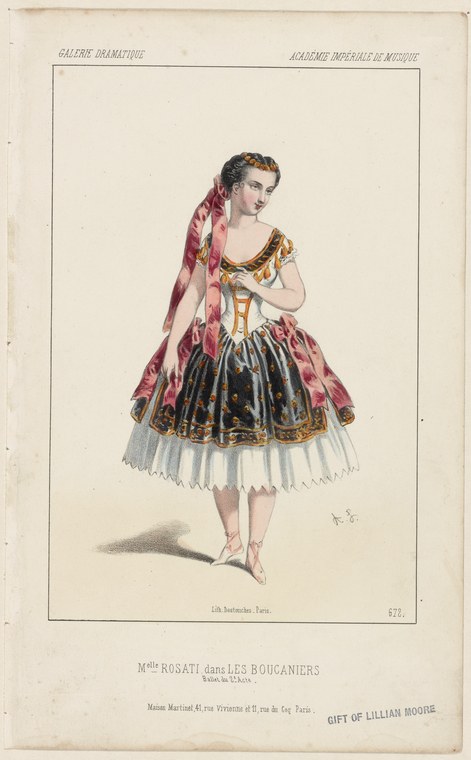
Melle Rosati, dans Les boucaniers, ballet du 2e acte
Unknown artist
- Collection:
- Prints depicting dance
- Source:
- New York Public Library
- Rights:
- Public domain — free to use, share and adapt.
- Recorded as:
- Public Domain
Theatrical portraiture of dancers is one of the primary visual records of how nineteenth-century ballet actually looked—what costumes looked like, how dancers carried their bodies, and what roles captured public imagination. This print documents both a specific ballerina and the aesthetic conventions of Romantic-era dance. Such prints also reveal the commerce of ballet: dancers' images were commodified and circulated to fans much as photographs of performers are today.
What you are looking at
A young female dancer stands alone against a plain cream background, posed in a moment of arrested motion characteristic of mid-nineteenth-century theatrical dance portraiture. She wears a Romantic-era ballet costume: a white tulle skirt of knee length, fitted bodice in pale yellow or champagne silk trimmed with gold or bronze ornament, and a rose-pink silk shawl draped asymmetrically across her left shoulder and arm. Her dark hair is styled up and back from her face in the period fashion. She stands in three-quarter view, weight on her right leg with a slight turn inward, her left leg extended or relaxed. Her gaze is directed downward and to the left, away from the viewer, giving her an introspective or demure expression. The pose suggests a moment between movements—neither a formal standing position nor an active leap, but rather the pause of theatrical elegance that the Romantic ballet privileged. The costume is richly colored and detailed, with careful attention to the fall of fabric and the interplay of textures.
The dancing
A single dancer is depicted in a standing pose with her weight shifted to one leg, the other leg relaxed. Her upper body is angled slightly away from the viewer, her left arm reaching behind or across her body while her right arm is held loosely at her side. Her head is inclined gently downward, avoiding direct eye contact with the viewer—a convention of Romantic-era ballet imagery that emphasizes the dancer's detachment and ethereal quality rather than her engagement with an audience. The pose suggests trained deportment: an upright carriage, turned-out legs (evident in the positioning of her standing leg), and an overall lightness despite her stationary position. This is clearly a professional dancer posed for portraiture, not a spontaneous moment.
The dance depicted
This is a portrait of a Romantic-era ballet dancer, most likely from a specific Paris Opera production. The inscription identifies her as "Melle Rosati" performing in "Les Boucanniers" (The Buccaneers), a ballet d'action from the second act. Rosati was a prominent Italian ballerina active in Paris during the 1840s–1850s, celebrated for her technical skill and dramatic presence. The costume—a short tulle skirt, fitted bodice, and draped shawl—is consistent with mid-nineteenth-century ballet practice, where such costumes allowed visibility of the dancer's legs and footwork while maintaining the modesty expected in the period. The pose itself suggests the dancer as a character in the narrative rather than in active technique display; she is costumed for a specific role, not presented in a technical position like an arabesque or développé.
How it was made
This is a hand-colored engraving or lithograph, likely produced in the 1840s–1850s. The delicate line work, the pale color palette, and the careful rendering of fabric textures are consistent with commercial theatrical portraiture of the period. Hand-coloring (evident in the careful application of rose, gold, yellow, and flesh tones) distinguishes this as a luxury product aimed at affluent collectors and ballet enthusiasts. The technique allowed for relatively rapid reproduction and distribution—these prints were sold to the public as souvenirs of celebrated performances and dancers, making the work a document of both theatrical costume and celebrity culture.
About this work
This is a portrait print of an Italian ballerina, Rosa Rosati, captured in the costume and manner of French Romantic ballet in the mid-nineteenth century. It is a commercial theatrical portrait—a souvenir of a specific performance at the Paris Opera—and belongs to a large genre of such prints that documented celebrated dancers and roles. The work is important both as a document of how Romantic ballet was costumed and performed, and as evidence of the star system and celebrity culture surrounding the art form.
How to look at it
Observe the asymmetrical pose and the direction of the dancer's gaze—she is not presenting herself frontally to the viewer, but rather caught in a moment of introspection or character portrayal. This was the Romantic convention: the ballerina as a figure of mystery and otherworldly beauty, not as a virtuoso on display. Note the deliberate richness of the costume—the interplay of textures and colors—and how the short tulle skirt would have revealed the dancer's legs and pointe shoes in performance. The print captures not action but presence; Rosati is costumed for her role in a narrative ballet, and the pose suggests the emotional or theatrical moment rather than technical difficulty.
The artist
The artist is not recorded in the catalogue. The print was published by Martinet of Paris, a major producer of theatrical portraiture in the mid-nineteenth century. Such prints were typically commissioned by theaters or dancers themselves and distributed through print sellers; they were often drawn by theatrical illustrators whose names were not consistently recorded. The quality of the hand-coloring and the careful attention to costume detail suggest a skilled commercial workshop rather than a fine-art printmaker.
The period
This print dates to the height of the Romantic ballet era (roughly 1830–1860), when ballet was dominated by ethereal, otherworldly narratives and the figure of the ballerina en pointe became the central image of the art form. The Paris Opera was the capital of ballet, and French audiences were intensely invested in celebrated dancers—Italian sopranos of the operatic stage had analogs in Italian ballerinas who performed in Paris, and Rosati was among the most celebrated of these. The mid-nineteenth century saw rapid expansion of lithographic and engraving technology, making theatrical portraiture an accessible commercial product. Such prints were sold at the theater, through print shops, and through subscription, making the dancer's image a form of merchandise.
Where it lives
This is a hand-colored theatrical portrait engraving or lithograph from the New York Public Library's collection of prints depicting dance. Such prints were commercial products distributed in the nineteenth century to ballet enthusiasts and collectors.
Dance in this work
Questions about this work
Who was Rosa Rosati?
Rosati was an Italian ballerina who was a star of the Paris Opera in the mid-nineteenth century, active during the 1840s–1850s. She was celebrated for both her technical abilities and her dramatic presence in character roles. She performed in the major ballets of the Romantic era and was one of the most sought-after dancers in Europe.
What was 'Les Boucanniers'?
Les Boucanniers (The Buccaneers) was a ballet d'action—a narrative ballet with a dramatic plot rather than an abstract one. It was a typical vehicle for star ballerinas of the mid-nineteenth century, which allowed them to display both technical skill and dramatic acting ability. This print documents Rosati's costume and role in the second act.
Why are so many ballet prints from this era hand-colored?
Hand-coloring was a labor-intensive but cost-effective way to produce colored prints in the nineteenth century, before color lithography became standard. The delicate work required skilled colorists, and the result was a relatively affordable luxury product—expensive enough to signal refinement, but accessible to middle-class theater enthusiasts who wanted to collect images of celebrated dancers.
What does the pose tell us about Romantic ballet?
The downward gaze, the turned-out legs, and the asymmetrical positioning are all conventions of Romantic-era dance portraiture. Rather than showing a dancer in a virtuosic technical position (like a grand développé), this pose emphasizes the dancer as a character in a narrative, with an introspective or ethereal quality. It reflects the aesthetic values of Romanticism: mystery, emotion, and otherworldliness rather than technical display.
More dance artwork





