49 works in this view — arrow keys or swipe to move between them.
Dance in Art
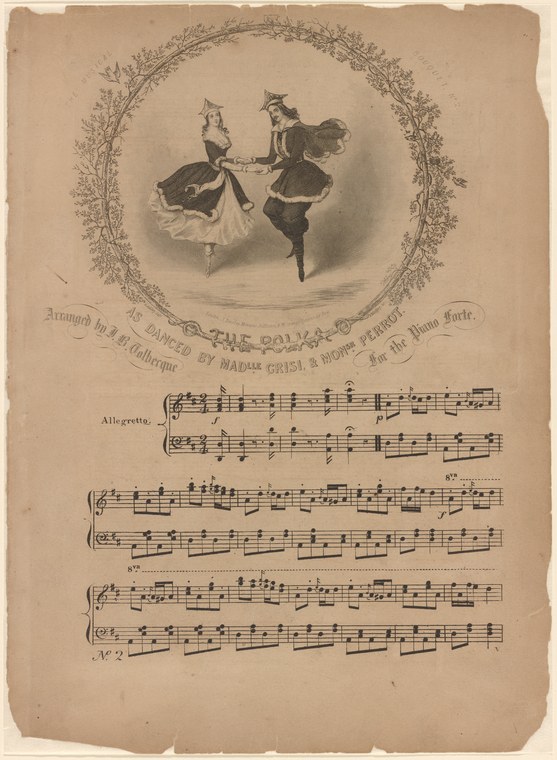
The polka as danced by Madlle. Grisi, & Monsr. Perrot.: Arranged by B. Tolbecque for the piano forte
Unknown artist
- Collection:
- Prints depicting dance
- Source:
- New York Public Library
- Rights:
- Public domain — free to use, share and adapt.
- Recorded as:
- Public Domain
This image is evidence of the permeability between ballroom and stage in the Romantic era: celebrated ballet dancers performed ballroom dances theatrically, and those performances were then taught to the public through illustrated sheet music. It shows how a social dance was transformed through the bodies and technique of trained performers, and how that transformation was commodified and disseminated.
What you are looking at
A pair of dancers in theatrical dress perform against a plain background, framed by an ornamental circular border of delicate vines or ivy. The female dancer, in a pale dress with dark accents and what appears to be a fitted bodice, is captured mid-movement with her skirt lifted and swirling around her in a dynamic arc. The male dancer, dressed in dark clothing, faces her in an attentive pose. Both figures are elevated on their toes, suggesting vigorous, springing movement. The composition freezes a moment of lively interaction between the pair—likely a turning figure or traveling step. Below the illustration lies the musical score in two staves, marked Allegretto, indicating this is sheet music for piano arrangement.
The dancing
Both dancers are on the balls of their feet in a light, upright carriage typical of social dance training. The man's posture is alert and engaged, his body angled toward his partner. The woman's weight is clearly transferred into the turn; her free leg is extended and her skirt follows the momentum of her rotation. The relationship between them suggests a partnered dance requiring close connection and timing, with the man attending to the woman's movement. Their positioning—facing each other with evident spring and lift—indicates a dance of considerable technical demand.
The dance depicted
The title names this as the Polka as performed by Carlotta Grisi and Lucien Perrot, two of the most celebrated dancers of the Romantic ballet era. The polka was a fashionable ballroom dance of the 1840s, but this image documents a theatrical adaptation—a stage performance by star dancers of the Paris Opéra. The dance shown here combines the characteristic hopping, turning motion of the social polka with the trained elevation and precision of ballet technique. The arrangement by Tolbecque for piano suggests this was widely circulated sheet music, intended for amateur performers to learn the dance at home.
How it was made
This is a lithograph or engraving (the technique is established from the image rather than the record, which does not specify medium). The delicate line work and the capacity to show subtle shading in the figures' dress and the background suggest stone lithography. The ornamental border was a common device in theatrical prints of this period, elevating the image and framing the dancers as worthy of display. The inclusion of the full musical score below indicates this was published as a complete dance instruction or souvenir—common practice for fashionable dances of the 1840s.
About this work
This is a printed souvenir of a theatrical performance capturing a moment in the early history of ballet's engagement with ballroom dance. Grisi and Perrot were canonical figures—she danced the role of Giselle in its premiere in 1841, and both were principal dancers at the Opéra—and their performance of a polka on the theatrical stage was noteworthy enough to be published and circulated. The work documents how elite theatrical dancers adapted and elevated social dances, and how those adaptations were then distributed for amateur consumption through sheet music publications. It sits at the intersection of Romantic ballet, ballroom culture, and print circulation in the 1840s.
How to look at it
Notice the precise moment the artist has chosen: a full rotation or hop, with the woman's weight transferred and her skirt describing the arc of her movement. The male dancer's body is perfectly balanced, attending to his partner without looking down—this was the ideal of Romantic partnering. The ornamental border and the musical score together transform this from a mere illustration into a souvenir and teaching tool, suggesting how seriously the print culture of dance took the dissemination of fashionable movement.
The artist
The artist is not recorded. The engraver or lithographer is unnamed, and the publisher's name does not appear in the catalogue record. This anonymity was typical for commercial dance prints of the period, which were often produced by printing houses rather than signed by individual artists. The arrangement is credited to B. Tolbecque, a pianist and composer of the era known for producing dance music arrangements.
The period
The 1840s were the height of the Romantic ballet period, when Carlotta Grisi was at the peak of her fame and the Opéra was the center of European dance prestige. At the same time, the polka was sweeping European ballroom culture—it had emerged in Bohemia in the 1830s and by the early 1840s was the fashionable social dance of choice. The printed sheet music with illustration was a new form of cultural commodity, allowing the dances and music of the stage to circulate widely and inexpensively. This work captures the moment when theatrical and social dance were in active dialogue.
Where it lives
The work is held in the Prints collection of the New York Public Library, indicating it is part of a major research collection of theatrical and commercial prints. The presence of sheet music below suggests this was published as an integrated object—image and music together.
Dance in this work
Questions about this work
Were Grisi and Perrot really dancing the polka on stage?
Yes. While the polka was primarily a ballroom dance, celebrated dancers of the era did perform it theatrically, often as divertissements or between acts. This print documents that performance by Grisi and Perrot, two of the most prestigious dancers of the Romantic ballet period.
What is Tolbecque's arrangement for?
The piano arrangement allowed amateur musicians and dancers to learn and practice the polka at home. Sheet music with illustrations was a mass-market product in the 1840s, bringing fashionable ballroom and theatrical dances within reach of middle-class households.
How does ballet technique show in this image?
The dancers' carriage, the spring in their feet, the control and lightness of their movement, and the woman's elevation all reflect ballet training. The polka as performed by trained dancers looks quite different from the social version—more precise, more lifted, more theatrical.
More dance artwork





