49 works in this view — arrow keys or swipe to move between them.
Dance in Art
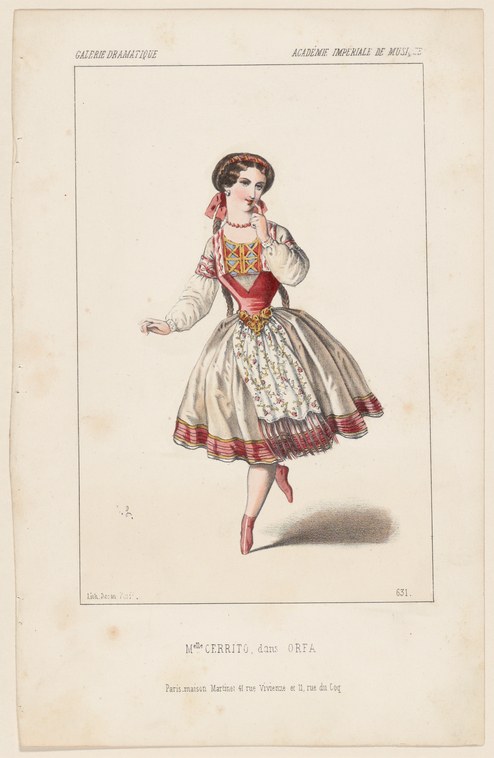
Melle Cerrito, dans Orfa
Unknown artist
- Collection:
- Prints depicting dance
- Source:
- New York Public Library
- Rights:
- Public domain — free to use, share and adapt.
- Recorded as:
- Public Domain
This image documents the aesthetic and physical practice of Romantic ballet at its height, preserving the costume, the body position, and the emotional register of a performance tradition that existed only in the moment and left few other records. For historians of dance and theater, it provides precise visual evidence of how a leading nineteenth-century ballerina moved, dressed, and presented herself on stage—information that cannot be recovered from written sources alone.
What you are looking at
A single female dancer occupies the center of the composition, captured mid-performance against a plain background. She wears a striking costume of the Romantic era: a white muslin skirt with deep red or crimson trim at the hem, a fitted red or burgundy bodice with ornamental gold or yellow embroidery across the front, and a white chemise with puffed sleeves. A red ribbon is tied at her neck. Her dark hair is styled close to her head in the fashion of the 1840s, topped with what appears to be a small bonnet or headdress. Her pose is dynamic—one leg is raised slightly in a jumping or light springing movement, her arms are positioned expressively with one hand raised near her face in a gesture suggesting both grace and the fleeting quality of the moment. The lighting is soft and even, with a subtle shadow cast beneath her feet emphasizing the flatness of the print medium. The overall impression is of a skilled performer captured at the apex of a movement, demonstrating both technical control and theatrical presence.
The dancing
The dancer stands in near profile, with her weight appearing to be on the ball of one foot while the other leg lifts lightly in what may be a petit développé or similar balletic movement. Her upper body is held upright with evident turnout, and her arms frame the torso in an open, expressive position characteristic of Romantic ballet. The raised hand near her face suggests a moment of tender emotion or reverie. Her entire frame conveys the ethereal, weightless quality that was the aesthetic ideal of the period: the body is elongated, the carriage regal, and the movement appears effortless.
The dance depicted
This is a Romantic-era ballet dancer, identifiable by the costume, the barefoot or near-barefoot technique, the style of the skirt, and the quality of the pose. The raised leg and open frame are consistent with the vocabulary of Classical ballet as it was performed in the 1840s. The dancer is identified in the inscription as Melle Cerrito, who was one of the leading prima ballerinas of the mid-nineteenth century. The character she portrays here appears to be Orfa (as stated in the title), a role that would have been performed in the dramatic ballets of the period. The image shows the dancer in a moment of lyrical stillness within a jump or lift, a hallmark of Romantic ballet performance, where emotional expression and technical display were equally valued.
How it was made
This is a hand-colored lithograph or engraving, a reproductive print technology that allowed wide dissemination of dance imagery. The technique permits fine detail in the costume and the subtle modeling of the figure's form; the coloring is applied in flat washes with careful registration of the red, cream, and skin tones. The use of this medium—neither a photograph nor a painting—indicates this was a commercial theatrical print, produced for sale to ballet enthusiasts and collectors. The quality of execution and the presence of maker's marks suggest this was published by a professional Paris house, likely Martinet (as indicated by the signature), one of the major publishers of theatrical prints in mid-nineteenth-century France.
About this work
This is a mid-nineteenth-century theatrical print documenting one of the greatest prima ballerinas of the Romantic era in a celebrated role. Cerrito was known for her technical brilliance, her dramatic intensity, and her ability to move audiences—qualities that this image attempts to capture in a single, emblematic pose. The print belongs to a vast archive of commercial theatrical documentation from the period: images of leading performers in signature roles, circulated as souvenirs, as promotional material, and as records of performance practice. Such prints were essential to the international reputation of dancers; they carried information about costume, carriage, and the moment of performance into homes and studios far from the theater itself.
How to look at it
The pose itself is the key: notice how the artist has chosen not a moment of maximum extension or display, but rather a moment of repose within the movement—a suspended point where the dancer appears almost weightless, held between effort and grace. This reflects the Romantic ballet aesthetic, which valued emotional interiority and the appearance of effortlessness over athletic display. Look at the costume: the red and gold embroidery on the bodice suggests a character role (not the abstract white tulle of a sylph), and the careful rendering of the muslin skirt shows how the fabric would move and fall. The hand near the face is not arbitrary: it is a gestural vocabulary that informed how audiences read emotion and character in ballet.
The artist
The print was produced by the Paris publishing house Martinet, one of the major commercial printers of theatrical images in the nineteenth century. Martinet specialized in portraits of performers—ballet dancers, opera singers, actors—and distributed these prints throughout Europe and beyond. The firm operated in a mode between journalism and fine art, creating affordable documentary images of celebrated performances and performers. While the name of the artist or lithographer is not recorded here, such prints typically represented collaborative work between the publisher, a designer, and a technician.
The period
The 1840s were the high point of the Romantic ballet movement, when the ethereal, otherworldly aesthetic reached its apotheosis. Dancers such as Cerrito, Marie Taglioni, and Fanny Elssler were celebrated across Europe as embodiments of new ideals of grace, emotion, and technical mastery. This period saw the development of the pointe shoe as a standard tool, the refinement of the vocabulary of classical technique, and the creation of narrative ballets that combined spectacle, emotion, and technical display. At the same time, lithography and other reproductive print technologies had made theatrical images accessible to a broad public, creating a culture of celebrity and fan culture around dance that was unprecedented. The prints were essential to this culture: they carried the image of the dancer beyond the theater and into the homes of admirers.
Where it lives
This print is held in the New York Public Library's collection of dance prints and theatrical imagery. It is part of the library's extensive holdings of nineteenth-century theatrical documentation, which constitute one of the most important archives of dance and theater history in North America.
Dance in this work
Questions about this work
Who was Cerrito?
Fanny Cerrito (1817–1909) was an Italian-born ballerina who became one of the most celebrated performers of the Romantic era. She was known for her technical brilliance, her dramatic intensity, and her skill in both classical and character roles. She performed across Europe and was particularly celebrated in Paris, London, and Milan. She was also a choreographer and created roles for herself and other dancers.
What is Orfa?
Orfa was a dramatic ballet character role performed by Cerrito. The role belonged to the tradition of Romantic ballet narrative, in which dancers portrayed characters with emotional depth and dramatic significance. Without access to the libretto or detailed records, the specific plot cannot be determined, but the costume—particularly the red bodice with gold embroidery—suggests a character of some distinction or passion.
How do we know this is Cerrito?
The inscription at the bottom of the print reads 'Mlle Cerrito, dans Orfa' (Mlle Cerrito in Orfa). This was the standard format for theatrical prints of the period: the name of the performer and the name of the role or ballet. Martinet issued many such prints, and this one, like others, was sold as a record and souvenir of a celebrated performance.
Why are these prints important to dance history?
Before photography became common, such prints were the primary visual record of how dancers looked, moved, and dressed on stage. They show us the costume, the posture, the moment of movement that mattered, and the aesthetic values of the period. They also document the international circulation of dance: a print like this could be purchased in London, Paris, Milan, or Vienna, making the dancer's image known to admirers who might never see a live performance.
More dance artwork





