49 works in this view — arrow keys or swipe to move between them.
Dance in Art
Pose Silfidée
Unknown artist
- Collection:
- Prints depicting dance
- Source:
- New York Public Library
- Rights:
- Public domain — free to use, share and adapt.
- Recorded as:
- Public Domain
This is direct evidence that Romantic ballet imagery and vocabulary remained culturally significant in the 1870s, decades after *La Sylphide*'s premiere. The image demonstrates how ballet technique and aesthetics were transmitted to non-specialist audiences through periodical illustration, making dance accessible as visual culture rather than lived performance. For historians tracking the popularization of ballet and the codification of its poses, this represents exactly the kind of material that shows how technique became visual reference and commercial product.
What you are looking at
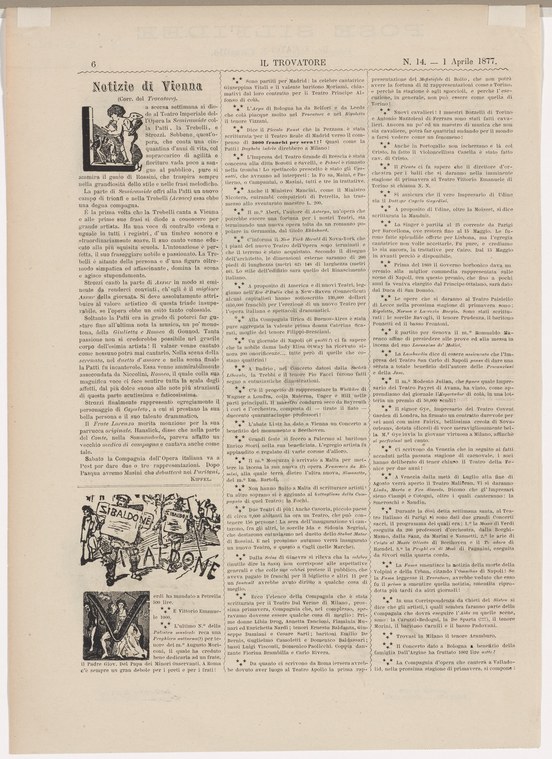
This is a page from *Il Trovatore*, an Italian illustrated periodical from April 1, 1877. The layout shows the magazine's typical format: dense columns of text flanking several wood-engraved illustrations. Three distinct images are visible on the page. At top left is a vignette showing what appears to be a classical or mythological female figure in flowing drapery, positioned against architectural elements. Below this is a theatrical scene showing multiple figures in period costume, with dramatic gestures suggesting a moment of heightened emotion—possibly a confrontation or recognition scene. At the bottom is another engraving labeled with text that is partially legible. The page's typography, illustration style, and printing technique are consistent with mid-19th-century Italian periodical publishing. The images interrupt the text column flow in a manner typical of illustrated journalism of the period, where engravings served as visual commentary on or illustration of the written content.
The dancing
The upper figure is a single female dancer or mythological character depicted in a classical contrapposto stance, with weight shifted to one leg and the body in a graceful S-curve. Her costume consists of classical drapery—a long flowing chiton or similar garment rendered in fine detail by the engraver. In the lower theatrical scene, multiple figures are shown in various poses of dramatic interaction; the body language and gestures suggest narrative action rather than formal dance positions. The drawing style shows careful attention to human anatomy and period costume silhouettes characteristic of skilled wood engraving.
The dance depicted
The upper figure labeled 'Pose Silfidée' (Sylph Pose) refers directly to the Romantic ballet tradition, specifically the ethereal style associated with *La Sylphide* and its descendants. The term 'silfidée' indicates a pose or position derived from or evoking the sylph—the weightless, otherworldly female figure that became iconic in mid-19th-century ballet. This is not documentation of an actual performance but rather a reference image or artistic recreation of an idealized balletic pose for the magazine's readers. The pose itself shows the classical elongation, verticality, and apparent effortlessness prized in Romantic ballet technique. Whether this represents a specific moment from a known ballet or a generic exemplification of the 'sylph' aesthetic cannot be determined from the image alone.
How it was made
This is a wood engraving, a relief printing technique that dominated illustrated periodicals in the 19th century. Wood engraving allowed for fine detail, small print run flexibility, and easy integration with letterpress text—advantages that made it the standard for newspapers and journals throughout this era. The engraver has used parallel lines (hatching and cross-hatching) to model form and create tonal gradation, a characteristic of the medium's capability. The technique's constraints—the need for bold lines and high contrast—shaped how the figure's drapery and pose were rendered. This page's presence in *Il Trovatore*, a commercial periodical, indicates the image was intended for a broad educated audience interested in dance, theater, and the arts.
About this work
This page from an 1877 Italian periodical documents a moment when Romantic ballet imagery had become part of illustrated journalism's visual vocabulary. The 'Pose Silfidée' is presented as a reference or teaching image—a way of showing readers what the idealized balletic body looked like in a pose associated with the Romantic era's most famous ballet archetype. The wood engraving medium allowed *Il Trovatore* to circulate images of dance performance and technique to an audience that might never see a live performance, making dance knowledge a matter of visual education through print. The image sits at the intersection of theatrical documentation, artistic instruction, and popular culture. It shows how Romantic ballet, by the 1870s, had become sufficiently established that its poses could be cited by name in a general-interest periodical, assuming readers would recognize and value the reference.
How to look at it
Attend first to the figure's pose: the weight is over the supporting leg, the free leg is extended or lightly placed, and the torso and arms create an impression of verticality and weightlessness despite the figure's substantial form in the engraving. This is the key to the 'sylph' aesthetic—the appearance of effortless elevation and balletic grace. Notice the detail in the drapery: the engraver has rendered the fall of the fabric to emphasize the body's line beneath. The classical architectural setting frames the figure as an artwork within an artwork, elevating the pose from mere movement to a celebrated aesthetic object. This was how Romantic ballet presented itself: not as spectacle but as idealized beauty captured in a pose.
The artist
The page is from *Il Trovatore*, a Roman periodical founded in 1875 by entrepreneur and publisher Augusto Sommaruga. The periodical was known for its generous use of wood-engraved illustrations and its coverage of theater, literature, and the arts. The specific engraver of this image is not recorded in the catalogue, but the quality and style are consistent with the skilled wood engravers working in Rome in the 1870s. *Il Trovatore* represented a new wave of illustrated journalism that aimed at affluent urban readers interested in cultural life.
The period
The 1870s marked both the decline and the canonization of Romantic ballet. *La Sylphide* (1832) and *Giselle* (1841) were no longer new, yet the aesthetic and technical innovations they introduced had become the foundation of ballet training and practice across Europe. Italian ballet in this period was experiencing a transition: while stars like Carlotta Grisi and Marie Taglioni had retired, dancers like Cecchetta were establishing new pedagogical standards that would shape the next era. Illustrated journalism was at its height as a medium, before photography displaced wood engraving. *Il Trovatore* and similar periodicals were part of a cultural moment when dance could be represented, discussed, and circulated through printed images.
Where it lives
This page is held by the New York Public Library as part of its collection of prints depicting dance. The item is a periodical page, a common form in which dance imagery circulated in the 19th century. The catalogue record identifies it only as a print and assigns it to the category of dance imagery; it is dated only 'unknown' in the record, though the printed date on the page (April 1, 1877) is visible.
Dance in this work
Questions about this work
What is a 'Pose Silfidée'?
Silfidée refers to the sylph—the weightless, ethereal fairy character made famous in Romantic ballet, especially in *La Sylphide* (1832). A 'Pose Silfidée' is a balletic position or silhouette that evokes this character: elongated, vertical, appearing to defy gravity. By the 1870s, this pose type was sufficiently well-known that it could be referenced by name in illustrated periodicals as a standard of balletic beauty.
How do we know this is about ballet and not just a classical figure?
The label 'Pose Silfidée' is a direct reference to Romantic ballet terminology. The term 'sylphide' appears in no context outside dance except as a literary or mythological allusion, and in the 1870s it was above all associated with ballet. The costume, the pose, and the overall aesthetic—graceful elongation, verticality, classical drapery—are all consistent with how Romantic ballet represented itself in contemporary art.
Is this a record of an actual performance?
Probably not. This appears to be an idealized or reference pose created for the periodical, showing readers what a sylph-like balletic figure should look like. It is a teaching image or visual definition, not a documentation of a specific dancer in a specific role. The engraving style and the magazine's purpose suggest it was created to inform and educate readers about balletic aesthetics.
Why would an Italian periodical publish ballet imagery in the 1870s?
By the 1870s, ballet was an established and prestigious art form, and illustrated periodicals served educated urban audiences interested in culture, theater, and the arts. Showing a canonical balletic pose was a way of demonstrating cultural sophistication and keeping readers informed about artistic standards and aesthetics. Dance was not a niche topic but part of broader cultural discourse.
More dance artwork





