49 works in this view — arrow keys or swipe to move between them.
Dance in Art
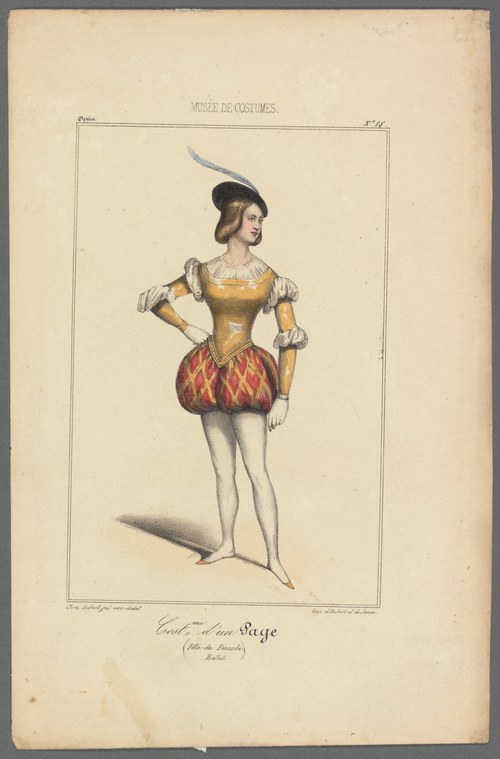
Costme. d'un page (Fille du Danube. Ballet)
Unknown artist
- Collection:
- Prints depicting dance
- Source:
- New York Public Library
- Rights:
- Public domain — free to use, share and adapt.
- Recorded as:
- Public Domain
As a costume document from the height of Romantic ballet, this plate reveals what the stage looked like and how supporting characters were visualized—information that survives primarily in these printed records, since the ballets themselves are known mainly through choreographic notation and description. For historians and dancers, such plates are primary sources for understanding the aesthetics, silhouettes, and theatrical conventions of the period.
What you are looking at
A single figure in theatrical costume stands in a three-quarter pose against a plain background, facing left with head turned toward the viewer. The dancer wears a golden-yellow fitted bodice with short puffed sleeves and a striking balloon skirt in red and gold flame-like patterns that flares dramatically from the waist. The skirt's volume and shape suggest the dancer is caught mid-movement, with the fabric billowing outward. Pale stockings and pointed shoes complete the outfit. A small feathered hat or plume sits atop the head. The figure's stance is elegant and controlled, with one hand placed on the hip and the other arm relaxed at the side, suggesting the poise of a trained stage performer. The composition is a simple full-length portrait rendered with delicate hand coloring over an engraved or lithographed base.
The dancing
The dancer stands in a relaxed but poised contrapposto, weight seemingly on one leg, with arms framing the body asymmetrically—the upstage hand on the hip and the downstage arm hanging naturally. The posture reads as a between-movements position: neither fully extended in a developed attitude nor in a closed fifth position, but rather the kind of moment a dancer might hold for a curtsy or a stage introduction. The silhouette prioritizes the costume's volume, especially the dramatic skirt, over any display of technical footwork.
The dance depicted
This is a costume plate for a minor character—a page—in the Romantic-era ballet *La Fille du Danube* (The Danube's Daughter), a work that premiered in the 1830s during the height of Romantic ballet. The character appears to be a male page or young male dancer in service to a principal character, dressed in courtly pageboy attire with Romantic-era theatrical ornamentation. The pose and presentation are characteristic of costume documentation from this period: the figure is presented as a performer in an attitude of readiness or introduction, not in the midst of a virtuosic phrase. The costume—particularly the jewel tones, the puffed sleeves, and the decorative skirt—is typical of Romantic-era supporting roles that required theatrical presence and courtly comportment rather than extensive technical display.
How it was made
This is a hand-colored engraving or lithograph, a format standard for theatrical costume documentation in the 19th century. The base image—fine line work establishing the figure, drapery, and anatomical clarity—was created by the intaglio or lithographic process, then finished with watercolor or gouache to establish the costume's colors and subtle modeling. This technique allowed for rapid, relatively inexpensive reproduction and distribution of costume information to theater companies, dancers, and patrons across Europe. The delicate hand coloring suggests this is from a prestige publication rather than a quick working document.
About this work
This is a costume plate documenting a supporting character from *La Fille du Danube*, a Romantic-era ballet. The work belongs to the extensive tradition of 19th-century theatrical documentation in which each character's costume was recorded in a hand-colored print, often assembled into bound volumes or published as series. Such plates served multiple purposes: they provided a reference for costume makers and stage managers, advertised the spectacle and fashion of the production to the public, and created a visual record of a ballet's visual world. This particular print captures not just the dress but also the bearing and courtly grace expected of a page in a romantic ballet's narrative.
How to look at it
This is not an action shot but a presentation of costume and character type. The artist has chosen a moment of repose or readiness—the kind of pose a dancer would hold for a curtsy or during a character introduction scene. The flatness of the background and the frontal-to-three-quarter angle recall fashion plates and portrait engravings of the same era. Notice the extreme volume of the skirt relative to the dancer's frame; this balloon silhouette was a hallmark of Romantic-era theatrical fashion and would have created a striking visual impression on stage, especially in ensemble scenes or processional moments.
The artist
The artist is not recorded in the catalogue. However, the work belongs to a tradition of theatrical engravers and colorists who specialized in costume plates for Paris opera productions in the 1830s–1840s. Such artists worked from sketches by the stage designers or from live observation of dancers in costume and frequently did not sign their work; attribution is often lost. The quality of the engraving and coloring suggests a professional workshop engaged by the Opéra.
The period
The 1830s–1840s were the height of Romantic ballet in Europe. Ballets often drew on literary and folkloric sources—in this case, a Danube-set narrative—and featured Corps de ballet members and supporting roles in historically or fantastically costumed roles. Hand-colored theatrical engravings were a major form of public engagement with dance; they circulated widely, shaped audience expectations, and allowed the ballet to be 'consumed' as a commodity of images and fashion as much as of movement. This plate documents a moment when ballet was the dominant theatrical spectacle of Paris and across Europe.
Where it lives
The work is held in the New York Public Library's collection of prints depicting dance. It appears to have been part of a larger series of costume plates documenting productions at the Paris Opéra during the 1830s–1840s.
Dance in this work
Questions about this work
What is *La Fille du Danube*?
*La Fille du Danube* was a Romantic-era ballet, likely choreographed in the 1830s, that drew on folkloric and literary sources centered on the Danube river. Like many Romantic ballets, it featured a mix of principal dancers in leading roles and supporting characters in elaborate theatrical costumes. The ballet is now lost to active repertory, but prints like this one document its visual world.
Why was this character a 'page'?
In 19th-century Romantic ballet, pages, attendants, and courtiers were supporting roles that provided narrative context and visual spectacle without requiring extensive soloist technique. They typically danced in processions, ensemble formations, and character scenes. The pageboy costume here—with its ornate decoration and theatrical silhouette—signals a courtly or fantastical setting.
How were these costume plates used?
Costume plates served multiple purposes: they were references for seamstresses and wardrobe staff preparing costumes, souvenirs sold to theater patrons and dance enthusiasts, and promotional materials advertising the spectacle and fashion of a production. Collected in albums or bound volumes, they also created a visual archive of the ballet as a spectacle.
What can this tell us about how the ballet was danced?
The pose—relaxed, elegant, and courtly rather than virtuosic—suggests that supporting roles like the page emphasized theatrical presence, good carriage, and participation in ensemble formations over technical display. The costume's volume and ornamentation would have been the focus on stage, which is why the plate prioritizes the silhouette over anatomical clarity.
More dance artwork





