49 works in this view — arrow keys or swipe to move between them.
Dance in Art
Lola has come
Unknown artist
- Collection:
- Prints depicting dance
- Source:
- New York Public Library
- Rights:
- Public domain — free to use, share and adapt.
- Recorded as:
- Public Domain
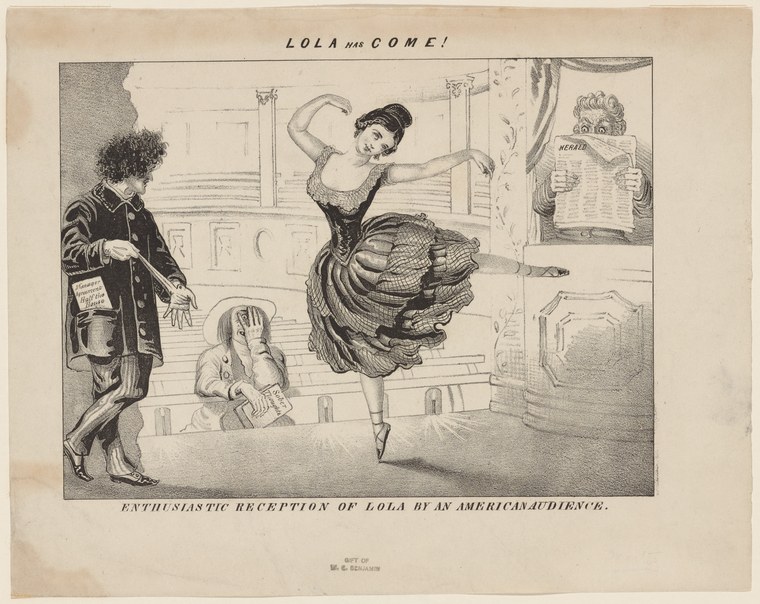
Lola Montez was one of the first modern dance celebrities, and this print captures how she was marketed and perceived—as a figure of danger, exoticism, and erotic allure rather than as a classically trained dancer. The engraving documents the 19th-century celebrity apparatus and the role of popular prints in shaping public fascination with performers, especially women who challenged Victorian norms.
What you are looking at
A theatrical scene of mid-19th-century ballroom society captures the moment when a celebrated dancer—identified in the title as Lola—arrives at an elegant interior. The composition is divided between foreground action and background spectacle. In the center, a woman in an elaborate dark dress with voluminous skirts executes a dramatic pose, one arm raised gracefully overhead, the other extended, her body in a fluid contrapposto. To the left, a fashionably dressed gentleman in a patterned coat and curled hair observes, holding what appears to be a printed announcement or playbill. At lower left, a young child sits on the floor, gazing upward at the spectacle. The background reveals a grand room with classical columns, draped curtains, and what appears to be an elaborate headdress or theatrical crown visible in an inset portrait at upper right. The engraving employs sharp hatching and fine line work to establish depth and convey the luxurious textures of silk, velvet, and ornament. The title—"Lola has Come!"—and the subtitle "Enthusiastic Reception of Lola by an American Audience" make explicit that this documents the arrival and reception of a specific celebrity performer.
The dancing
The central dancer's posture suggests a moment of display rather than technical footwork: her body is upright and slightly arched, with one arm raised in an attitude of presentation and the other gesturing outward. The pose is balletic in its grace and asymmetry, with her weight appearing concentrated as she stands in her voluminous costume. Her male companion is static, his attention directed toward her, establishing a clear hierarchy of motion and spectacle. The child's seated position creates a compositional base and emphasizes the adult audience's absorbed attention.
The dance depicted
This image documents the theatrical reception of Lola Montez, the Irish-Spanish dancer and courtesan who became an international celebrity in the 1840s–1850s. Montez was famous for her bold, sensual dances—particularly the "Spider Dance," in which she performed with live spiders on her costume—and for her defiance of Victorian propriety. The engraving captures not her in the act of dancing but in the moment of her arrival or announcement, emphasizing her status as spectacle and cultural phenomenon rather than a skilled technician of any particular dance style. The pose suggests the theatrical presentation and posturing rather than the athletic execution of structured choreography.
How it was made
This is an engraving, executed with fine cross-hatching and careful line work typical of mid-19th-century reproductive printmaking. The technique allows for sharp definition of facial features, textile patterns, and architectural detail, and produces a print suitable for wide circulation through newspapers, journals, and bound collections. The skill of the engraver is evident in the graduated tones created through varying densities of parallel lines, particularly in the rendering of the dancer's elaborate costume and the spatial recession of the ballroom.
About this work
This is a satirical or documentary engraving recording the sensation caused by Lola Montez's arrival in America, likely in the early 1850s. It captures a moment not of choreographed dance but of theatrical celebrity—the performer presented to an admiring (or titillated) public. The work sits at the intersection of theatrical history, celebrity culture, and social commentary; it documents both a specific historical figure and a broader 19th-century fascination with the female dancer as spectacle, transgression, and embodiment of Continental sophistication. For students of dance history, it records how Montez was received and imagined in the American imagination: not as a ballet technician but as a bold, controversial performer whose presence alone was considered remarkable and worthy of reproduction.
How to look at it
Observe the moment the engraver chose: not a leap or pirouette, but a moment of static presentation and display. Notice how the composition directs all attention toward the central figure—the gentleman's gaze, the child's upward look, the architectural framing—and how the title and subtitle establish this as a document of reception and social reaction rather than of choreographic skill. The elaborate costume and the theatrical pose emphasize presentation over technique.
The artist
The artist is not recorded. The print was published as a popular satire or news engraving, likely in a periodical or as a stand-alone sheet. The style and execution suggest a skilled reproductive engraver working in the mid-19th-century commercial print trade, producing images for a broad middle-class audience.
The period
Lola Montez arrived in the United States in 1851 and became an immediate sensation, performing widely and scandalizing American society with her bold dances and openly transgressive behavior. She embodied a figure that fascinated and repelled Victorian audiences: the European courtesan-performer, sexually liberated and artistically audacious. The 1850s saw an explosion of lithographic and engraved prints documenting theatrical celebrities and social spectacles, distributed through illustrated newspapers and periodicals. This image belongs to that moment of mass-market interest in theater, celebrity, and the female dancer as cultural symbol.
Where it lives
The print is held in the NYPL's collection of prints depicting dance. It is catalogued with minimal metadata, reflecting the status of popular theatrical prints of the period, which were produced in quantity for periodical publication and ephemeral consumption.
Dance in this work
Questions about this work
Who was Lola Montez?
Lola Montez (1818–1861) was an Irish-born dancer and actress who became an international celebrity in the 1840s–1850s. She performed across Europe and America, becoming famous for her scandalous personal life, her bold and sexually suggestive dances (including the notorious "Spider Dance"), and her refusal to conform to Victorian propriety. She was as much a celebrity for her notoriety as for her dancing.
What does this engraving actually show?
It documents the moment of Montez's arrival or announcement to an American audience, rather than an actual performance. The scene is theatrical and satirical, emphasizing her status as spectacle and sensation rather than capturing her in the act of dancing. The composition foregrounds public reception and the attention of her viewers.
Why was Lola Montez controversial?
She was a woman who lived as an independent performer, took multiple lovers publicly, refused to marry for propriety, and danced in ways that emphasized sensuality and physical risk rather than technical refinement. She represented everything Victorian society officially condemned in a woman while simultaneously making her an object of fascination and commercial success.
What does the Spider Dance have to do with this image?
The Spider Dance was Montez's most famous routine, in which she pretended to discover and remove spiders from her costume, implying undressing and physical contact with her body. It became legendary and is what many Americans associated with her name, even if they never saw it performed. This engraving capitalizes on that celebrity, even if it does not depict the dance itself.
More dance artwork





