49 works in this view — arrow keys or swipe to move between them.
Dance in Art
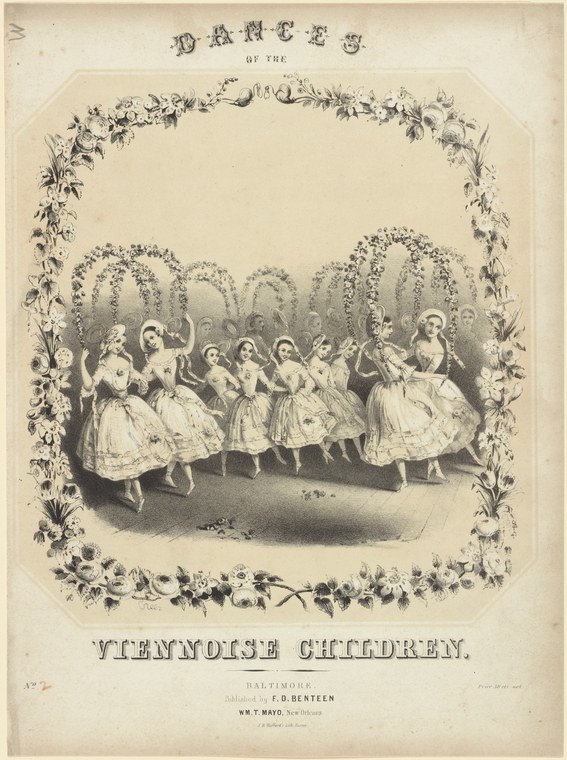
Dances of the Viennoise children
Unknown artist
- Collection:
- Prints depicting dance
- Source:
- New York Public Library
- Rights:
- Public domain — free to use, share and adapt.
- Recorded as:
- Public Domain
This print is direct evidence of how children were trained and presented as ballet dancers in mid-nineteenth-century Vienna, capturing both the costumes and the choreographic conventions of Romantic ballet performance. It also documents the circulation of dance imagery through the commercial print market, showing how theatrical spectacle was made portable and affordable for urban audiences. For historians of dance, childhood, and Romantic aesthetics, the image reveals the continuities between elite European ballet and regional or student performances.
What you are looking at
A lithograph showing a group of young female dancers arranged in a semicircular formation within an ornamental wreath of flowering vines. The dancers wear pale, full-skirted tutus with fitted bodices and are positioned in a line that curves gently across the composition, creating a sense of collective movement and harmony. Each figure stands in a similar pose with arms raised or positioned gracefully at the sides, their bodies angled to suggest synchronized motion. The setting is theatrical and dreamlike: the dancers appear to float against a soft, neutral background with minimal spatial definition, emphasizing the decorative and formal arrangement over naturalistic representation. The enframing botanical border—elaborate and densely detailed with climbing flowers and foliage—reinforces the romantic, idealized quality of the scene. The print shows the characteristic pale tonalities and soft gradations of hand-colored or naturally aged lithography, with the delicate figures rendered in fine detail against the ornamental frame.
The dancing
The dancers are arranged in a corps de ballet formation, each figure standing in nearly identical posture with arms raised or held at shoulder height in a classical port de bras. Their weight appears centered and poised, suggesting the upright carriage and turned-out legs central to ballet technique, though the full skirts obscure the lower leg positions. The line of dancers curves gently, creating visual unity; there are approximately eight to ten figures, all young and slender, their faces shown in profile or three-quarter view. The uniformity of pose and the synchronized arrangement suggest trained dancers executing a coordinated ensemble movement rather than individualized expression.
The dance depicted
The image depicts Romantic ballet, most likely a corps de ballet scene from the 1840s–1850s European theatrical tradition. The pale tutus, the ethereal quality of the composition, and the massed arrangement of young female dancers are all hallmarks of the Romantic ballet idiom that dominated Paris and Vienna during this era. The title "Dances of the Viennoise Children" suggests this may represent a Vienna-based children's or student ballet troupe, performing in a style that echoed the great Romantic works. The emphasis on uniformity, grace, and the dreamlike floral frame places this firmly within theatrical ballet rather than folk or social dance, though the specific ballet or choreography cannot be identified from the image alone.
How it was made
This is a hand-colored or printed lithograph, established by the soft tonal gradations, the characteristic pale palette, and the fine detail in both the botanical frame and the figures. The decorative border—with its intricate vines, flowers, and scrollwork—is typical of 1840s–1850s European theatrical prints, which often used such ornamental framing to enhance the romantic and elevated status of the subject. The technique allowed for relatively affordable reproduction and distribution, suggesting this was a commercial print aimed at a general educated audience interested in theatrical subjects. The inclusion of publisher or location information (visible in the inscription at bottom) confirms this as a commercial theatrical print rather than an artist's unique work.
About this work
This lithograph documents a mid-nineteenth-century Vienna-based children's ballet performance, likely from the 1840s–1850s, celebrating the Romantic ballet aesthetic at the height of its influence. The image shows a corps de ballet—a line of young trained dancers in classical tutus, posed in synchronized formation within an ornamental floral frame that emphasizes the idealized, theatrical nature of the subject. The composition itself is a genre image: a record of what Viennese audiences might have seen when attending performances by the city's young ballet students or touring child performers. The work exemplifies how dance was documented and promoted in the nineteenth-century European print market, functioning as both theatrical promotion and as an object of aesthetic interest in its own right.
The piece matters because it offers concrete evidence of what children's ballet training and performance looked like in the 1840s–1850s Vienna: the costumes, the choreographic line, the theatrical presentation. It also reveals the visual conventions of the period—the Romantic emphasis on uniformity, grace, ethereality, and youth—and the commercial infrastructure that circulated dance imagery among a literate urban public.
How to look at it
Observe the uniformity and grace of the dancers' postures and the careful arrangement of the line into a gentle curve—this is the choreography, frozen. Note how the artist has rendered the lifted carriage, the poise, and the classical port de bras that define ballet training. Look at the faces: the dancers gaze downward or away in characteristic Romantic reserve, not toward the viewer, reinforcing the formal, staged quality. The ornamental frame itself is not mere decoration but part of the composition's meaning—it elevates the dancers into a realm of aesthetic beauty separate from everyday life, a core ambition of Romantic ballet.
The artist
The artist is not recorded, but the inscription indicates the print was published in Baltimore by E. D. Benteen. This suggests an American publication of a European ballet image, likely based on a European theatrical print or report of an actual Viennese performance. The style and execution are consistent with mid-nineteenth-century commercial lithography, a medium that enabled rapid dissemination of theatrical imagery across the Atlantic.
The period
This print dates to the height of the Romantic ballet era in Europe, a period (roughly 1830–1860) when ballet became a dominant theatrical form focused on the female body, ethereal movement, and romantic narratives. Vienna was a major center for ballet during this time, with performances by leading European dancers and the cultivation of local ballet schools. The depiction of young female dancers in massed formation reflects the ballet master's increasing interest in creating visual spectacle through synchronized ensemble work. The ornamental, decorative frame of the print itself reflects broader mid-nineteenth-century aesthetic interests in romantic nature and ornamental design. The 1840s–1850s also saw an expansion of commercial theatrical prints for consumption by middle-class audiences, both in Europe and America.
Where it lives
The print is held in the New York Public Library's Prints collection, part of a larger body of dance-related prints and theatrical imagery. It is a commercial lithograph published in Baltimore, likely circulating in the American market as documentation or promotion of European ballet performance.
Dance in this work
Questions about this work
Who were the Viennoise Children and where did they perform?
The catalogue provides no details of the troupe's identity or specific performance venues. The title suggests they were a children's or student ballet company based in or associated with Vienna, likely performing during the 1840s–1850s. Such troupes were common in major European cities, often attached to opera houses or independent theatrical ventures. This print may have been created to promote their performances or to commemorate a tour.
Is this Romantic ballet?
Yes. The pale tutus, the ethereal poses, the synchronized corps arrangement, the ornamental framing, and the title all point to Romantic ballet of the 1840s–1850s. This was a period when ballet emphasized female grace, unity, and idealized beauty, often set in fantastic or dreamlike narratives. The image captures the visual aesthetic that defined the era.
Why is the frame so elaborate?
The ornamental floral border was standard for mid-nineteenth-century theatrical prints, particularly those celebrating dance or female performers. The frame serves multiple purposes: it elevates the subject into the realm of fine art, it signals luxury and good taste to potential buyers, and it physically separates the dancers from the everyday world, reinforcing Romantic ideals of art as transcendent beauty.
How do we know this is a lithograph?
The soft tonal gradations, the pale palette, the fine detail in both the figures and the ornamental border, and the characteristics of hand-coloring or natural aging are all consistent with nineteenth-century lithography. The inclusion of a publisher's mark (Baltimore) and the aesthetic conventions of the medium confirm this. Lithography was the dominant technology for theatrical prints during this period, allowing for affordable reproduction and distribution.
More dance artwork





