49 works in this view — arrow keys or swipe to move between them.
Dance in Art
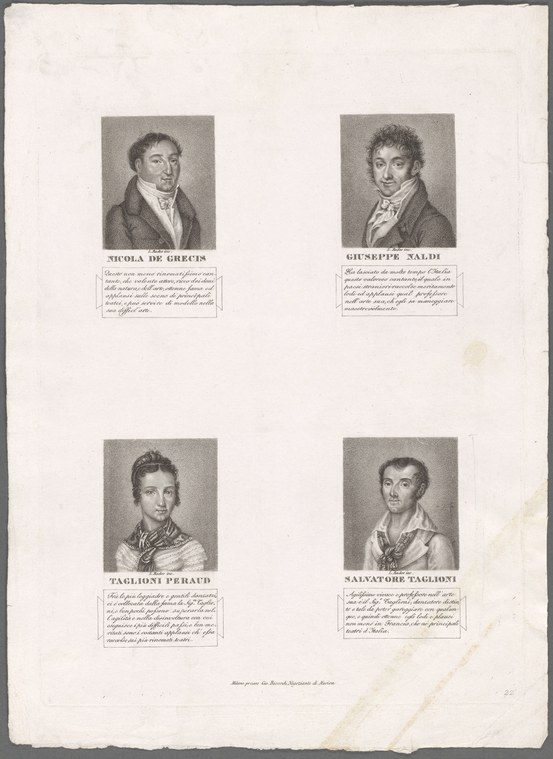
Nicola de Grecis; Giuseppe Naldi; Taglioni Peraud; Salvatore Taglioni
Unknown artist
- Collection:
- Prints depicting dance
- Source:
- New York Public Library
- Rights:
- Public domain — free to use, share and adapt.
- Recorded as:
- Public Domain
This engraving preserves the faces and names of dancers whose performances shaped the Romantic ballet revolution but whose own dancing technique can now only be inferred from written accounts and the choreography that survives. Salvatore Taglioni's role in his daughter Marie's career and the emergence of the Taglioni dynasty makes this a crucial document of family networks in nineteenth-century dance. The work also testifies to a shift in how dance artists were promoted and memorialized in the early 19th century: as celebrity faces whose individual identity mattered as much as their physical art.
What you are looking at
This is a composite engraving showing four portrait busts of male dancers, each identified by name in Italian capitals below. The figures are arranged in a two-by-two grid on a single sheet. Each occupies a rectangular frame approximately 4 by 5 inches. The men wear the formal dress of the early 19th century: fitted jackets with high collars, cravats, and carefully arranged hair in the Romantic era style. The rendering is in the neoclassical engraving manner—fine cross-hatching creates subtle modeling of the face, neck, and shoulders, while the backgrounds remain plain. The portraits are head-and-shoulders only, showing no dance posture or movement. The inscriptions below each portrait are in italic script and appear to include biographical or professional information, though the text is too small to read clearly in reproduction. The overall effect is of a gallery of celebrity dancers, presented with the formality and dignity accorded to major theatrical stars of their time.
The dancing
The four subjects are presented in a standardized portrait format showing only the head, neck, and upper torso. No arms, hands, or body posture are visible. Each man is turned slightly, showing three-quarter view rather than full profile. The engraver has attended to the individual features of each face—Naldi appears heavier-set, while Salvatore Taglioni has a narrower face—but the formal dress and plain backgrounds prevent any sense of movement or dance character. The portraits convey authority and celebrity status through their presentation alone, not through physical demonstration of dance skill or style.
The dance depicted
These are portraits of male dancers who were stars of European Romantic ballet in the first half of the 19th century. Salvatore Taglioni was the father of the celebrated dancer Marie Taglioni; the Taglioni name was synonymous with the Romantic ballet revolution. Naldi and the others named here were prominent soloists and partners of the era, performing in ballets that emphasized ethereal female dancers and supporting male virtuosos. The absence of any visible dance movement in these portraits—unlike some contemporary dance prints that show the body in action—suggests this is a commemorative or biographical gallery rather than a documentation of technique. The engraving format and formal presentation indicate these were likely published as part of a theater annual, collected prints, or biographical compendium, and would have circulated among dance enthusiasts and collectors who knew these dancers' reputations from live performance.
How it was made
This is an engraving, executed in the academic neoclassical style with fine parallel hatching to model form and tone. The technique allows sharp definition of facial features and the careful rendering of textile detail—the folds and weave of the jackets are precisely indicated. Engraving was the standard reproductive medium for theatrical portraiture in this period and allowed multiple impressions to be distributed. The plain backgrounds and standardized format suggest this is one plate from a larger series or publication; the line at the bottom of the sheet indicates a printed source attribution. As an engraving rather than a lithograph or woodcut, it implies a more expensive, longer-lasting, and more prestigious circulation, likely reaching educated audiences and serious collectors rather than the popular theater-going public.
About this work
This is a composite engraving of four celebrated male dancers from the Romantic ballet era of the early 19th century, presented as formal portrait busts in the neoclassical style. The figures are Nicola de Grecis, Giuseppe Naldi, Taglioni Peraud, and Salvatore Taglioni, men who were known throughout Europe for their virtuosity as partners and soloists in ballets that revolutionized the art form. The work is not a document of dance movement or technique, but rather a theatrical memorial—a gallery of celebrity that acknowledges these performers' importance through formal portraiture and careful engraving. It belongs in a dance gallery as evidence of how Romantic-era dancers were promoted, remembered, and canonized: not primarily through images of the body in motion, but through their status as stars whose faces and names were as important as their feet.
How to look at it
Study the faces closely: the engraver has individualized each portrait while maintaining a uniform format, suggesting both that these were distinct performers with recognizable features and that they belonged to a coherent professional community. The formal dress and three-quarter pose are the conventions of theatrical celebrity portraiture, derived from aristocratic portrait practice but applied here to commercial entertainers—a sign of the rising social status of prominent dancers. The inscriptions below each portrait would have been legible to the original viewers and would have provided biographical or career information that anchored these faces to lived reputation; without that text, the portraits are formally impressive but historically opaque. The plain background and absence of any dance reference force the viewer to recognize these as stars not through their bodies but through their faces and names—a radically different form of documentation than images showing dancers in movement.
The artist
The artist is not recorded. The engraving style and the subject matter suggest a professional theater or music publisher's workshop, likely Italian or based in a major Italian dance center such as Milan or Rome, where such commemorative prints were regularly produced and sold to dance enthusiasts. The careful execution and the prestige of the subjects indicate a skilled reproductive engraver working for a publishing house of some standing.
The period
This engraving dates to the era when Romantic ballet was establishing itself as the dominant form of European dance. Marie Taglioni's Paris Opéra debut was in 1832, and her innovations in pointe work and ethereal characterization revolutionized the art form during the 1830s and 1840s. Male dancers during this period were increasingly relegated to supporting roles—partners and character dancers—even as the technical demands on them remained extreme. The emphasis on the male dancer's face and celebrity status in this print reflects a moment when male stars still commanded significant attention, though their theatrical roles were being reshaped by the dominance of the female dancer. The formal, neoclassical engraving style reflects a transitional aesthetic: the academic finish of earlier portraiture applied to subjects who embodied the Romantic revolution.
Where it lives
The holding collection is noted as 'Prints depicting dance' at the New York Public Library. The source attribution line at the foot of the sheet indicates this is from a larger publication or series, likely a theater annual, biographical compendium, or collected prints of notable dancers. The object is a single-sheet engraving, part of a circulation practice in which individual portraits and scenes were issued separately or in bound volumes for collectors.
Dance in this work
Questions about this work
Who was Salvatore Taglioni?
Salvatore Taglioni was a celebrated male dancer and choreographer of the early 19th century, best known as the father of Marie Taglioni, whose innovations in Romantic ballet (especially the use of pointe shoes) revolutionized the art form in the 1830s–40s. Salvatore was himself a leading dancer of his generation and worked across major European ballet centers. He also served as a choreographer and teacher, shaping the next generation of dancers.
Why are there no images of these dancers actually dancing?
Dance portraiture in this period took two forms: formal celebrity portraits (like this one) and narrative or staged scenes showing dancers in character or in action. The choice of formal bust-length portraiture here reflects the intention to create a commemorative or biographical gallery emphasizing the dancers' individual celebrity and prestige. Such prints were sold to collectors and enthusiasts who already knew these dancers' work from live performance and wanted to own their likenesses.
How do we know what kind of dance these men performed?
The dating, the names, and historical records of their careers establish that these were Romantic ballet dancers. But the engraving itself shows us nothing of their technique or style—no pointe shoes, no turnout, no dramatic posture. We depend on written accounts, surviving choreography, and visual documents that explicitly depict these dancers in performance to know how they actually moved.
What makes this an important historical source if it doesn't show dance?
It is important precisely because it shows how Romantic dancers were promoted, remembered, and valued as individuals and celebrities. The choice to honor these men through formal portraiture, the investment in skilled engraving, and the circulation through print networks all testify to their cultural status. The work is a document not of dance itself but of how dance stardom was constructed and commodified in the early 19th century.
More dance artwork





