49 works in this view — arrow keys or swipe to move between them.
Dance in Art
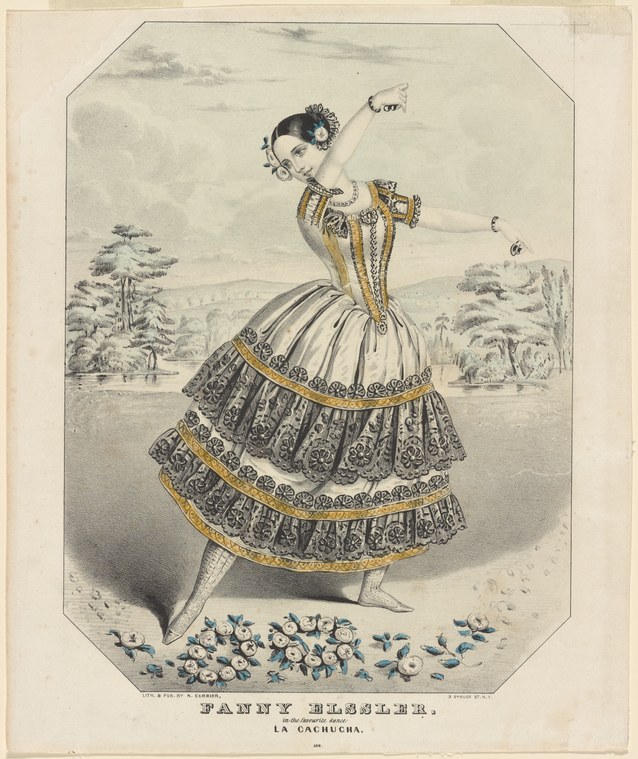
Fanny Elssler in the favorite dance La cachucha
Unknown artist
- Collection:
- Prints depicting dance
- Source:
- New York Public Library
- Rights:
- Public domain — free to use, share and adapt.
- Recorded as:
- Public Domain
Fanny Elssler was one of the two most famous dancers of the Romantic age, rivalling Marie Taglioni, and *La Cachucha* was the role that defined her brand—a demonstration of technical brilliance and seductive charm in a costume that promised both authenticity and fantasy. This print is a primary document of how the Romantic ballet was imagined, circulated, and consumed by the public; it shows us what audiences wanted to see and what the dancer was willing to be.
What you are looking at
A female dancer in theatrical costume stands alone in a landscape, captured mid-movement in a three-quarter pose that displays the full extent of her dress. She wears a fitted bodice with short, heavily decorated sleeves in gold and dark patterning, and a voluminous skirt comprising multiple tiers of white material separated by bands of ornate dark fabric trimmed in gold. The skirt is caught in mid-twirl, creating a dramatic bell shape that extends to mid-calf, revealing pale tights and flat ballet slippers. Her arms are raised—one extended upward with a small object (possibly a castanets or fan) in hand, the other extended sideways—in an attitude of joyful display. Her dark hair is arranged in an elaborate upswept style. The setting is a romanticised landscape with distant mountains, scattered trees, and flowering plants in the foreground; the entire composition is rendered in sepia tones typical of 19th-century hand-coloured prints. The framing is intimate and celebratory, designed to showcase both the dancer and her costume as objects of admiration.
The dancing
A single dancer in a balletic stance with weight shifted onto one supporting leg, allowing the torso to tilt and the opposite leg to extend or lift. Her raised arms and upward gaze suggest elevation and exuberance rather than technical constraint; the posture reads as a moment of display and pleasure rather than formal classical alignment. The costume—with its short sleeves, tiered skirt, and fitted bodice—allows full visibility of the body's line and the legs. The dancer appears to be en demi-pointe or flat-footed rather than on full pointe, and the overall frame is open and expansive, oriented toward the viewer as much as toward the imagined space of performance.
The dance depicted
This is Fanny Elssler, the celebrated Austro-Italian dancer, performing *La Cachucha*, a Spanish-inflected solo that became her signature vehicle in the 1830s–1840s. The print records not the literal Spanish folk dance but the Romantic-era theatrical version created for her: a vehicle for brilliant footwork, flirtation, and national colour. Elssler was famous for her vivacity, technical precision, and sensual presence—qualities this image captures through her raised arms, animated posture, and the prominence given to the skirt and legs. The costume, with its Spanish decorative vocabulary, signals the exotic nationalism of Romantic ballet, in which European dancers performed stylised versions of non-European dances as markers of adventure and otherness.
How it was made
This is a hand-coloured engraving or lithograph, a reproductive print designed for mass circulation. The fine linear work, subtle tonal gradation, and capacity for registration of detail suggest engraving; the medium allowed this image of Elssler to reach theatregoers, collectors, and the curious public well beyond those who could attend a live performance. The hand-colouring—visible in the gold leaf and sepia wash—indicates a luxury product, but one affordable to middle-class households. Such prints were common merchandise in the 1830s–1840s, sold in print shops and theatre lobbies, and served as both souvenirs and promotional material.
About this work
This is a portrait of Fanny Elssler at the height of her fame, dancing the role that made her a star: *La Cachucha*. The print captures not a literal transcription of the choreography but the image of the dancer herself—her grace, vivacity, and the visual spectacle of her costume. It is both artwork and commodity, designed to circulate the dancer's likeness and to fix in memory a performance that was itself ephemeral. For historians of dance, it documents the cult of the ballerina in the Romantic era, the allure of national exoticism in early 19th-century theatre, and the technologies by which celebrity was manufactured and distributed before photography.
How to look at it
Notice how the artist has frozen the dancer in a moment of display rather than of technical exertion: the arms are high and open, the torso is animated, and the gaze is direct and confident. This is not a moment of narrative drama or classical restraint, but of personality and charm—the dancer as performer and subject of desire. Observe how much of the composition is devoted to the costume, particularly the skirt: the tiers of fabric, the gold trim, the decorative patterning are rendered with almost as much detail as the dancer's body. This reflects the reality of Romantic-era theatre, where costume was as much a subject of aesthetic attention as the dancer herself. The landscape setting, though minimal, places the dancer in an imagined romantic space rather than on an actual stage—a convention of theatrical portraiture that blurred the line between the dancer as a person and the dancer as a character.
The artist
The artist is not recorded, but the print was likely made by one of the numerous reproductive engravers and lithographers working in Paris, London, or Vienna in the 1830s–1840s. Such prints were unsigned industrial products, made for publishers rather than for individual artistic credit. The quality of the image and the hand-colouring suggest a mid-range commercial workshop, not a hack job but not a fine-art print either.
The period
This print dates from the height of the Romantic ballet era (c. 1830–1850), when the female dancer became the central figure of theatrical attraction and when the ballerina's body—revealed by the shortening skirt and the adoption of pointe work—became the primary subject of art and commerce. Elssler rose to prominence in the late 1820s as an alternative to the ethereal, sylph-like Marie Taglioni; where Taglioni represented spirituality and weightlessness, Elssler represented vitality, earthiness, and sensual charm. *La Cachucha*, created for her in 1835, was a masterstroke: it allowed her to display brilliant footwork and Spanish-inflected rhythmic complexity while remaining within the bounds of theatrical propriety. The 1830s–1840s were also the moment when lithography and hand-coloured engraving became the primary media for celebrity portraiture and when theatrical performers began to be marketed as consumer goods.
Where it lives
This print is held in the New York Public Library's collection of prints depicting dance. It is an example of the ephemeral commercial graphics that circulated widely in the 19th century and that are now rare and fragile; many such prints were discarded or lost, making surviving examples valuable documents of theatrical history and material culture.
Dance in this work
Questions about this work
Who was Fanny Elssler and why was she important?
Elssler (1810–1884) was an Austro-Italian dancer who became one of the two most celebrated performers of the Romantic era, rivalling Marie Taglioni. Where Taglioni represented spirituality and ethereal beauty, Elssler embodied vitality, technical brilliance, and sensual charm. She became an international celebrity and toured Europe and the Americas, helping to establish the cult of the ballerina as a cultural phenomenon.
What was La Cachucha?
*La Cachucha* was a solo created for Elssler, likely by her choreographer Jean-Auguste Vestris, that combined Spanish-inflected rhythmic footwork with classical ballet vocabulary. It became her signature role and showcased her technical skill, musicality, and personality. The dance was not an authentic Spanish folk dance but a Romantic-era theatrical invention that used Spanish costume and style to signal exoticism and national colour.
Why was this kind of print made and who bought it?
Theatrical prints were made to commemorate performances and to promote dancers; they were sold in print shops and theatre lobbies as souvenirs. They were affordable to middle-class households and served as both mementos and advertisements. In an era before photography, such prints were the primary way the image of a famous performer could be circulated and consumed.
What does this image tell us about Romantic-era ballet?
It shows that Romantic ballet was centred on the female dancer as a spectacle of beauty, vivacity, and technical skill; that national exoticism and costume were central to the aesthetic; and that the dancer's body—particularly the legs and feet—was the primary focus of artistic attention. It also reveals that the Romantic ballet was not a purely artistic endeavour but a commercial enterprise, dependent on celebrity, marketing, and the circulation of the dancer's image.
More dance artwork





