49 works in this view — arrow keys or swipe to move between them.
Dance in Art
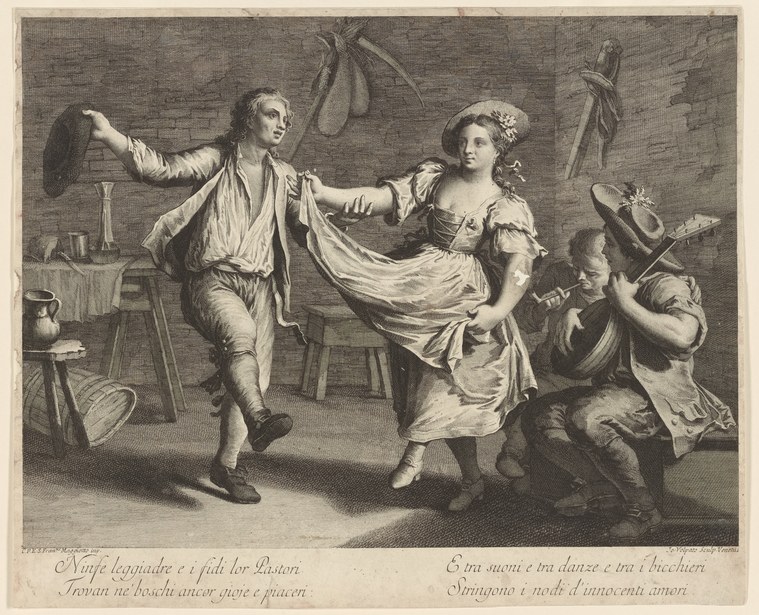
Ninfe leggiadre e i fidi lor pastori trovan ne' boschi ancor gioie e piaceri: e tra suoni e tra danze e tra i bicchieri stringono i nodi d'innocenti amori
Unknown artist
- Collection:
- Prints depicting dance
- Source:
- New York Public Library
- Rights:
- Public domain — free to use, share and adapt.
- Recorded as:
- Public Domain
For dance historians, this image preserves visual evidence of how early modern Europeans imagined and represented the dancing body in moments of social and erotic encounter—a mode of dance-making that was neither courtly formality nor rustic folk tradition, but rather a theatrical synthesis of both. The print's circulation and the care taken in its execution suggest that images of dancing figured prominently in how people of the period understood movement, desire, and social pleasure.
What you are looking at
A pastoral scene of courtship and celebration unfolds in what appears to be a rustic outdoor or garden setting. At center, a young man in classical drapery reaches toward a woman in an off-shoulder chemise, their bodies arranged in an attitude of flirtation or invitation to dance. She responds with a graceful turn, one arm extended. To the right, a cherub or putto plays pipes or a wind instrument, while another child-figure behind holds cymbals or a tambourine aloft. The ground is scattered with the implements of pleasure and hospitality: a wine pitcher and vessels suggest feasting; bundles of grain or dried plants hang in the background. The entire composition is suffused with a sense of pastoral ease and erotic promise—the text inscribed below speaks of nymphs and faithful shepherds finding joy in the woods, among music and dancing and innocent love.
The dancing
The central couple forms the compositional pivot. The man stands with his weight forward, one leg extended, torso turned toward the woman in an open, approaching stance; his draped cloak suggests rapid movement. The woman's posture is reactive but not resistant—her body angles away but her arm reaches back toward him, her head turned to regard him. Her shift and the way the fabric clings suggests movement already in progress. The putti are posed as attendants and musicians rather than dancers: one actively playing, one holding instruments aloft. The overall frame is one of invitation and response rather than formal partnering.
The dance depicted
This appears to represent a pastoral or mythological dance of courtship, likely informed by the commedia dell'arte and early modern theatrical traditions rather than a codified ballroom form. The setting and text suggest this is a recreational or amorous dance between shepherds and nymphs in an Arcadian landscape—a literary and visual trope of the 16th and 17th centuries. The open, pursuing posture of the man and the turning, evasive-yet-engaged response of the woman suggest a game of chase or advance-and-retreat that mimics the narrative of seduction. No formal dance technique is evident; the emphasis is on spontaneous gaiety and the expression of desire through the body.
How it was made
This is an engraving, identifiable by the parallel hatching lines that model form and create tonal gradation throughout the composition. The technique allows for fine linear detail in the drapery and the delicate features of the figures, and the print's modest scale and monochrome palette suggest it was designed for reproduction and circulation among a literate and cultured audience. The inscription in Italian at the base indicates the work was intended for a viewer who could read the textual frame alongside the image. The precision of the line work and the classical subject matter point to a print of the 16th or early 17th century, likely produced in Italy or the Italian-influenced regions of Europe.
About this work
This engraving documents a moment of theatrical or pastoral dance as it was imagined and performed in the early modern period—a genre scene that conflates mythological and rustic settings with the conventions of courtly entertainment. The work belongs to a rich tradition of prints that circulated knowledge of dance, music, and courtship among educated Europeans. It is neither a formal dance instruction manual nor a pure narrative illustration, but rather a hybrid image that uses the dance encounter as a vehicle for exploring themes of desire, nature, and civilized pleasure. The inscription grounds the image in a specific literary and philosophical tradition—the Arcadian fantasy of innocent pastoral life enriched by music and dancing.
How to look at it
Observe the arrested moment: the artist has caught the couple mid-encounter, with the man's approach and the woman's turning response still in dynamic tension. Note how the drapery—both the man's heavy cloak and the woman's light chemise—is rendered to suggest motion: the fabric billows and clings in ways that imply the bodies beneath are in the act of moving. The positioning of the putti as musician and instrument-holder frames this as a theatrical scene, not a naturalistic one; they are stage attendants rather than fellow dancers. The inscription should be read as part of the composition: the image illustrates and the text explains, together creating a narrative of Arcadian pleasure.
The period
The engraving belongs to the tradition of pastoral imagery that flourished in the 16th and 17th centuries, when Arcadian themes from classical literature were adapted into visual art, theatrical spectacle, and dance. This was the era of the court ballet in France and Italy, when nobles and rulers staged elaborate dances that drew on classical mythology and pastoral romance. Simultaneously, the commedia dell'arte and other forms of popular theater incorporated dance as a vehicle for comedy and courtship narratives. Prints like this one circulated models of dancing and courtship across borders and social classes, making them instruments of cultural transmission and refinement.
Where it lives
The work is held in the New York Public Library's collection of prints depicting dance. It appears in their catalogue as an undated, unattributed engraving, suggesting it is one of many such works acquired for their documentary and historical value rather than for attributional or market significance.
Dance in this work
Questions about this work
What dance is this showing?
The engraving does not depict a named or codified dance form, but rather a theatrical or pastoral encounter that incorporates dance as an expression of courtship and pleasure. It draws on the conventions of early modern entertainment—court ballet, commedia dell'arte, pastoral drama—in which dancing was a natural and frequent element of scenes involving courtship or seduction.
Why are there cherubs in a dance scene?
The putti (child-figures) serve as attendants and musicians, a convention inherited from Renaissance allegorical imagery. Their presence elevates the pastoral scene to a literary and philosophical register: they represent the divine or timeless quality of love, music, and dancing in Arcadian life.
Is this Italian or from elsewhere?
The inscription is in Italian, the subject matter (pastoral myth and courtship) is characteristic of Italian and Italian-influenced art, and the engraving technique and style are consistent with 16th or early 17th-century printmaking in the Italian peninsula or neighboring regions. Without a signature or documented provenance, the precise origin cannot be determined, but the cultural context is clearly Mediterranean and courtly.
More dance artwork





