49 works in this view — arrow keys or swipe to move between them.
Dance in Art
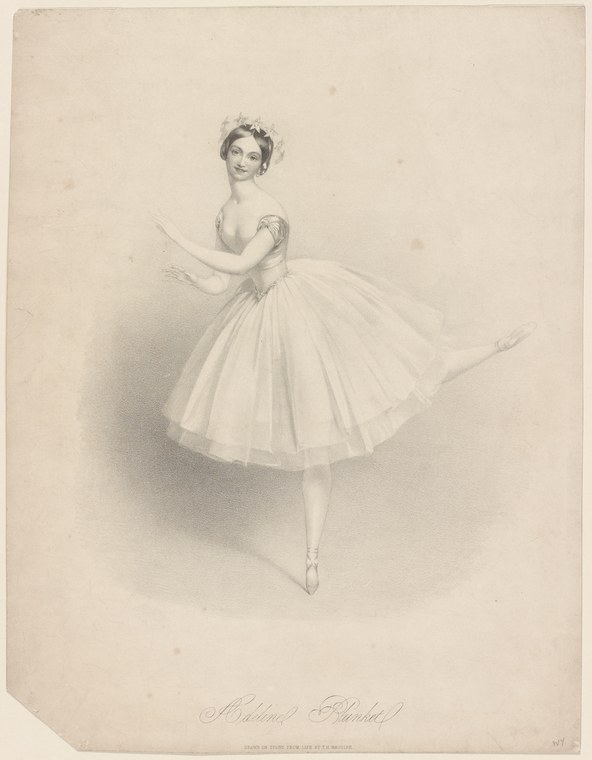
Adeline Plunket
Unknown artist
- Collection:
- Prints depicting dance
- Source:
- New York Public Library
- Rights:
- Public domain — free to use, share and adapt.
- Recorded as:
- Public Domain
This image documents the visual and bodily ideal of Romantic ballet at its height, showing not just the vocabulary of classical technique but the aesthetic and spiritual values the era attached to dancing women. It is evidence of how ballet was marketed, consumed, and remembered—through mass-produced prints that shaped public taste and created star personas.
What you are looking at
A single female dancer in a light, delicate pose against a plain cream background. She wears a white tulle tutu—voluminous and bell-shaped—and a fitted bodice with short sleeves. Her hair is crowned with what appears to be a wreath or decorative headpiece. She stands en relevé (on the balls of her feet), with one leg extended behind her in an arabesque or attitude, her torso turned gracefully to the side and her arms held in a soft, open frame. The pose captures a moment of sustained balance and elegance; her body is weightless and ethereal, emphasizing the delicacy and refinement expected of the Romantic era ballerina. The work is executed in fine pencil or graphite, with subtle shading to model the figure and suggest the transparency and volume of the tulle.
The dancing
The dancer's frame is classical and controlled: her weight is lifted through the supporting leg, her extended leg trails behind in a long, articulate line, and her arms are held softly away from her body in an open, expressive position. Her head is turned to gaze toward the audience, with chin slightly raised. The posture shows perfect alignment and turnout from the hip, characteristic of ballet of the period. A single dancer is isolated against a void, allowing the viewer to focus entirely on the precision and grace of the pose.
The dance depicted
This is a work of Romantic ballet, almost certainly from the mid-19th century. The tutu, pointe work, arabesque, and overall aesthetic are consistent with the classical vocabulary established in works like *La Sylphide* (1832) and *Giselle* (1841). The figure's ethereal, weightless quality—emphasized by the billowing tulle and the elevated pose—reflects the Romantic ideal of the otherworldly, supernatural dancer. Without attribution or inscription visible here, we cannot confirm the dancer's identity, though the naming of the print suggests this may be a portrait of a specific performer or a generalized study of the Romantic ballerina type.
How it was made
This is a lithographic print, identifiable by its linear clarity, the uniform tonal range, and the characteristic grain of stone-based reproduction. Lithography allowed for fine detail and broad circulation: such prints were produced in significant quantities and sold as souvenirs, portraits of celebrated dancers, and pedagogical images for aspiring dancers and the broader public. The medium's ability to render soft gradations of tone made it ideal for capturing the ethereal quality of the tulle and the subtle modeling of the figure. This is a mass-market image, not a unique work of art—a document of popular taste and the star system of 19th-century ballet.
About this work
This is a mid-19th-century lithographic portrait of a Romantic ballet dancer, most likely produced between the 1830s and 1860s. The image captures the visual and physical ideals of the era: ethereal beauty, weightless elevation, and refined classical technique. Such prints were commercial products, sold cheaply and collected by the public as mementos of celebrated performances and performers. The New York Public Library's holding of such works reflects the period's obsession with the ballerina as a visual commodity and a symbol of grace, artificiality, and refined femininity. The work belongs in a gallery of dance because it is both a historical document of Romantic ballet and an artifact of how dance was commodified, circulated, and consumed in the 19th century.
How to look at it
Notice the precise moment the artist has frozen: the dancer is neither ascending nor descending, but suspended in a moment of perfect stillness and control. The extended leg and lifted torso suggest effort held in check, the effortless floating that Romantic aesthetics prized. Observe how the artist has used the volume and lightness of the tulle to create a sense of buoyancy and otherworldliness—the skirt seems to move even in stillness. The isolation of the figure against a blank ground is not naturalistic but theatrical; it reflects the convention of ballet portraiture, which presents the dancer not as a person in a place but as an archetype or ideal.
The artist
The artist is not recorded. The print was likely produced by a commercial lithographic workshop in Paris or London, where such images were manufactured in bulk. Many such prints were unsigned or attributed only to the publisher, reflecting the industrial and collaborative nature of 19th-century print production. The quality of the draughtsmanship suggests a trained hand, but the work is typical of commercial portraiture rather than the work of a celebrated artist.
The period
The Romantic era in ballet (roughly 1830–1860) privileged the supernatural, the exotic, and the ethereal—expressed through the idealized figure of the sylph or spirit-woman, danced on pointe in a gossamer tutu. This aesthetic coincided with and was enabled by technical innovations: the development of the pointe shoe, the refinement of the tutu into a lighter, fuller form, and advances in gas and candle lighting that allowed for atmospheric dimness and spotlight effects. Lithography, which came into widespread use after 1820, democratized the circulation of images of celebrated dancers, turning performances into souvenirs and dancers into celebrities whose likenesses could be possessed and displayed. The print format also meant that these images shaped the expectations and aspirations of amateur dancers and the general public.
Where it lives
The work is held in the New York Public Library's *Prints depicting dance* collection, a curated assemblage of visual representations of dance across media and periods. The print's presence in this collection affirms its status as a document of dance history, not fine art.
Dance in this work
Questions about this work
Is this a portrait of a real dancer?
The catalogue record titles the work as 'Adeline Plunket,' which suggests it may depict a specific performer, but without a signature or inscription visible in the image, we cannot confirm the dancer's identity or whether she was a celebrated performer of the day. Many such prints were also sold as generic images of 'the Romantic ballerina,' not specific individuals.
When was this made?
The image is undated, but the style—the tutu design, the pointe work, the aesthetic—places it firmly in the Romantic era of ballet, most likely between 1830 and 1860. The technique and popularity of such lithographic prints peaked in the mid-19th century.
What dance is she doing?
The dancer is in an arabesque or similar sustained pose from the classical ballet vocabulary. There is no narrative or dramatic context; the image presents a moment of pure technique and grace, typical of ballet portraiture of the period.
Why is she on her toes?
Dancing en pointe was the hallmark of Romantic ballet technique and a visual marker of ethereal, otherworldly beauty. Pointe work became standard and codified during this era and remains central to classical ballet today.
More dance artwork





