49 works in this view — arrow keys or swipe to move between them.
Dance in Art
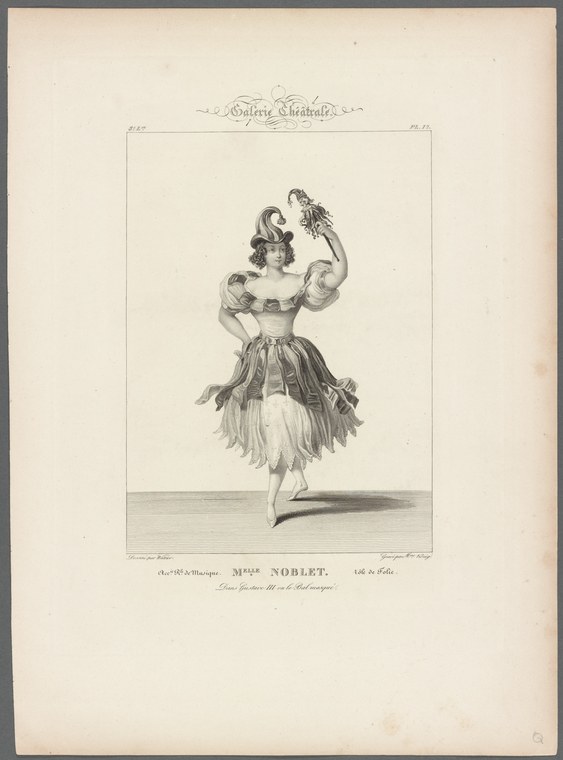
Melle. Noblet, rôle de Folie, dans Gustave III; ou Le bal masqué, Acc'ie r'le de musique
Unknown artist
- Collection:
- Prints depicting dance
- Source:
- New York Public Library
- Rights:
- Public domain — free to use, share and adapt.
- Recorded as:
- Public Domain
Noblet is a documented historical figure in Romantic ballet, and this print is a direct record of her performance practice and the visual spectacle of French opéra comique in the 1830s. The image shows us how theatrical character roles were costumed and posed for dramatic effect, revealing that early Romantic dance was not solely abstract classical ballet but a hybrid of pantomime, characterization, and virtuosity.
What you are looking at
A single female dancer stands in contrapposto against a plain ground, captured in a moment of theatrical display. She wears a richly layered skirt of white silk with deep pleats or flounces at the hem, topped by a fitted bodice with puffed sleeves in a darker fabric—likely the costume of a classical theatrical role. Her hair is styled elaborately, swept up and curled, in the Romantic era fashion. She holds a parrot or similar bird aloft in her raised right hand at shoulder height, displaying it with a gesture of presentation or triumph; her left arm hangs naturally at her side. The figure is rendered in fine engraved line work with careful cross-hatching for shadow, creating volume and a sense of the body's weight and poise. The composition is centered and frontal, emphasizing the dancer's silhouette and the sculptural quality of her pose.
The dancing
The dancer stands in a relaxed but alert vertical line, weight distributed evenly, the body upright and poised without obvious strain. Her right arm is raised and slightly bent, the hand at eye level holding the bird; this is a gesture of display rather than a technical dance position. The left arm hangs loosely, not engaged in any balletic frame or hold. The posture suggests a moment of pantomime or character acting rather than pure dance technique—the body is a vehicle for dramatic narrative rather than the demonstration of elevation or turnout.
The dance depicted
This print depicts Mademoiselle Noblet in the role of Folie (Madness) from Auber's opera-ballet *Gustave III; ou Le bal masqué* (*Gustave III; or The Masked Ball*), which premiered in 1833. Noblet was a leading Paris Opéra dancer of the Romantic era, and this image documents her performance in a specific theatrical rôle—not a pure classical ballet, but a character part within an operatic work. The costume and pose indicate a theatrical character dance of the period, blending elements of classical ballet training with dramatic pantomime, a common feature of French opéra comique and grand opéra of the 1830s. The bird is an attribute of the Folie character, symbolizing madness and caprice.
How it was made
This is a finely executed line engraving, likely made for theatrical documentation or commercial circulation among theatergoers of Paris. The technique—precise linear hatching and cross-hatching to model form—is characteristic of Parisian theatrical prints of the 1830s, a medium that allowed rapid, relatively inexpensive reproduction of stage images. Such prints were sold as souvenirs and advertisements for specific performances and dancers, serving as an early form of theatrical publicity and celebrity documentation. The inscription at the bottom credits the role, performer, and work, suggesting this was an official or semi-official record of a notable stage performance.
About this work
This engraving documents a specific moment in early Romantic opera-ballet: Mademoiselle Noblet's portrayal of the allegorical character Folie in Auber's 1833 *Gustave III*. It is a theatrical portrait as much as a dance image, capturing a performer in a named rôle rather than executing a named choreographic step. The print belongs to a rich tradition of Parisian theatrical prints that recorded the star dancers and singers of the Opéra, preserving their likenesses and roles for audiences who could not attend performances. These objects were both souvenirs and advertisements, circulating widely among the theatergoing public and helping to establish the celebrity of principal dancers in the early 19th-century French theater.
How to look at it
Notice the dancer's posture and the deliberateness of her gesture—this is not a moment of pure dance motion but a pose held for theatrical effect. The raised arm and the bird are narrative elements, not dance vocabulary. Observe also the costume details: the fullness of the skirt, the fitted bodice, and the elaborate hair are all indices of 1830s stage fashion. The engraving technique itself—linear, precise, almost sculptural—creates an idealized image of the performer, emphasizing her silhouette and formal beauty rather than capturing the fluidity of actual movement.
The period
The 1830s in Paris saw the emergence of Romantic ballet as a dominant theatrical form, with works like *La Sylphide* (1832) establishing new aesthetic values: ethereality, pointe work, the supernatural, and a new kind of leading female dancer. Simultaneously, the Opéra was producing grand opéras and opéras comiques that incorporated dance as one element among many—singers, dancers, and elaborate pantomime shared the stage. Mademoiselle Noblet and her peers were trained in classical technique but expected to embody character roles and dramatic narratives. The print medium itself was flourishing as a way to document and publicize these performers, making theatrical prints an important source of visual evidence for how early 19th-century dance looked in performance.
Where it lives
The print is held in the New York Public Library's collection of prints depicting dance. Such theatrical prints were produced in Paris and distributed widely; they document the performance practices and celebrity culture of the Parisian Opéra during the Romantic era.
Dance in this work
Questions about this work
Who was Mademoiselle Noblet?
Noblet was a leading French dancer at the Paris Opéra during the early Romantic period (1820s–1840s). She was known for both her classical technique and her skill in character roles. She performed in many of the defining works of early Romantic ballet and opera-ballet.
What is *Gustave III; ou Le bal masqué*?
It is a five-act opéra comique (comic opera) with music by Auber and a libretto by Scribe and Delavigne, which premiered at the Opéra-Comique in February 1833. Despite its title, it is not purely comic but a grand spectacular work with elaborate sets, costumes, and dance sequences. The plot involves political intrigue and assassination at a masked ball.
What does 'Folie' mean in this context?
Folie means Madness or Folly. In 18th- and 19th-century French theater, allegorical characters representing abstract concepts (Madness, Love, Fortune, etc.) were common. Folie as a character type would typically be portrayed as capricious, erratic, and playful, often appearing in divertissements or character scenes within larger works.
How were theatrical prints like this used?
Theatrical prints were sold in Paris as souvenirs of performances and as advertisements for upcoming productions. They were collectible items for theatergoers and helped to establish the celebrity and fame of principal dancers and singers. They were also a form of documentation, preserving images of specific performances and roles.
More dance artwork





