49 works in this view — arrow keys or swipe to move between them.
Dance in Art
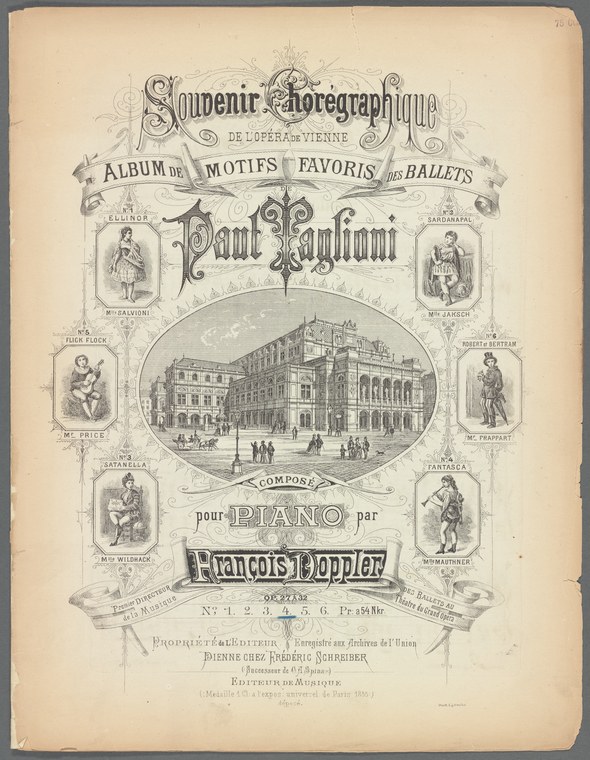
Souvenir chorégraphique de l'opéra de Vienne: album de motifs favoris des ballets [de] Paul Taglioni
Unknown artist
- Collection:
- Prints depicting dance
- Source:
- New York Public Library
- Rights:
- Public domain — free to use, share and adapt.
- Recorded as:
- Public Domain
This souvenir reveals how Romantic ballet was commodified and circulated beyond the opera house: through sheet music, character imagery, and architectural celebration. For dance historians, it documents both the international reach of Taglioni's choreography (Paul Taglioni was active in Vienna when this was made) and the role of published music in sustaining choreographic works in cultural memory and domestic practice.
What you are looking at
This is a decorative souvenir title page for a collection of piano arrangements based on ballet motifs from Paul Taglioni's works at the Vienna Opera. The composition is ornate in the style of 19th-century commercial music publishing: a large central engraving depicts the Vienna Opera House, a grand Renaissance Revival building with distinctive arcaded facades and rustication, shown in three-quarter view with small figures of pedestrians scattered in the plaza before it. The building occupies the visual anchor of the page. Surrounding this architectural centerpiece are eight oval vignettes arranged in a symmetrical border, each containing a figure in theatrical costume—dancers or opera characters in various poses and period dress. At the top and bottom are elaborate decorative ribbons and scrollwork bearing text. The overall effect is that of a celebratory document, asserting the prestige of both the Vienna Opera and Taglioni's choreographic legacy through the marriage of architecture, portraiture, and ornamental typography. The engraving is printed in black and gray tones on cream paper.
The dancing
The eight surrounding figures are depicted in individual ovals as static poses rather than dynamic dance positions. From what can be discerned, they wear Romantic-era theatrical costume—long skirts, fitted bodices, and period headdresses—typical of mid-19th-century operatic dress. The figures appear to represent different characters from Taglioni's ballets, each identified by name in small captions beneath. None are shown in active movement or in relation to one another; these are portrait-style presentations of roles or characters rather than depictions of dance technique or partnering. The poses suggest formal presentation rather than the capture of a movement phrase.
The dance depicted
This is a souvenir publication tied to the Romantic ballet repertory of Paul Taglioni, a major choreographer of the mid-19th century. Taglioni was the son of the legendary Marie Taglioni and followed in the Romantic ballet tradition, creating works for the Vienna Court Opera in the 1850s–1870s. The title specifies these are piano reductions of orchestral motifs—thematic material—from his ballets, arranged for domestic use. The image itself does not depict actual dance performance but rather celebrates the institutional and artistic status of that repertory through architectural grandeur and character portraiture. The work belongs to the culture of Romantic ballet fandom and the commercial circulation of choreographic music in the 19th century.
How it was made
This is a wood or steel engraving with typography—a common format for music title pages of the period. The fine linear detail and tonal modeling visible in the architecture and the figural vignettes are characteristic of engraving technique, which allowed precise, reproducible imagery suited to commercial printing in large editions. The page combines engraved pictorial elements with letterpress typography, typical of mid-to-late 19th-century music publishing. This hybrid technique made the document both visually ambitious and economically viable for a commercial publisher (the imprint reads 'Dierne chez Bédéric Schneider'), allowing wide circulation to amateur pianists and ballet enthusiasts.
About this work
This is a decorative cover or introductory page from a mid-19th-century published collection of piano arrangements of music from Paul Taglioni's ballets. It does not depict dance in motion but rather commemorates the Romantic ballet repertory through architectural representation and character portraiture. The Vienna Opera House dominates the composition, asserting the institutional prestige of the works, while the eight surrounding ovals present characters or roles from Taglioni's choreography in theatrical costume.
The work belongs to a broader 19th-century culture of ballet fandom and musical domesticity—the arrangement of opera and ballet scores for home performance by amateurs. It testifies to the enduring fame of the Taglioni family and the market for Romantic ballet imagery and music in the decades following Marie Taglioni's retirement.
How to look at it
Observe how the building, not the dancers, is the visual center of the composition. The eight surrounding portraits are secondary, presented as evidence or appendage to institutional prestige. The engraver has chosen to monumentalize the opera house rather than to illustrate choreography in action—a choice that reflects how Romantic ballet was marketed and remembered in print: through association with permanent institutions and famous roles, not through the documentation of movement. Notice the fine linear detail in the architectural rendering, which speaks to the technical virtuosity of engraving and the cost and care invested in this commemorative object.
The artist
The engraver is not recorded. The publisher is Bédéric Schneider, an active music publisher based in Paris during the mid-19th century. The work is part of a broader commercial ecosystem of music publishing and theatrical souvenirs that flourished during the height of the Romantic era.
The period
This work dates to the heyday of Romantic ballet, likely the 1850s–1870s when Paul Taglioni was actively creating works for European opera houses, particularly Vienna. The Romantic ballet had become not only a theatrical form but a major commodity: music was published in arrangements for home use, dancers' images were sold as lithographs and engravings, and operatic buildings became symbols of cultural capital. The Vienna Opera House itself (shown here) was completed in 1869, which may anchor the date. This was also the era in which ballet music was beginning to circulate independently from the stage, valued both as concert music and as nostalgic reference to celebrated choreography.
Where it lives
Held in the New York Public Library's collection of prints depicting dance. The item is a published music souvenir, likely issued in multiple copies for sale to the ballet-going public. The specific edition and date of publication are not recorded in the catalogue.
Dance in this work
Questions about this work
Is this an actual depiction of a ballet performance?
No. This is a decorative souvenir title page for a collection of piano music arrangements. It celebrates the Vienna Opera and Paul Taglioni's choreography through architecture and character portraiture, not through the representation of choreography in action. The eight surrounding figures are named characters from Taglioni's ballets, shown in static theatrical costume rather than in the midst of dancing.
Who was Paul Taglioni?
Paul Taglioni (1808–1884) was a major Romantic-era choreographer and ballet master, and the son of the legendary dancer Marie Taglioni. He created numerous ballets for European opera houses, including works performed at the Vienna Court Opera, where he served as ballet master. He was central to the dissemination of Romantic ballet across Europe and was celebrated during his lifetime through imagery, published music, and theatrical commemoration.
What are these piano arrangements?
These are reductions of orchestral music from Taglioni's ballets, arranged for solo piano. Such arrangements were a major commercial product in the 19th century, allowing amateur pianists to perform and relive music from celebrated stage works at home. They kept choreographic works culturally alive between performances and made ballet music accessible to a wider domestic audience.
Why show the Vienna Opera House so prominently?
The opera house was the institutional home of Taglioni's work and a symbol of cultural prestige. By placing it at the visual center, the publisher asserts both the legitimacy of the ballets (they belong to a great institution) and the status of the souvenir itself. The building was relatively new when this was likely published (completed 1869), making it a contemporary monument to the power of opera and ballet culture.
More dance artwork





