49 works in this view — arrow keys or swipe to move between them.
Dance in Art
Elisa Albert Bellon
Unknown artist
- Collection:
- Prints depicting dance
- Source:
- New York Public Library
- Rights:
- Public domain — free to use, share and adapt.
- Recorded as:
- Public Domain
Named theatrical portraits like this one are rare and valuable evidence of who danced in the early 19th century and how performers were promoted and remembered. The quality of the engraving and the care taken in depicting the subject's bearing and costume reflect the cultural significance of dance and dancers during the Romantic era. For historians and dancers, this image documents not just a named performer but the visual language through which dancers were marketed and celebrated to the public.
What you are looking at
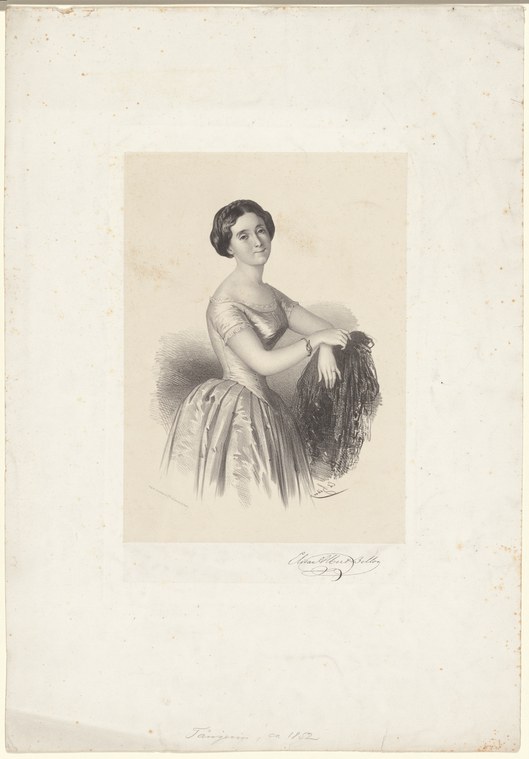
A young woman in a neoclassical or Romantic-era dress sits in three-quarter view against a plain background, her body turned to our left. She wears a low-cut, short-sleeved gown of pale fabric that falls to mid-calf, and her dark hair is arranged in the close-cropped style of the early 19th century. Her right arm rests lightly on her lap; her left arm is raised and bent, the hand relaxed near her shoulder. Most strikingly, she holds a large dark shawl or wrap in her left hand, its heavy folds falling dramatically across her body and trailing to the ground. Her posture suggests a moment of repose or contemplation, yet the arrangement of the shawl and the lift of her arm suggest readiness for movement. The composition is vertical and intimate, framed by a simple rectangular border.
The dancing
A single female figure occupies the composition. Her upper body leans slightly forward at the waist, with her weight settled on the seated position. The raised left arm, bent at the elbow, is held with ease and grace; the right arm is relaxed. The positioning of both arms—one elevated, one resting—creates an asymmetrical balance characteristic of Romantic-era portraiture. Her gaze is directed upward and to the left, away from the viewer, lending a sense of theatrical abstraction rather than direct address. The drapery of the shawl, held in her left hand, is rendered with careful attention to its weight and volume, suggesting familiarity with how fabric moves in dance and gesture.
The dance depicted
The subject and context suggest a professional or semi-professional performer, likely a dancer, caught in a moment that conveys both poise and potential movement. The raised arm, the carefully arranged drapery, and the formal yet graceful pose are consistent with early 19th-century theatrical dance, particularly Romantic ballet or theatrical performance. The shawl or wrap is a common prop in such works—a vehicle for expressing emotion and for creating flowing visual lines. However, the image does not freeze a moment of active choreography; instead, it presents a portrait of a dancer in a pose that references the elegance and emotional register of dance. The identity of the subject—Elisa Albert Bellon—suggests this is a portrait of a named performer, and the print's style and quality indicate it was intended for circulation, likely as a souvenir or promotional image of a celebrated dancer.
How it was made
This is a steel or copper engraving on paper, a medium well suited to the reproduction and distribution of theatrical portraits in the early 19th century. The fine, deliberate line work and careful modeling of light and shadow through parallel hatching are characteristic of intaglio printmaking. Engravings of this type were relatively expensive but durable, and they circulated among audiences as records of celebrated performers—a predecessor to theatrical photography. The quality of execution and the formal presentation suggest this was a commercial product of a professional print workshop, likely made for sale to theatre-goers and collectors of performance imagery.
About this work
This is a portrait engraving of a performer named Elisa Albert Bellon, presented in a style consistent with early 19th-century theatrical promotion. The woman is shown in a graceful, poised pose wearing the neoclassical dress of the Romantic era, holding a dramatic drapery that speaks to the aesthetics of theatrical performance. Though the image is not a depiction of active dance, it is fundamentally a dancer's portrait—a moment of composed elegance designed to commemorate a celebrated performer and circulate her image to admirers. The work sits within a rich tradition of theatrical prints that documented the stars of the Romantic stage, capturing not movement itself but the poise and presence that made dancers memorable.
How to look at it
Observe the pose as a composite of stillness and readiness: the raised arm and lifted gaze suggest a moment poised between repose and the possibility of movement, which is the signature of Romantic dance portraiture. Notice how the drapery of the shawl creates flowing lines that echo the principles of Romantic choreography—the emphasis on soft, sustained movement and emotional expression. The artist's choice to show the subject seated rather than in active dance allows us to see the refined posture and emotional inwardness that were valued in theatrical performance of the era. The formal border and the artist's signature at the base indicate this was a finished, saleable work, part of the machinery of theatrical celebrity.
The period
In the early 19th century, Romantic ballet emerged as a dominant theatrical form, with dancers celebrated as celebrities and their likenesses circulated via engravings and lithographs. The neoclassical dress depicted here—the Empire waistline, short sleeves, and Grecian simplicity—reflects the aesthetic preferences of the Romantic stage, which valued an idealized, ethereal femininity. Theatrical prints of named performers served as both souvenirs and promotional tools, allowing audiences to own an image of dancers they had seen perform and to engage in the emerging culture of celebrity. The careful rendering of fabric and the graceful, elongated pose reflect conventions of Romantic-era dance portraiture that emphasized elegance, refinement, and an almost otherworldly beauty.
Where it lives
The print is part of the New York Public Library's collection of prints depicting dance, categorized within their holdings of theatrical and performance ephemera. It is likely a commercial theatrical print from the early 19th century, produced for public sale and circulation.
Dance in this work
Questions about this work
Was Elisa Albert Bellon a famous dancer?
The image and inscription indicate she was a named performer whose likeness was considered valuable enough to engrave and sell to the public. This suggests she held some prominence in the theatrical world, though the precise details of her career are not evident from the print itself. Engravings were typically produced for celebrated performers who had achieved sufficient fame to warrant commercial circulation of their image.
Why is she holding a shawl?
Shawls and draperies were standard props in Romantic-era dance and theatrical performance, used both for movement and as visual embellishments. The folds of fabric allow the artist to demonstrate grace and elegance, and the shawl itself was a common element of costume and choreography. Holding the drapery allowed dancers to create flowing, expressive lines and to convey emotion through gesture.
Is this a depiction of an actual dance or moment?
This is a formal portrait pose rather than a representation of a specific choreographed moment. The pose is composed to suggest the elegance and refinement associated with Romantic dance, but it is not a freeze-frame of active dancing. Instead, it presents the subject as a dancer—emphasizing the grace, poise, and emotional sensitivity valued in the performer.
More dance artwork





