49 works in this view — arrow keys or swipe to move between them.
Dance in Art
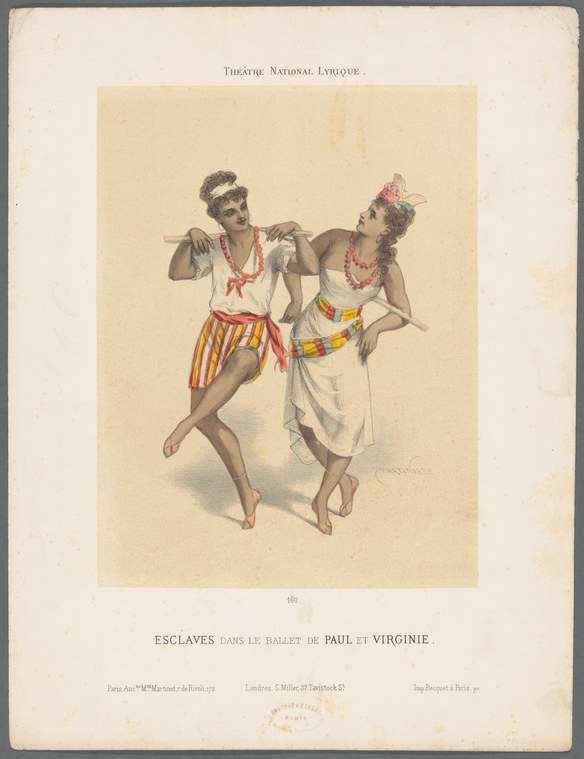
Esclaves dans le ballet de Paul et Virginie
Unknown artist
- Collection:
- Prints depicting dance
- Source:
- New York Public Library
- Rights:
- Public domain — free to use, share and adapt.
- Recorded as:
- Public Domain
This image is essential for understanding how early-19th-century European ballet used the bodies of dancers to perform colonial fantasy and racial narratives, and how theatrical spectacle participated in the cultural work of colonialism. For historians, it documents both the technical and ideological content of Romantic ballet; for dancers and choreographers, it reveals the uncomfortable genealogy of contemporary theatrical practice and the need to examine how bodies, costume, and narrative still carry these histories.
What you are looking at
Two dancers in exotic costume perform against a pale yellow background. The figure on the left wears a striped skirt in red and yellow with a red beaded necklace and white upper garment, positioned in a dynamic lunging pose with weight shifted forward and one leg extended behind. The figure on the right, dressed in white drapery with similar red beaded necklace and yellow-and-red hip band, leans back with arm raised, creating a diagonal line of energy between the two bodies. Both dancers have dark, styled hair adorned with decorative elements. The composition is frontal and symmetrical, staged as if for theatrical presentation, with no naturalistic setting—the figures exist as pure spectacle against the void of the background. The hand-coloring is delicate and carefully applied, with particular attention to the jewelry and fabric patterns.
The dancing
Both dancers exhibit high extension and dynamic weight shifts characteristic of trained performers. The male figure (left) demonstrates forward momentum with an extended rear leg and engaged core, while the female figure (right) counters with a reclining arabesque-like position, her arm raised and torso arched back. The spatial relationship between them—separated but visually connected through their gestures—suggests interaction rather than unison movement. Their bodies display the controlled flexibility and turnout expected of trained theatrical dancers, not casual movement.
The dance depicted
This is a scene from Paul et Virginie, a narrative ballet based on Bernardin de Saint-Pierre's 1788 novel, which was a significant work in early-19th-century French theater. The inscription identifies these figures as enslaved characters ("Esclaves") in the ballet. The work appears to document a theatrical spectacle where exotic dancers performed narrativized slavery, a widespread and deeply troubling practice in European romantic ballet of this era. The poses suggest classical training applied to a romanticized vision of colonial subjects, likely choreographed as part of a larger narrative ballet spectacle.
How it was made
This is a hand-colored lithographic print, as evidenced by the characteristic stippled tone, outlined forms, and applied watercolor wash. The printing technique allowed mass reproduction of theatrical imagery for urban audiences and souvenir circulation. The careful hand-coloring—applied unevenly in places, more saturated in the jewelry and borders—indicates this was a mid-range commercial product: not a unique painting, but more finished than a plain print. The technique was standard for European theatrical documentation of the 1820s–1840s.
About this work
This lithographic print documents a scene from the ballet Paul et Virginie, likely performed in Paris in the 1820s or 1830s. It shows two trained dancers in colonial costume performing a pas de deux or interaction scene, identified in the inscription as enslaved characters. The work is a primary document of European Romantic ballet's engagement with exoticism and colonialism—a practice now recognized as deeply problematic but historically significant for understanding how 19th-century theaters staged racial difference and narrative exploitation. The print demonstrates both the technical sophistication of classical training and the disturbing aestheticization of slavery that characterized this period of dance history.
How to look at it
Attend to the bodies first: these are trained classical dancers, demonstrating turnout, extension, and the kind of upper-body control associated with ballet technique. The theatrical framing—the frontal composition, the isolated figures, the costume specificity—marks this as documentation of a staged spectacle, not social dance. Notice the inscription's explicit identification of these figures as enslaved people: this labeling is the key to understanding how Romantic ballet audiences were invited to read these bodies and what narrative they were meant to illustrate. The dynamic interplay of the two figures suggests a choreographed relationship, but the romanticized styling obscures the violence of the representation.
The artist
The artist is not recorded in the catalogue, but the lithograph bears the mark of a professional Parisian theatrical print publisher—likely from the press of Martinet or a comparable operation that specialized in opera and ballet documentation. These prints were often created by atelier staff rather than named artists, and were produced to capitalize on successful productions by selling souvenirs to theatergoers.
The period
Paul et Virginie was a beloved subject across European culture, adapted repeatedly into dance, opera, and spectacle. The ballet version drew on the novel's tropical colonial setting to justify the inclusion of "exotic" choreography and costumes. The 1820s–1840s were the height of Romantic ballet's enthusiasm for orientalism and exoticism—a cultural moment when European theaters systematized the staging of non-European peoples and narratives as objects of visual consumption. The lithographic print technology was relatively new and enabled rapid circulation of such imagery, creating a feedback loop between theatrical performance and visual culture.
Where it lives
This print is held in the New York Public Library's collection of prints depicting dance. It is one of many theatrical prints circulated in Paris and beyond during the 1820s–1840s, documenting popular operatic and balletic productions.
Dance in this work
Questions about this work
What is the ballet Paul et Virginie?
Paul et Virginie was a narrative ballet based on Bernardin de Saint-Pierre's 1788 novel, a sentimental story of two foundlings raised together on the island of Mauritius. It was adapted into ballet multiple times in the early 19th century, with the most famous version choreographed by Jean Aumer (premiered 1806). The ballet was popular throughout Europe and was frequently revived and restaged, each version incorporating fashionable choreography and exotic spectacle to match audience taste.
Why were enslaved people depicted in European ballet?
Romantic-era ballet frequently incorporated representations of non-European peoples and colonial subjects as part of narratives set in exotic locations. These representations were rooted in European colonial fantasy and served to exoticize and aestheticize the world being colonized. Dancers, including European dancers in costume, performed these roles as part of the spectacle. This practice is now recognized as a foundational problem in ballet history—one that linked theatrical representation to the cultural justification of colonialism.
How were these prints made and distributed?
This is a hand-colored lithograph, a technology that enabled affordable mass reproduction. Parisian print publishers created these as theatrical souvenirs, selling them to audiences who had just seen performances. The prints circulated widely through commercial channels and were collected as mementos of popular entertainments, making them important documents of what performances actually looked like and how audiences understood them.
More dance artwork





