49 works in this view — arrow keys or swipe to move between them.
Dance in Art
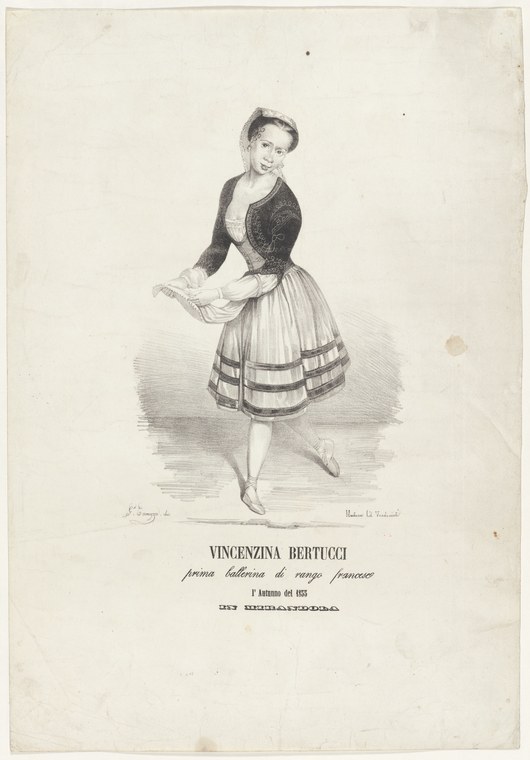
Vincenzina Bertucci, prima ballerina di rango francese, l'autunno del 1855, in Mirandola
Unknown artist
- Collection:
- Prints depicting dance
- Source:
- New York Public Library
- Rights:
- Public domain — free to use, share and adapt.
- Recorded as:
- Public Domain
This engraving is a rare documented image of a named Italian prima ballerina performing the Romantic ballet repertoire at a specific moment (autumn 1855). It provides concrete visual evidence of how a mid-19th-century dancer held her body, how she dressed, and what the theatrical presentation of ballet looked like outside France and Russia—knowledge that most records of Italian ballet from this period do not preserve. For historians of dance iconography, it exemplifies the convention of the isolated portrait of the celebrated dancer, a format that defined how audiences understood theatrical dance.
What you are looking at
A single female dancer is depicted in three-quarter view against a plain background, captured mid-performance in a moment of dynamic movement. She wears a dark corseted bodice with a fitted waist and a full skirt of pale material with three dark horizontal bands or flounces near the hem—a silhouette characteristic of mid-19th-century theatrical costume. Her posture is upright and alert, with one leg extended and the other bearing her weight, suggesting a moment of elevation or turning. The engraving is finely detailed, with careful cross-hatching to model the fabric's drape and the body's form. Her hair is arranged in the fashion of the 1850s, and her face shows the refinement typical of Romantic-era theatrical portraiture.
The dancing
The dancer stands in a controlled vertical alignment with a straight spine and lifted carriage. Her weight appears to be on one leg while the other is extended at an angle, suggesting either a développé or a preparatory position before turning. Her arms are held in a graceful frame, positioned to balance the upper body. The pose conveys both strength and elegance—the controlled ease expected of a trained theatrical dancer rather than the abandoned freedom of folk or social dance.
The dance depicted
This is a Romantic-era theatrical ballet dancer, almost certainly performing a character variation or solo rather than pure classical technique. The costume—corseted bodice with a full tiered skirt—and the moment of balanced elevation are consistent with the ballet vocabulary of the 1850s, when dancers performed variations from narrative ballets such as *La Sylphide* or *Giselle*. The specific tiered skirt construction was fashionable in Romantic ballet, falling between the shorter tutus of earlier decades and the full-length skirts of dramatic roles. Bertucci was a prima ballerina of the Italian school working in the mid-19th century, and this image documents her in a characteristic theatrical moment.
How it was made
This is an engraving, likely steel engraving given the fineness of the line work and the capacity to produce multiple impressions for distribution. The technique allowed for the wide circulation of theatrical imagery in the 1850s—prints like this one were sold to the public as souvenirs and records of celebrated performances. The artist has used fine parallel lines (cross-hatching) to model form and shadow, achieving subtlety in the rendering of fabric, skin, and the dancer's musculature. The inscription below suggests this was a commercial print made for the theatrical print market.
About this work
This is a mid-19th-century engraved portrait of the prima ballerina Vincenzina Bertucci, captured in a moment of Romantic ballet technique and costume. The print documents both the appearance and the movement vocabulary of Italian ballet in the 1850s, preserving a record of a dancer and a dance form in a specific historical moment. Such theatrical prints served as ephemeral mementos of performances, circulating among audiences and collectors and forming a crucial archive of how dance was seen and celebrated in the pre-photographic era. The work belongs to a rich tradition of ballet portraiture that extended from the Romantic period through the early 20th century.
How to look at it
Look at the position of the dancer's feet and the angle of her extended leg—the artist has chosen to freeze a moment of sustained elevation or turning, capturing the sense of control and lightness that was the Romantic ballet ideal. Notice how the engraver has rendered the tiered skirt: each band of fabric is distinct, catching light differently, which gives the impression of movement and volume even in a still image. The uprightness of the spine and the placement of the head are conventions of Romantic portraiture applied to dance—the dancer is presented as both a virtuoso and a lady of refinement, a social fantasy as much as a technical achievement.
The artist
The artist is not recorded, which is typical for commercial theatrical engravings of the period. Such prints were often produced by workshops or by staff engravers working for theatrical print publishers, with the focus on capturing the likeness and costume of the celebrated performer rather than on artistic signature. The inscription credits a publication or publisher rather than an individual artist.
The period
The 1850s were the height of the Romantic ballet era, though the movement was beginning to shift. *Giselle* and *La Sylphide* had established the syntax of Romantic ballet—the ethereal heroine, the supernatural encounter, the pointe work and the floating skirt—and these works dominated European stages. Italy maintained a strong ballet tradition distinct from the French and Russian schools, with dancers trained in the Cecchetti lineage. The theatrical print market was booming: lithography and engraving made images of celebrated dancers affordable and collectable, and actors and dancers were among the first celebrities to be mass-produced as prints. This engraving sits at the intersection of that commerce and the visual documentation of movement.
Where it lives
This engraving comes from the New York Public Library's collection of prints depicting dance. It is a commercial theatrical print, likely produced in Italy or France in the mid-to-late 1850s, part of the vast archive of dance portraiture that documented the era's most celebrated performers for a paying public.
Dance in this work
Questions about this work
Who was Vincenzina Bertucci?
Vincenzina Bertucci was an Italian prima ballerina active in the mid-19th century, trained in the Italian (Cecchetti) ballet tradition. Little detailed documentation of her career survives, but this print establishes that she was celebrated enough to be commemorated in a theatrical engraving in autumn 1855. She represents the Italian ballet world of the Romantic era, which was distinct from but contemporary with the French and Russian schools.
What does 'prima ballerina di rango francese' mean?
The inscription translates as 'prima ballerina of French rank,' indicating that Bertucci held the highest rank in the ballet hierarchy—equivalent to the rank used in French and international ballet establishments. This suggests either that she trained under the French system or that her company adopted French ranking conventions. It emphasizes her status as a leading dancer rather than a corps member or secondary soloist.
How do we know this is Romantic ballet and not another style?
Several visual markers identify this as Romantic-era ballet: the tiered skirt construction (characteristic of the 1850s), the pointe-ready posture and vertical alignment, the refined theatrical costume, and the moment of sustained elevation captured in the pose. The date and the Italian context also place it firmly in the Romantic period, when that aesthetic dominated European ballet.
What was the purpose of prints like this?
Theatrical prints served as souvenirs and promotional images for performances, sold to audiences and collectors. They functioned like modern theater programs or cast photos, preserving a record of celebrated dancers and allowing fans to own an image of their favorite performers. They were also distributed to other theaters and among dance professionals, serving as a network of visual information about contemporary dance and costume.
More dance artwork





