49 works in this view — arrow keys or swipe to move between them.
Dance in Art
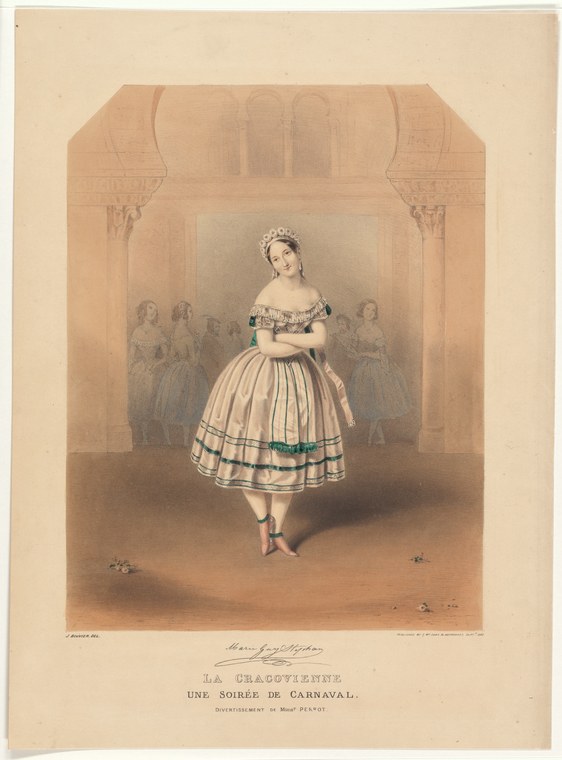
Marie Guy Stephan [facsimile signature]: La cracovienne, Une soirée de Carnaval, divertissement de Mons'r Perrot
Unknown artist
- Collection:
- Prints depicting dance
- Source:
- New York Public Library
- Rights:
- Public domain — free to use, share and adapt.
- Recorded as:
- Public Domain
The cracovienne was a signature divertissement of the Romantic ballet era, and this print preserves the image of one performance and one star in one of its canonical versions, choreographed by Perrot. For historians of Romantic ballet and its character dances, this is primary visual evidence; for dancers, it shows the costume, presentation, and theatrical context of a work that shaped the balletic vocabulary of the period.
What you are looking at
A young woman in a full, pale skirt with dark horizontal stripes stands alone in the center of a grand interior space, captured mid-performance. She wears an off-shoulder bodice and a tiara or decorative head ornament, her posture upright and dignified. The setting is an elegant hall with classical architectural features: arched doorways with coffered ceilings visible in the recessed background, and what appear to be columns or pilasters flanking the space. The background contains a shadowy audience of multiple figures in formal dress, barely articulated, watching from the darkness. The composition uses warm, muted tones—browns, tans, and pale creams—with dramatic lighting that isolates the dancer in a pool of visibility. Her position suggests a moment of stillness or preparation rather than active motion.
The dancing
The dancer stands in an upright, formal stance with her weight centered and her arms held softly at her sides or slightly forward. Her body is presented straight to the viewer with no twist or turn. The posture is one of presentation rather than active dancing—the moment before the dance begins, or during an interlude. Her figure is slim and elongated, consistent with early nineteenth-century silhouettes. No other dancers are visible; she is the sole focus, a solitary performer before an assembled audience.
The dance depicted
This is a representation of a romantic-era solo dance, likely a *cracovienne* (a polonaise-derived character dance with a Polish theme), as confirmed by the inscription. The cracovienne was a fashionable balletic divertissement in early nineteenth-century European theatre, often performed by prima ballerinas as a national character piece. The costume—the full skirt with dark trim, the off-shoulder neckline, and the tiara—is consistent with the Romantic ballet idiom of the 1830s-1840s. The image likely documents the costume and setting of such a theatrical moment rather than capturing mid-movement choreography. Monsieur Perrot was a celebrated choreographer of this era, known for creating divertissements and character dances for the stage.
How it was made
This is a hand-colored lithograph or tinted lithograph, a reproductive print technique that allowed wide circulation of theatrical imagery. The soft blending of tones, the delicate stippling of light and shadow, and the handling of the background architecture are characteristic of lithographic printing. The artist has used the medium to create atmospheric recession and focus attention on the solitary figure through selective illumination. This type of print was a standard vehicle for documenting and promoting theatrical performances and famous performers in the 1830s-1840s, circulated to the public and to theatre patrons.
About this work
This is a theatrical portrait print documenting a famous performance: Marie Guy Stephan in the title role of a cracovienne divertissement, a Polish-themed character dance choreographed by the legendary Monsieur Perrot for a carnival-season programme. The print captures not the movement of the dance itself but the presentation of the dancer in costume before her audience—the formal, almost ceremonial moment of theatrical display that was central to Romantic-era ballet. The work belongs in a dance gallery as evidence of how early nineteenth-century ballet was documented, promoted, and circulated; it is a record of a specific star, a specific choreographer, and the conventions of theatrical spectacle at a particular historical moment. The image is also a document of the cracovienne itself—its costume, its theatrical context, and its status as a fashionable balletic import from Eastern Europe.
How to look at it
The viewer should note the isolation of the figure—she is presented not in the midst of choreography but in a formal, nearly portrait-like stance, the moment of introduction or stillness. Attend to the costume: the full skirt with its horizontal stripes, the off-shoulder bodice, and the tiara are all markers of the Romantic-era balletic aesthetic and the national-character-dance tradition. The architectural setting is grand and formal, emphasizing the theatrical, official nature of the performance. The shadowy audience visible in the background grounds this as a theatrical event, not a study or an imagined scene. The print's light and shadow are key: the dancer glows against the darker background, a standard strategy in theatrical imagery to emphasize the performer.
The artist
The print credits a facsimile signature "Marie Guy Stephan," likely the dancer herself rather than the printmaker. The actual artist or lithographer is not named in the catalogue record. Theatrical portrait prints of this era were often published under the name of the performer rather than the printmaker, particularly when prints were sold as souvenirs or publicity images at the theatre or through commercial print dealers.
The period
The cracovienne emerged as a fashionable balletic divertissement in the 1820s-1830s, part of the broader Romantic fascination with national character dances and exotic (to Western European eyes) folk materials. Monsieur Jules Perrot (1810–1894) was one of the most celebrated choreographers of the age, known for creating precisely these kinds of showpiece divertissements for ballerinas. The print's date is uncertain, but the style—the lithographic technique, the fashion of the costume, the theatrical presentation—places it within the 1830s-1840s, the heyday of Romantic ballet. Carnival productions were important venues for such divertissements, often featuring a mixed programme of short dances, pantomimes, and theatrical pieces.
Where it lives
The work is held in the New York Public Library's collection of prints depicting dance. It is a commercial theatrical print, likely published as a souvenir or advertisement for the performance; such prints were sold to audiences or distributed by the theatre to promote the work and the dancer.
Dance in this work
Questions about this work
What was a cracovienne?
A cracovienne was a solo character dance performed in Romantic-era ballet, based on or inspired by Polish folk music and dress. It was typically a short, showy divertissement—a self-contained piece within a larger programme—and was a vehicle for displaying a ballerina's technique and personality. The costume included a full skirt, often with national or folk motifs, and was part of the nineteenth-century balletic appetite for 'national' and 'character' dances.
Who was Monsieur Perrot?
Jules Perrot (1810–1894) was a French dancer, choreographer, and ballet master, one of the most celebrated choreographers of the Romantic era. He created divertissements, full-length ballets, and character pieces for the major European opera houses, and was known for his inventive use of mime, music, and national dance vocabulary. He was particularly famous for creating showcase roles for famous ballerinas.
Why would a theatrical print focus on a moment of stillness rather than active movement?
Theatrical prints of this era often aimed to serve as portraits of the performer and as records of the costume and setting, not as documentation of choreography. The moment of stillness—the presentation of the dancer—was often the most recognizable and photogenic moment, and it emphasized the dancer's beauty and the elegance of the costume. Such prints were promotional and commemorative objects, more akin to portrait engravings than to movement studies.
What does a lithograph tell us about how this image circulated?
Lithography was a relatively new and efficient printing technology in the 1830s, allowing for colour prints and wide distribution at lower cost than hand-coloured engravings. This print could be reproduced in significant quantity and sold to theatre-goers, collectors, and the general public, making it a form of mass-market theatrical promotion. The technology democratized access to images of famous performers and performances.
More dance artwork





