49 works in this view — arrow keys or swipe to move between them.
Dance in Art
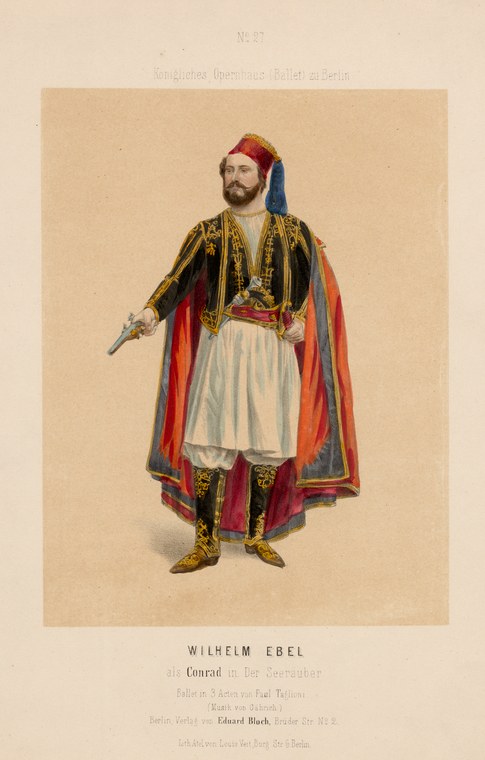
Wilhelm Ebel als Conrad in Der Seeräuber. Ballet in 3 Acten von Paul Taglioni (Musik von Gährich)
Unknown artist
- Collection:
- Prints depicting dance
- Source:
- New York Public Library
- Rights:
- Public domain — free to use, share and adapt.
- Recorded as:
- Public Domain
Romantic ballet relied on strong male characters and dramatic roles, yet male dancers in this period are far less documented in surviving imagery than their female counterparts. This print preserves a record of Ebel and of the costuming practices that gave shape to male dramatic roles in Taglioni's work. The costume itself—a blend of European and orientalist elements—reveals the era's fascination with exotic and foreign settings, a defining feature of Romantic choreography.
What you are looking at
A single male figure is presented in a three-quarter pose against a neutral beige ground, dressed in an elaborate costume that combines European Romantic-era theatrical dress with orientalizing elements. He wears a richly embroidered dark jacket with gold trim over a white pleated skirt or kilt, a deep crimson cape lined with red fabric that sweeps behind him, and a red velvet cap with a blue silk scarf wound through it. His left arm extends downward holding what appears to be a dagger or sword; his right arm rests at his side. The figure stands with weight distributed evenly, feet planted in a stable stance rather than an active dance position. The costume suggests a corsair or brigand character—consistent with the ballet's title Der Seeräuber (The Pirate)—and the image functions as a costume portrait or theatrical documentation rather than a depiction of movement.
The dancing
The dancer stands upright with no clear weight shift or preparatory position for movement. His arms are at ease rather than engaged in a balletic frame or hold. The stance is frontal and presentational, the body arranged for maximum visibility of costume detail rather than articulation of a dance phrase. This is a portrait orientation of the performer in character, not a captured moment of choreography.
The dance depicted
This is a costume plate documenting Wilhelm Ebel as the character Conrad in Paul Taglioni's three-act ballet Der Seeräuber (The Pirate), with music by Gährich. Taglioni was a significant nineteenth-century ballet choreographer and composer. Ebel was a Romantic-era male dancer, and this print records his costume for a specific role rather than capturing the dance itself. The work belongs to the tradition of theatrical documentation through costume prints, which served as both publicity and record of major productions. Without the choreography visible, the image tells us about character costuming, the orientalizing and exotic aesthetics typical of mid-nineteenth-century Romantic ballet, and the importance of male dancers in dramatic roles during this period.
How it was made
This is a hand-colored lithograph or engraving, a print medium designed for wide circulation. The technique allowed for detailed rendering of fabric, embroidery, and decorative trim; the subtle shading and depth of color suggest careful hand-coloring of a lithographic base. The print served as publicity and souvenir for the ballet production, documenting the performer and his costume for audiences who had attended or would attend the work. The medium indicates this was a published, commercial product distributed to a broad theatrical public.
About this work
This is a costume plate from a nineteenth-century ballet, recording the appearance of a specific performer—Wilhelm Ebel—in a named role within Paul Taglioni's Der Seeräuber. It belongs to a rich tradition of theatrical documentation through print in the Romantic era, when elaborate costuming and character-driven narrative ballets dominated European stages. The work sits at the intersection of theater history, dance documentation, and visual culture, recording not the dance itself but the visual persona that shaped the audience's experience of it. It is evidence of how mid-nineteenth-century ballet was promoted, remembered, and circulated beyond the theater itself.
How to look at it
Approach this as a theatrical document rather than a captured dance moment. The viewer should attend to the costume's construction—the embroidery, the layering of fabrics, the symbolic elements (the dagger, the cap, the cloak) that communicate character. Notice how the artist balanced legibility of costume detail with the idealized, frontal presentation of the performer; this was the standard format for costume plates. The absence of movement or expression is not a limitation but a convention—the point was to show what the performer wore and how he appeared, so that audiences could imagine the role and dancers could reconstruct it.
The artist
The artist is not recorded. The print was published in Berlin by Eduard Bloch, Preuße Str. No. 5, indicating it was a commercial theatrical print from an established Berlin publisher. Such costume plates were often created by multiple hands—a designer, engraver or lithographer, and colorist—working from costume designs or live observation, and attributing work to a single artist was not the standard practice.
The period
This work dates to the height of the Romantic ballet era, roughly 1830s–1860s, when narrative ballets with elaborate costumes, exotic settings, and strong male dramatic roles were central to European theatrical life. Paul Taglioni (1808–1884) was a leading choreographer of this period, known for ballets with dramatic storylines, foreign settings, and showcases for star dancers. Male dancers in Romantic ballet occupied important roles as partners, villains, and dramatic protagonists, and their costumes—like Ebel's corsair outfit—blended European formal dress with orientalizing fantasy. The taste for pirates, brigands, and exotic warriors in ballet reflected broader Romantic interests in the picturesque, the foreign, and the dramatically charged.
Where it lives
This print is held in the New York Public Library's collection of prints depicting dance. It is a published theatrical costume plate, likely produced in Berlin around mid-nineteenth century for distribution to ballet audiences and practitioners.
Dance in this work
Questions about this work
What was Der Seeräuber and why did it matter?
Der Seeräuber (The Pirate) was a three-act narrative ballet choreographed by Paul Taglioni, a leading figure in Romantic ballet. Taglioni's ballets, like those of his contemporaries, were built around dramatic storylines, exotic locales, and strong roles for both male and female dancers. This ballet fit the Romantic era's appetite for adventure, foreign settings, and theatrical spectacle.
Who was Wilhelm Ebel?
Wilhelm Ebel was a male dancer in the mid-nineteenth century, active in German theatrical dance. Little is recorded of his career beyond his roles in specific productions; this print documents one of his known performances. Male dancers of this era are much less well-documented than female stars, making such costume plates valuable historical records.
What does this costume tell us about Romantic ballet?
The costume—part European formal dress, part orientalizing fantasy—exemplifies Romantic ballet's love of exotic and foreign settings. The rich embroidery, layered fabrics, and dramatic colors reflect the era's investment in visual spectacle and theatrical character. The fact that a male dancer wore such an elaborate costume shows that male roles in Romantic ballet were dramatic and central, not secondary.
Why is this a print and not a painting?
Costume plates like this were printed and hand-colored for distribution to ballet audiences, critics, and practitioners. This medium allowed for multiple copies to be sold as souvenirs, advertisements, and records of major productions. A unique painting would not have served this commercial and documentary purpose.
More dance artwork





