49 works in this view — arrow keys or swipe to move between them.
Dance in Art
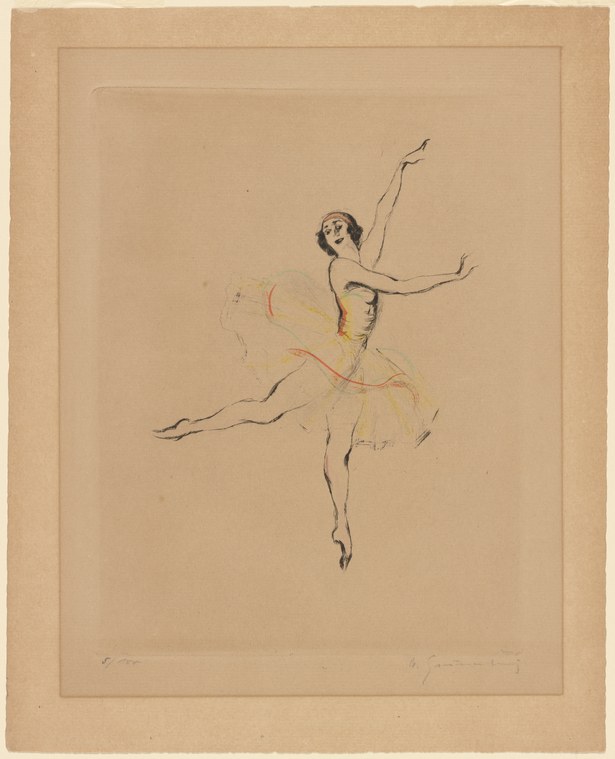
Anna Pavlova in Les sylphides
Unknown artist
- Collection:
- Prints depicting dance
- Source:
- New York Public Library
- Rights:
- Public domain — free to use, share and adapt.
- Recorded as:
- Public Domain
Pavlova was perhaps the most influential ballerina of her era, and her interpretation of the Sylph became the defining performance of that role for decades. This sketch, however quickly executed, preserves a moment of that performance and the aesthetic of early Fokine choreography. For historians of ballet, it is primary evidence of how the Romantic revival was danced and how artists of the period chose to visualize virtuosity.
What you are looking at
A single female dancer is shown in mid-leap against a plain tan background, captured in a moment of ethereal suspension. She wears a pale yellow tutu and a fitted bodice, her body aligned in a classical balletic pose with one leg extended behind and the other supporting her weight in the air. Her arms are raised expressively—one reaching upward and the other extended to the side—in a gesture of lyrical grace. The figure is rendered in fluid pen or pencil lines with delicate watercolor washes of yellow, red, and orange suggesting the costume and movement. The drawing technique is economical but assured, capturing the essential geometry of the pose rather than laboring over anatomical detail.
The dancing
The dancer's body is elongated and weightless, positioned in a clear balletic alignment with turned-out legs and a lifted spine. Her supporting leg is nearly straight beneath her, while the other extends into a développé or similar position. The port de bras shows both arms engaged—one lifted toward the vertical, the other extended laterally—in the open, expressive arm carriage characteristic of early twentieth-century classical ballet. The head is tilted slightly upward, completing a line of elongation from foot to fingertip. There is only one figure, isolated against the page.
The dance depicted
This is Romantic or Classical ballet, almost certainly depicting a moment from Les sylphides (also called Chopiniana), the celebrated 1909 ballet choreographed by Michel Fokine. The catalogue record attributes it to the legendary Russian ballerina Anna Pavlova, whose performances in this role defined an era of ballet. The image captures the weightless, lyrical quality that Fokine demanded of the work—a choreography built on flowing port de bras, minimal narrative, and the illusion of effortless flight. The pale tutu, the vertical line of the body, and the open arm gestures are all signatures of the Romantic ballet vocabulary that Fokine revived in this work.
How it was made
This appears to be a drawing in pen or ink with watercolor additions, a common medium for dance studies and theatrical documentation of the early twentieth century. The economy of line—visible especially in the legs and torso—suggests working memory or a notation sketch rather than a finished painting. The color washes are applied sparingly to define costume and suggest movement, a technique well suited to capturing the ephemeral quality of performance. Works of this type were often produced as souvenirs, reviews, or studies for dancers and choreographers, and their lightness of touch suggests both speed of execution and confidence in the artist's hand.
About this work
This is a sketch of a moment from Les sylphides, attributed to the performance of Anna Pavlova, one of the most celebrated dancers of the early twentieth century. The work documents a crucial moment in ballet history—Fokine's 1909 revival of the Romantic ballet aesthetic for the Ballets Russes. The drawing captures not just a pose but an entire philosophy of movement: weightlessness, lyricism, and the elevation of line over narrative. It belongs in a dance collection as a visual record of an iconic role and as evidence of how the early twentieth century understood and represented classical ballet.
How to look at it
Observe the line from the extended leg through the torso and raised arm—this is the central gesture of the Romantic ballerina, an expression of weightlessness and verticality. The artist has chosen a moment of suspension, not of arrival or preparation, which captures the suspended quality that Fokine required. Notice how little anatomical detail is rendered; instead, the artist has prioritized the integrity of the line and the extension of the limbs. The color applied to the tutu is suggestive rather than literal, allowing the silhouette to dominate the composition.
The artist
The artist is not recorded. The sketch's style and medium—pen with watercolor, rapid but assured—are typical of theatrical documentation and costume studies from the Ballets Russes era. It may be a study by a designer, a choreographer's notation, or a souvenir sketch produced for circulation. Without signature or attribution, the work's value lies entirely in its subject—Pavlova in a role she made legendary.
The period
Les sylphides premiered in 1909 and revolutionized ballet by abandoning narrative in favor of pure movement and music. Michel Fokine's choreography drew on the Romantic ballet of the mid-nineteenth century—the era of La Sylphide and Giselle—but reconceived it for modern dancers and modern taste. The early twentieth century saw a renaissance of interest in the Romantic ballet, and Pavlova's interpretations were central to that revival. She danced the role repeatedly and throughout her career, making it one of the most documented ballets of the period. The sketch's style—economical line drawing with color—reflects the graphic vocabularies of early twentieth-century theater design and publicity.
Where it lives
The work is held in the New York Public Library's collection of prints depicting dance. The catalogue record offers no date, medium, or artist attribution, suggesting it may be part of a larger collection of theatrical documentation or dance studies whose provenance has not been fully established.
Dance in this work
Questions about this work
How do we know this is Pavlova dancing Les sylphides?
The catalogue record attributes it as such, though without a signature or dated inscription on the work itself, attribution rests on historical record. The costume, pose, and period of the sketch style are consistent with Pavlova's performances of this role in the early twentieth century, but the artist remains unidentified.
What is Les sylphides and why does it matter?
Les sylphides (1909) is Michel Fokine's plotless ballet set to Chopin piano music. It revived the vocabulary of Romantic ballet—weightlessness, lyricism, open enchainements—without narrative. It became a cornerstone of the modern ballet repertory and a defining role for generations of ballerinas including Pavlova.
Is this a finished artwork or a study?
It appears to be a sketch or study rather than a finished exhibition work. The economical line work, the sparse use of color, and the single-figure composition suggest it was made quickly, perhaps as a souvenir, a notation, or documentation of performance. Such works were common in the early twentieth century and were often circulated among dancers, choreographers, and theater professionals.
More dance artwork





