27 works in this view — arrow keys or swipe to move between them.
Dance in Art · 2024
La polka
Unknown artist
- Medium:
- Lithograph
- Dance:
- Polka
- Era:
- Late 1800s (Victorian Ballroom)
- Source:
- New York Public Library
- Rights:
- Public domain — free to use, share and adapt.
- Recorded as:
- public_domain
The polka was among the first dances to be embraced across all European social classes and the Atlantic world, and this image shows the form as it was performed in fashionable circles. For historians of ballroom dance, the precise hold and posture record how the dance was actually executed; for social historians, it documents the role of dancing in 19th-century courtship and the carefully choreographed nature of even 'social' dancing. The lithograph is also evidence of how dance images functioned as mass-produced teaching and aspirational material in the period.
What you are looking at
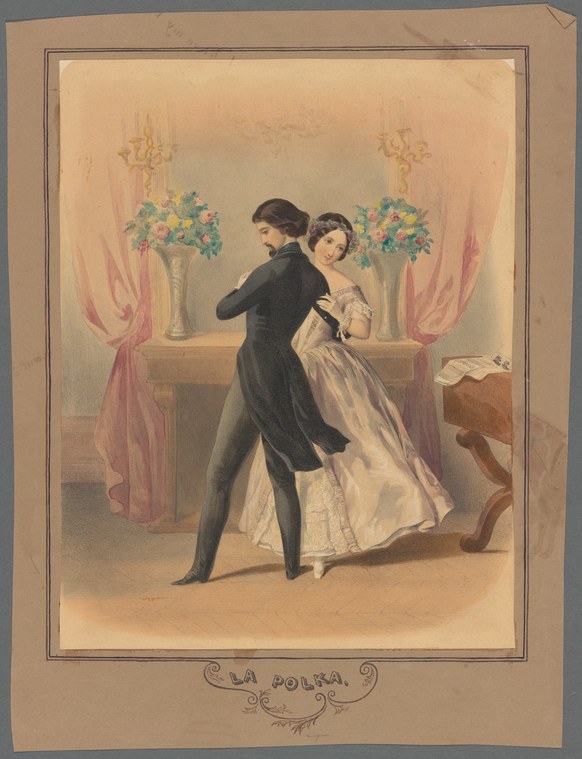
A man in formal black tailcoat and a woman in a pale ball gown stand together in an elegant interior, caught in the moment of a polka. The woman leans back slightly into the man's supporting arm, her weight shifted onto one foot in a characteristic polka figure. The setting is a richly appointed ballroom with coral-pink curtains framing tall windows, potted flowering plants on pedestals, and what appears to be a mantelpiece or architectural detail visible at left. The lithograph's warm color palette—creams, pale blues in the woman's dress, soft greens in the foliage—creates an intimate, romantic atmosphere. A piece of fabric or shawl lies on a chair at right, suggesting this is a moment plucked from an evening of social dancing. The composition is tightly framed around the couple, drawing focus entirely to their interaction and the elegance of their dress.
The dancing
The man stands upright in a supported frame, his left arm extended to hold the woman's hand while his right arm supports her at the waist—the classic closed ballroom position. The woman's posture is more dynamic: her body leans back into his hold with her right arm extended, creating the characteristic open, tilted frame of the polka. Her weight appears to be on her back foot, her body creating a diagonal line from shoulder to hip. The positioning suggests a moment mid-rotation or mid-chassé, with the woman's skirt catching light in a way that suggests movement. Both figures are poised with the upright carriage and formality expected of Victorian ballroom dancers.
The dance depicted
This is unambiguously the polka, a couple dance that dominated European and American ballrooms from the 1840s onward. The title confirms it; the hold, frame, and the woman's characteristic backward lean and open posture are those of the polka. The polka was danced in closed position with a springing, hopping step and a rotational action—what is visible here is the frame and stance that accompany that movement. The image captures the dance as it was performed in high society, by couples in formal dress at public or private balls. The polka was one of the defining dances of the 19th-century ballroom and remained popular into the early 20th century.
How it was made
This is a hand-colored lithograph, a reproductive technique that allowed wide circulation and affordable distribution of popular images in the late 19th century. Lithography's soft tonal range and capacity for fine detail made it ideal for the rendering of fabric, light, and the subtlety of facial expression and posture. The artist has used delicate color work to build atmosphere—the warm interior, the careful gradation of the woman's skirt, the glow of the setting—which suggests this was a commercially produced image aimed at a middle-class audience interested in fashionable dance and social manners. The technique allows both precision in the figures and a soft, romantic mood that appealed to Victorian taste.
About this work
This is a mid-to-late 19th-century lithographic image of the polka, one of the defining dances of the Victorian ballroom. The work captures the dance in its social context: an elegant interior, formal dress, and the intimate two-person frame that made the polka so popular for courtship and social display. It is a document of how the polka was performed, held, and understood in elite European society. The image belongs in a dance gallery as both a precise record of ballroom technique and as a window onto Victorian social culture, where dancing was central to courtship, social status, and public behavior.
How to look at it
Observe the frame: the closed position with the man's support and the woman's open, tilted posture are specific to the polka and distinguish it from the waltz or other ballroom dances of the period. Notice how the artist has captured the woman's weight shifted to her back foot and the slight backward lean of her body—this is the characteristic posture of the polka's backward figures. The formal dress and the refined interior setting are equally important: they show that the polka, despite its folk origins, had been fully absorbed into elite ballroom culture. The moment chosen is one of graceful equilibrium, not action, which is typical of dance portraiture of the period—the goal was to show the beauty of the frame and the dancers' deportment, not the vigor of the step.
The period
The polka originated in Bohemia in the 1830s and spread across Europe with extraordinary speed, reaching London and Paris by 1840 and America shortly after. By the 1860s–1880s, when this lithograph was likely made, the polka was an established staple of ballroom repertory, taught in dancing schools and performed at balls, assemblies, and public dances. It was considered a 'modern' and somewhat daring dance—faster and more animated than the waltz, with a hopping step and a playful character. In the visual arts, dance had become a popular subject for commercial lithography, particularly images of fashionable couples and social scenes. Publishers produced these images as affordable prints for the parlor, as dance instruction aids, and as popular entertainment.
Where it lives
This lithograph is held in the New York Public Library collection and is catalogued as a late 19th-century work. It is one of many such commercial dance prints and teaching images produced for a middle-class audience in the Victorian era.
Dance in this work
Questions about this work
How do you know this is the polka and not another ballroom dance?
The title reads 'La polka.' Beyond that, the posture and frame are diagnostic: the woman's open, backward-leaning stance and the man's supporting frame around her waist are specific to the polka. The waltz, by contrast, involves a more vertical, upright posture. The polka's characteristic tilted frame and hopping step are clearly indicated in the artist's rendering of the woman's weight and body angle.
What was the polka used for?
The polka was one of the primary couple dances of the Victorian ballroom, performed at formal balls, assemblies, and social dances. It was used for courtship, social display, and entertainment. Unlike the waltz, which was often the opening dance at a ball, the polka typically appeared later in the evening and was considered more playful and intimate. It remained popular for over a century.
Why do so many 19th-century dance images look like this?
Lithography was the dominant reproductive technology for popular images in the 1800s, and dance was a favorite subject because it sold. Publishers produced these prints as affordable parlor decoration, as teaching aids for dance students, and as fashion plates showing the latest in dress and deportment. The hand-colored technique allowed for rich detail and romantic mood, which appealed to Victorian taste.
Is there anything unusual about how this couple is dancing?
No—what we see is the standard polka frame and posture of the period. The formality of their dress and the elegance of the setting indicate that this is a representation of the polka as it was performed in fashionable society, not a folk version or a stage adaptation. The artist has rendered them with the precision and grace expected of trained ballroom dancers.
More Polka artwork