49 works in this view — arrow keys or swipe to move between them.
Dance in Art
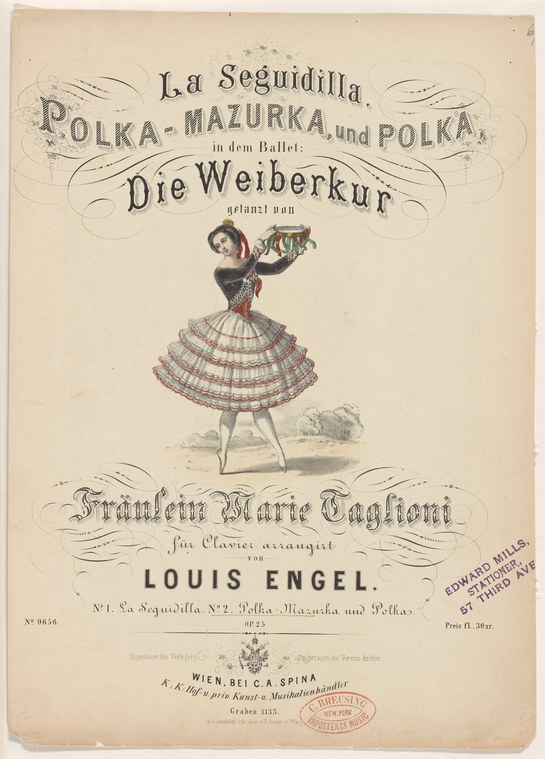
La Seguidilla. Polka-Mazurka, und Polka, in dem Ballet: Die Weiberkur: getanzt von Fräulein Marie Taglioni, für Clavier arrangirt von Louis Engel
Unknown artist
- Collection:
- Prints depicting dance
- Source:
- New York Public Library
- Rights:
- Public domain — free to use, share and adapt.
- Recorded as:
- Public Domain
Marie Taglioni was the defining ballerina of the Romantic era, and prints like this document her actual stage presence and the aesthetics of her performances. The work shows how folk dance elements—here the Seguidilla—were absorbed into ballet spectacle, a phenomenon that shaped the development of theatrical dance for decades to come.
What you are looking at
A single female dancer dominates the composition, posed in a moment of balanced suspension against a plain background. She wears a richly striped skirt with horizontal bands of color—reds, whites, and earth tones—arranged in a full, voluminous shape that extends nearly to her ankles. Her bodice is fitted and dark, with what appears to be a short puffed sleeve or decorative shoulder piece. Her arms are raised asymmetrically: the upper arm extends to the side at shoulder height while the forearm bends upward, and her other arm is held lower. Her posture suggests a moment caught between steps—weight appears shifted to one leg while the other extends or prepares to move. Her head is turned slightly, gazing toward the raised arm. The figure is rendered in colored lithograph or hand-colored print, with careful attention to the pattern and volume of the skirt. The composition emphasizes verticality and the sculptural qualities of the dancer's elongated frame and the architecture of her costume.
The dancing
A single female dancer shown at approximately three-quarter length. Her torso is upright, shoulders relatively level, with one arm raised to shoulder height and the other held at mid-body—a pose that reads as mid-motion rather than a held position. Her weight distribution suggests weight is carried through one leg while the other is free or lightly planted. The asymmetry of the arm positions and the turned head indicate a rotational or turning quality to the movement. The dancer appears trained and controlled; there is no flailing or excess, but rather a deliberate, articulated frame consistent with theatrical dance of the period.
The dance depicted
The title explicitly names three dances: Seguidilla, Polka-Mazurka, and Polka, all performed in the ballet *Die Weiberkur* (The Women's Cure). The work was danced by the celebrated Romantic-era prima ballerina Marie Taglioni. The costume and pose do not clearly belong to any single one of the three named dances; instead, this appears to be a stage costume image documenting Taglioni's appearance in the production. The Seguidilla is a Spanish folk dance form; the presence of the horizontal-striped, full skirt may allude to Spanish or regional costume tradition. The Polka-Mazurka and Polka are Central European social dances that had entered ballet repertoire by the 1830s–1840s. Without seeing the choreography itself, the image documents the spectacle and costume rather than specific steps.
How it was made
This is a colored lithograph with hand-coloring, a common format for theatrical prints and sheet music covers in the 19th century. The inscription at bottom identifies this as plate No. 2 ("N°. 2. La Seguidilla") and notes it was published in Vienna by C.A. Spina. The technique allowed for relatively rapid, affordable reproduction and distribution to the theater-going public and music lovers. The careful color work—particularly the jewel tones of the skirt stripes and the delicate rendering of the figure—suggests this was a premium item, likely purchased by patrons of ballet or owners of the musical arrangement for solo piano by Louis Engel.
About this work
This is a theatrical print documenting a specific performance or production costume from the Romantic ballet era, centered on the great danseuse Marie Taglioni. The work combines elements of Spanish regional costume (the striped skirt and full silhouette) with the formal bearing of a trained classical dancer, visualizing the period's fascination with exotic and folk-inspired choreography presented within the rigorous technique of European ballet. It belongs in the dance archive as evidence of how 19th-century ballet drew on and transformed folk traditions, and as a window into the celebrity of individual dancers and the commercial circulation of ballet imagery through prints and music publications.
How to look at it
Observe the pose and its relationship to the costume: Taglioni is not in a classical ballet position (no turned-out legs, no lifted fifth position), but rather in a pose that suggests motion and character. The turned head and asymmetrical arm placement create a sense of moment and personality. The horizontal stripes of the skirt emphasize its volume and the way the fabric would move in a turn or leap. Note too the careful rendering of the face and the delicate neck and shoulder line—hallmarks of Romantic-era dance portraiture that emphasized the dancer's beauty and refinement alongside technical prowess.
The artist
The print is credited to lithographer and publisher C.A. Spina in Vienna, with the piano arrangement by Louis Engel. The artist of the original design is not recorded on this print. Spina was a significant publisher of theatrical and musical prints in Vienna during the 1830s–1840s, producing a substantial output of ballerina portraits and operatic scenes. Such prints were typically produced from designs by theater designers, choreographers, or commercial lithographers working in the theatrical print trade, often from sketches made at performances or from costume designs.
The period
This print dates to the heyday of Romantic ballet (circa 1830–1850), when the art form turned toward supernatural subjects, exotic locales, and the cult of the individual prima ballerina. Marie Taglioni's introduction of the pointe shoe and her ethereal technique made her the template for the Romantic ballerina. Simultaneously, European composers and choreographers were mining folk traditions—Spanish, Polish, Hungarian, Scandinavian—for subject matter and musical color. Dances like the polka and mazurka had recently emerged as fashionable ballroom dances in Central Europe and quickly entered ballet. The publication of such prints alongside sheet music arrangements for home performance created a feedback loop between the concert stage and domestic music-making, extending the reach of ballet culture beyond the theater.
Where it lives
This print is held in the New York Public Library's collection of dance-related prints and images. It is a published theatrical print, likely sold to ballet-goers and music enthusiasts in Vienna and circulated throughout German-speaking Europe. The notation "N°. 2" suggests it was part of a series covering different dances or scenes from the same production.
Dance in this work
Questions about this work
Who was Marie Taglioni and why is she important?
Marie Taglioni (1804–1884) was a Swedish-born ballerina who became the defining dancer of the Romantic era. She popularized dancing en pointe as a technical foundation rather than a special effect, and her light, ethereal style set the standard for the next generation of ballerinas. She was also one of the first dancers to achieve international celebrity status, with her image reproduced in prints, lithographs, and sculptures across Europe.
What are the three dances named in the title?
The Seguidilla is a Spanish folk dance in triple meter with a rhythmic structure distinct from other national dances. The Polka-Mazurka is a hybrid form blending the Czech polka with the Polish mazurka, both of which had recently become fashionable in ballrooms. The Polka proper is a brisk, hopping dance in 2/4 time that became a craze in the 1840s. All three were incorporated into ballet as character dances or as exotic national numbers in Romantic ballets.
What does the costume tell us about the dance?
The full, horizontally striped skirt and fitted bodice suggest a Spanish or regional European aesthetic, appropriate to the Seguidilla and the ballet's title *Die Weiberkur* (an opera plot involving female characters and comic transformation). The costume is not a pointe-shoe ballet dress (no tutu in the classical sense), but a theatrical interpretation of folk or character costume, bridging the gap between ballroom and stage.
Why was this printed and what was it for?
This is both a souvenir for ballet patrons (a portrait of the famous Taglioni) and a music publication accessory. The lower credit line indicates it was issued alongside a piano arrangement of music from the ballet, allowing amateur musicians at home to play and sing the melodies. Such prints served as advertising, souvenirs, and cultural objects that extended the reach of the ballet beyond the theater into middle-class homes.
More dance artwork





