49 works in this view — arrow keys or swipe to move between them.
Dance in Art
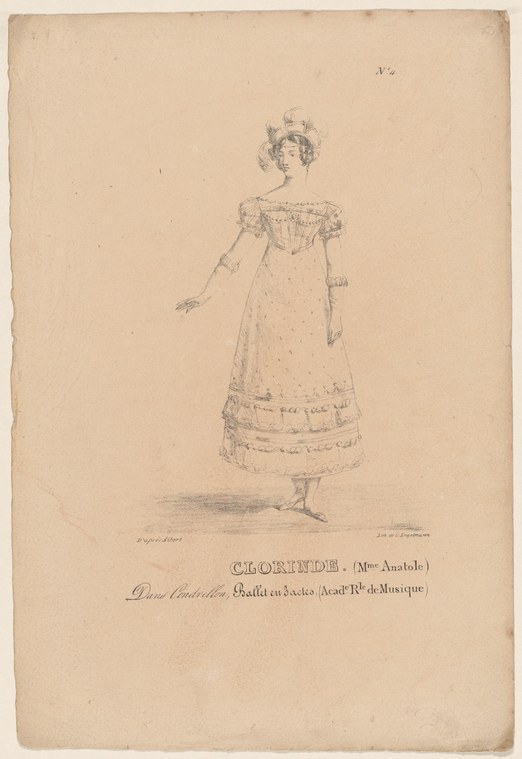
Clorinde (Mme Anatole) dans Cendrillon, ballet en 3 actes (Acade. Rle. de musique)
Unknown artist
- Collection:
- Prints depicting dance
- Source:
- New York Public Library
- Rights:
- Public domain — free to use, share and adapt.
- Recorded as:
- Public Domain
This image documents a real performer in a real production at a real moment in ballet history, preserving the appearance of a dancer whose name would otherwise be forgotten. It shows us what a working ballerina looked like—her actual body, dress, and bearing—rather than an idealized conception, and it reveals how theatrical portraiture functioned as a form of celebrity culture in the 19th century.
What you are looking at
A single female dancer stands in elegant repose against a plain background, her body angled three-quarters to the viewer. She wears a high-waisted muslin or cotton gown characteristic of early 19th-century fashion, with puffed sleeves that fall from the shoulder, fitted bodice with decorative detail across the chest, and a skirt descending to mid-calf with two horizontal bands of ornament near the hem. Her hair is arranged in tight curls piled atop her head in the Regency manner. Her right arm extends gracefully downward and outward; her left arm rests across her body. Her posture is upright and composed, weight balanced, suggesting a moment of stillness rather than active movement. The drawing is executed in fine pencil line with subtle shading, the figure rendered with anatomical precision against a neutral ground. The inscription below identifies her as "CLORINDE (Mme Anatole)" dancing in the ballet "Cendrillon" (Cinderella) in three acts at the Académie Royale de Musique.
The dancing
The dancer is shown in a posed, presentational stance rather than mid-movement—a portrait attitude. Her frame is upright and formal, with shoulders back and head held high, the bearing of a trained dancer or professional performer. Both arms are engaged: one extended in a gentle outward gesture, the other folded inward across the torso. There is no indication of turned-out positions, elevation, or the characteristic hyperextension of Romantic ballet technique; the pose is grounded and stationary. She is alone in the composition, the sole focus.
The dance depicted
This is a portrait of a named performer in the Romantic-era ballet *Cendrillon*, a three-act production at the Paris Opéra (Académie Royale de Musique). The work dates to the 1830s-1840s, the height of the Romantic ballet period. The dancer Mme Anatole is shown in character as Clorinde, one of Cinderella's stepsisters. Rather than depicting an active dance movement, the print presents her in formal dress costume and bearing—the standard format for theatrical portraiture of the period, allowing audiences to recognize the performer and admire the costume design. The pose reflects Romantic ballet's emphasis on grace, elongation, and nobility of bearing, though no specific dance step is illustrated.
How it was made
This is a finely executed pencil drawing, likely prepared as a design for lithographic or engraved reproduction—a common practice for theatrical portraiture in early 19th-century Paris. The technique is linear and precise, with restrained shading used to suggest volume and fabric texture without heavy modeling. The delicate line work and refined anatomical rendering suggest skilled draftsmanship trained in academic drawing. Works of this type circulated widely as prints to audiences attending the Opéra, serving both as souvenirs and as promotional images of celebrated dancers and their costumes.
About this work
This is a formal portrait drawing of the dancer Mme Anatole in her costume and character as Clorinde from the Romantic ballet *Cendrillon*, presented at the Paris Opéra. It belongs to the tradition of theatrical portraiture that documented the stars of early 19th-century ballet and their roles. Such images were not primarily documentary of dance technique or choreography, but rather celebrity portraits and costume studies—a significant genre through which audiences engaged with, remembered, and celebrated the performers and the elaborate spectacles of Romantic opera-ballet. The work reflects the period's investment in both the dancer's body as an object of refinement and the increasingly important role of costume design in theatrical spectacle.
How to look at it
Observe the dancer's posture and carriage—the upright spine, the composed arm positions, the sense of poised control rather than explosive movement. This is not action frozen mid-leap, but rather a formal presentation, the kind of portrait a dancer would commission or an Opéra house would issue to the public. Notice the precise rendering of the fabric and cut of the gown, details that were important to the identity and status of the character and performer. The artist's choice to show her standing still, in a three-quarter view that displays both her face and the full line of her silhouette, reflects the conventions of theatrical portraiture: clarity, recognition, and the display of the performer's disciplined body and refined presence.
The period
The image dates to the 1830s–1840s, the apex of Romantic ballet in Paris. This was the era of *La Sylphide* (1832) and *Giselle* (1841), when the Paris Opéra dominated European dance and when the ballerina—not the male dancer—became the central figure and commercial draw of theatrical production. *Cendrillon* (a three-act ballet with music by various composers, most notably Rossini's later versions) was a standard vehicle of the period, often staged to showcase multiple dancers and elaborate scenic effects. The aesthetic of Romantic ballet emphasized ethereal grace, elongated lines, and a nobility of bearing that this portrait embodies. Simultaneously, the rise of lithography and refined engraving techniques made theatrical portraiture affordable and collectable, creating a mass market for images of celebrated performers.
Where it lives
The work is held in the New York Public Library's collection of prints depicting dance. It is catalogued as a work of unknown artist and date, though the style, inscription, and subject matter place it firmly in the Parisian theatrical print tradition of the 1830s–1840s.
Dance in this work
Questions about this work
Who was Mme Anatole?
The inscription identifies her as a performer in the role of Clorinde (a stepmother character) in the three-act ballet *Cendrillon* at the Paris Opéra. Beyond this attribution, little is documented about her career or life. Such prints were important for recording and circulating the names and likenesses of performers who were celebrated during their era but who often left minimal biographical record.
Is this a dance movement or a portrait?
It is a theatrical portrait, not a depiction of choreography. The dancer is posed formally for presentation, not caught mid-movement. This was the dominant mode of theatrical portraiture in the 19th century: rather than illustrating specific steps or combinations, artists recorded the performer, her costume, and her bearing in a manner that allowed audiences to recognize and remember her.
What does this tell us about Romantic ballet?
It illustrates the period's investment in the ballerina as a refined, elongated figure, with upright posture and elegant bearing. The costume—a simple muslin gown rather than the later tutu—and the absence of any display of technique (turned-out legs, pointe work, elevation) reflects an earlier phase of Romantic aesthetics, closer to the late 1820s–1830s than to the more virtuosic displays of the 1840s onward.
More dance artwork





