28 works in this view — arrow keys or swipe to move between them.
Dance in Art · 2019
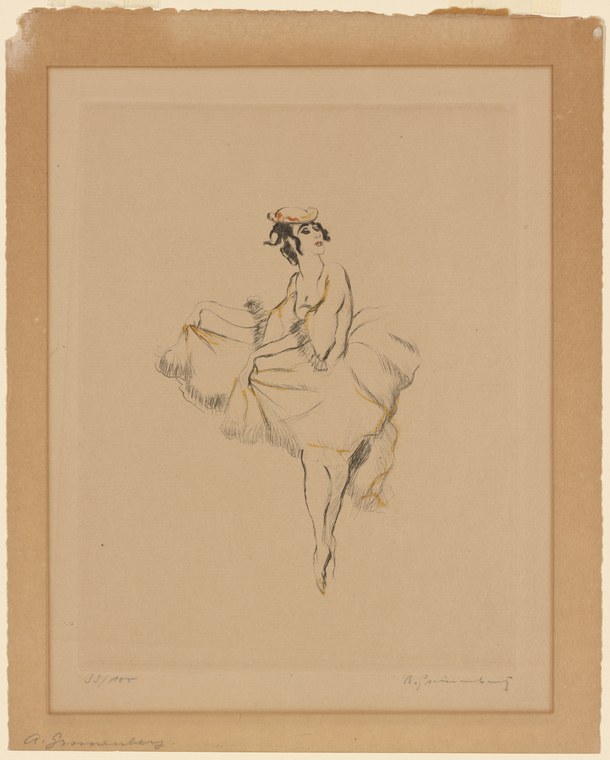
Tamara Karsavina in The Polka
Unknown artist
- Medium:
- Lithograph
- Dance:
- Polka
- Era:
- Late 1800s (Victorian Ballroom)
- Source:
- New York Public Library
- Rights:
- Public domain — free to use, share and adapt.
- Recorded as:
- public_domain
The Polka was one of the defining dances of the 19th century, and this print provides a rare visual record of how it was performed in ballroom contexts by professionals, capturing the movement and the costume in a single crystalline moment. If the inscription correctly identifies this as Karsavina, it documents the crossing of the Polka into theatrical and ballet contexts, suggesting the permeability of social and concert dance boundaries in the early 20th century.
What you are looking at
A single female figure occupies the center of a cream-colored page, caught in an animated moment of dance. She wears a voluminous skirt with deep pleating or fluting that lifts and billows around her legs, suggesting rapid rotational movement, and a fitted bodice with short sleeves. Her posture is upright and energetic, with her body tilted slightly forward as though propelled by momentum. Her arms are raised and slightly bent, positioned in a way that suggests either the culmination of a spin or the preparatory moment before one. The figure is rendered in confident line work—pen or lithographic crayon—with minimal shading, primarily accent marks on the face, hair, and bodice. The drawing style is economical and gestural, capturing the essential movement and silhouette rather than anatomical detail. The composition is spare and frontal, with the dancer isolated against empty space, emphasizing the verticality and lift of the figure.
The dancing
The dancer stands in a nearly upright alignment with a slight forward lean of the torso. Her weight appears to be centered or transitioning through a turn; the raised, bent arms and the lift of the skirts suggest active rotation. The arms are held at roughly shoulder height with elbows bent, hands delicate and undefined. The head is tilted slightly back, and the face is turned to one side, lending a moment of elegance and control to what is otherwise a figure in dynamic motion. The stance and arm carriage suggest ballroom or social dance training rather than folk or theatrical vocabulary.
The dance depicted
This is a polka, as the catalogue states, a Central European couple dance that entered fashionable ballrooms across Europe and America in the 1840s and remained popular through the Victorian era. The Polka is characterized by a quick, spirited tempo in 2/4 time, with couples moving in a turning or traveling pattern. The billowing skirt and the rotational energy captured here are hallmarks of the dance as performed in the late 19th century ballroom. The artist has frozen a moment of lift and turn rather than showing the couple—isolating the woman's movement allows the viewer to focus on the characteristic elevation and momentum of the dance. The refined posture and elegant arm position indicate this is a ballroom version rather than a folk or carnival variant.
How it was made
This is a lithograph, a planographic printing technique in which an image is drawn on a stone or metal plate with a greasy crayon or ink, then printed. The loose, gestural line work visible here—with quick strokes defining the skirt's pleating, the curve of the arm, the tilt of the head—is typical of lithography's expressive potential. The artist has not used color; the print is executed in dark line on cream paper. Lithography's relative accessibility and speed made it the primary medium for theatrical and celebrity promotion in the 19th century, and the presence of this work in a public collection suggests it was a promotional print, likely distributed to publicize a named dancer's performance.
About this work
This is a lithographic print depicting a female dancer in the costume and movement of the Polka, a ballroom dance that dominated European and American social dancing from the 1840s onward. The work is undated and unattributed in the catalogue record but bears signatures or markings that may indicate artist and publisher; the inscription 'Tamara Karsavina' in the catalogue suggests this may document the Russian prima ballerina's interpretation of the dance, though her career was primarily in classical ballet. The image captures the essential visual character of the Polka as performed in refined ballroom settings—the rapid rotation, the lift and spread of the skirt, the upright carriage and controlled arms. It belongs in a dance history collection as evidence of how a popular couple dance was recorded, celebrated, and circulated in the 19th-century print market.
How to look at it
Attend to the direction and lift of the skirt, which records the moment of rotation and upward momentum essential to the Polka. Notice the tilt of the body and the angle of the head—the artist has caught not a static pose but a fraction of a turn, at the point where centrifugal force is most evident. The arm position, with elbows bent and hands held at mid-level, is typical of ballroom frame rather than theatrical gesture. The economy of line allows the eye to follow the silhouette and understand the movement without distraction; this was a working method for theatrical lithographers, who needed to convey character and action with minimal detail.
The artist
The artist is not recorded. The style and composition are consistent with 19th-century theatrical lithography, a genre in which specialized artists created prints of celebrated performers for distribution to the public. The print may have been created by a house artist working for a theatrical publisher or lithographic firm, or by the choreographer or director of the production in which Karsavina danced. Without a signature legible in reproduction, attribution is not possible from the image alone.
The period
The Polka emerged in the 1830s in Prague and spread across Europe and America with remarkable speed, becoming the dominant couple dance in ballrooms by mid-century. It remained popular through the Victorian era and beyond, though by the early 20th century it was often viewed as old-fashioned by younger dancers. The date assigned to this work ('Late 1800s') aligns with the height of the Polka's popularity as a drawing-room and ballroom dance, though Karsavina's primary performances occurred in the early 1900s, suggesting the print may be from that period or later. Theatrically, the Polka was occasionally incorporated into ballet and music-hall productions as a character dance or comic interlude, though it was not part of the classical ballet canon.
Where it lives
The work is held in the New York Public Library collection. The catalogue record notes it as a lithograph from the Late 1800s (Victorian Ballroom) period, with the subject identified as Tamara Karsavina in The Polka. No artist, publisher, date, or accession number is recorded. The presence of signature or inscription marks at the bottom of the page suggests these may be legible in the original object.
Dance in this work
Questions about this work
Was Tamara Karsavina known for dancing the Polka?
Karsavina (1885–1978) was primarily a classical ballet dancer, a principal of the Imperial Ballet and the Ballets Russes under Diaghilev. The Polka was not a central work in her repertoire. However, she may have danced it in a music-hall or variety context, or the print may have circulated under her name posthumously. Without exhibition records or program notes, the attribution to Karsavina cannot be confirmed from the image alone.
What is the difference between the Polka and other Victorian ballroom dances?
The Polka is faster and more energetic than the Waltz, danced to a quick 2/4 tempo with a characteristic hop-and-step rhythm. Unlike the Quadrille, which is a formation dance for four couples, the Polka is danced by couples moving around the floor. The skirt lift and rotational energy visible in this print are distinctive to the Polka; Waltzes are typically shown with more fluid, continuous turning, while Polkas feature sharper, more staccato movement.
Why was the Polka so popular in the 19th century?
The Polka was seen as modern, energetic, and liberating compared to the formal, prescribed movements of earlier dances like the Quadrille and Minuet. It allowed couples greater freedom of expression and required physical vigor and joy rather than stiff propriety. It spread across Europe and America with remarkable speed, becoming an emblem of cosmopolitan, contemporary culture, and it remained socially acceptable across class boundaries.
More Polka artwork