49 works in this view — arrow keys or swipe to move between them.
Dance in Art
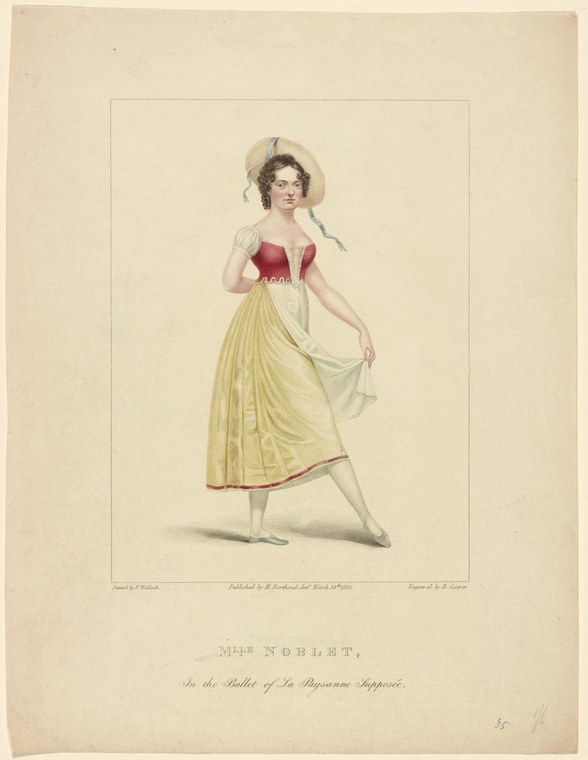
Mlle. Noblet, in the ballet of La paysanne supposée
Unknown artist
- Collection:
- Prints depicting dance
- Source:
- New York Public Library
- Rights:
- Public domain — free to use, share and adapt.
- Recorded as:
- Public Domain
This print documents a professional female ballet dancer in a named role at a moment when Romantic ballet was establishing itself as a central dramatic form in European theater. It is one of thousands of such prints, yet each is a record of a specific dancer, a specific role, and a specific moment in the development of ballet technique and theatrical presentation. For dancers and choreographers, the image offers evidence of how the body was posed and presented in early Romantic ballet, and what aesthetic was being marketed to paying audiences.
What you are looking at
A single female dancer is depicted in a three-quarter pose against a plain background, wearing a romantic-era costume of the 1830s–40s. Her dress consists of a fitted burgundy or deep rose bodice with short, puffed sleeves and a pale yellow skirt of considerable length that falls to mid-calf, with a deeper rose-colored hem band. She wears a large, pale bonnet tied under the chin with a ribbon. Her posture is elegant and composed: she stands with her weight primarily on her left leg, her right leg extended behind in a gentle line, and her left arm is raised gracefully. Her right arm extends downward with fabric (possibly her skirt or a prop) draped over it. The figure occupies the center of a rectangular frame on a cream-colored page, and the hand-coloring of the print shows delicate attention to the texture of the fabrics and the pale modeling of her face and neck.
The dancing
The dancer is alone in the frame, her body aligned in a classical balletic stance with the weight forward on a supporting leg and the other leg extended behind, not fully turned out but in a position of graceful extension. The arms are not held in a closed partnership hold but rather in an open, demonstrative position—the raised arm soft and rounded, the lower arm extended with an elegant gesture of the skirt or drapery. This suggests a solo display rather than partnered dancing. The elongated line from neck through torso to the extended leg suggests training in the balletic vocabulary of the period, though the overall posture is more restrained than the extreme extension of later pointe technique.
The dance depicted
This is a portrait of a professional ballet dancer, Mlle. Noblet, costumed for a specific ballet, *La paysanne supposée* (The Supposed Peasant Girl). The work appears to be a stage costume or role portrait rather than documentation of an actual moment of dance. *La paysanne supposée* was a vehicle for display of the female dancer as a theatrical figure—the title suggests a narrative of assumed identity or disguise, a common plot device of Romantic ballet. The costume blends theatrical fantasy with an idealized peasant dress of the period, the yellow skirt perhaps evoking pastoral or village origins. The pose is a formal display pose rather than an image of active dancing, designed to present the dancer's line and the silhouette of her costume to the viewer.
How it was made
This is a hand-colored engraving or aquatint, a reproductive print medium that dominated theatrical portraiture in the early 19th century. The technique allowed for rapid reproduction and wide circulation; these prints were sold separately or collected in series and were the primary way audiences encountered images of famous dancers between performances. The hand-coloring, applied after printing, lends warmth and individuality to each copy and suggests a market commodity aimed at middle-class collectors and theater enthusiasts. The inscription at the base identifies both the dancer and the role, reinforcing the print's function as a souvenir of a specific performance or role.
About this work
This is a hand-colored theatrical engraving of a Romantic-era ballet dancer in costume, likely from the 1830s or 1840s, presenting Mlle. Noblet in the character role from *La paysanne supposée*. It belongs to a large tradition of theatrical portraiture prints that documented the bodies, costumes, and celebrity of professional dancers in the decades when Romantic ballet was defining itself as a major art form. Such prints were widely distributed and collected and served as the primary visual record of dancers and roles for audiences who could not attend performances or who wished to remember them.
The image condenses several functions: it is a record of a costume, a portrait of a celebrated performer, a souvenir of a specific dramatic role, and a demonstration of the dancer's elegant line and bearing. For historians of dance and theater, these prints are primary documents of how roles were visualized, how dancers were marketed to audiences, and what bodies and lines were considered beautiful and professional in the Romantic ballet world.
How to look at it
Observe how the artist has frozen the dancer in a pose of display rather than active movement—she is presented to the viewer much as a sculpture might be, with her best line emphasized and her costume fully visible. The raised arm and the extended leg follow conventions of classical ballet portraiture; the pose is meant to suggest grace and training without depicting a specific step or moment of choreography. Notice how the costume itself—the bright yellow skirt, the trim, the bonnet—dominates the composition and is rendered with considerable detail; the print is as much a fashion plate as a dance portrait. The plain background ensures that all attention remains on the figure and her presentation.
The artist
The artist is not recorded in the catalogue. The inscription indicates that the work was published (likely in London or Paris, the two centers of theatrical print production), engraved, and designed by artists whose names appear to be partially legible at the base of the print. These were commercial workshops that specialized in theatrical portraiture; many such prints were rapid, fashionable productions made to capitalize on the popularity of specific dancers and roles. Individual artistic attribution was often secondary to the speed and commercial success of the print.
The period
This print dates to the height of Romantic ballet in Europe, when female dancers had become celebrated celebrities and the tutus, pointe work, and ethereal aesthetic that characterize the era were being codified. Ballets with narrative plots involving peasant girls, sylphs, spirits, and tales of crossed identities were enormously popular; *La paysanne supposée* fit squarely into this repertoire. The 1830s and 1840s were the peak years for such theatrical portraiture prints—photographs would eventually replace them, but for several decades these hand-colored engravings were the mass medium through which dance was circulated and remembered. Mlle. Noblet was a professional dancer of the period, likely trained in the French or Italian school and a performer in the major theaters of Europe.
Where it lives
This work is held in the New York Public Library's collection of prints depicting dance. It belongs to a large category of 19th-century theatrical portraiture prints, many of which are in institutional collections but remain understudied in dance history.
Dance in this work
Questions about this work
Who was Mlle. Noblet?
Mlle. Noblet was a professional ballet dancer active in Europe in the early to mid-19th century. The print identifies her in a named role, but biographical details about her are not recorded in the catalogue. Such prints are often the primary remaining evidence of the careers of dancers whose names were celebrated in their time but who left few written records.
What is 'La paysanne supposée' and why would it be a ballet?
The title translates as 'The Supposed Peasant Girl,' referring to a narrative of mistaken identity or disguise—a common plot of Romantic ballet. The ballet would have used the costume of a peasant girl (real or theatrical) as a basis for a vehicle to display the dancer's technique and grace. Many Romantic ballets used such narrative pretexts to justify spectacular costumes and displays of the female body.
How were these prints made and circulated?
These hand-colored engravings were made in commercial workshops that specialized in theatrical portraiture. An engraving would be printed from a copper plate, then hand-colored by assistants. The prints were sold to audiences as souvenirs, collected in albums, and framed for display. They were the primary way people outside major theater cities saw images of famous dancers and roles.
Why is the dancer posed this way rather than shown dancing?
Theatrical portraiture prints typically presented dancers in formal display poses that showcased their line, their costume, and their graceful bearing. These poses were conventions of the form, designed to highlight the elegance and training of the dancer and to present the costume clearly to the viewer. The prints were souvenirs and fashion plates as much as documents of actual dancing.
More dance artwork





