49 works in this view — arrow keys or swipe to move between them.
Dance in Art
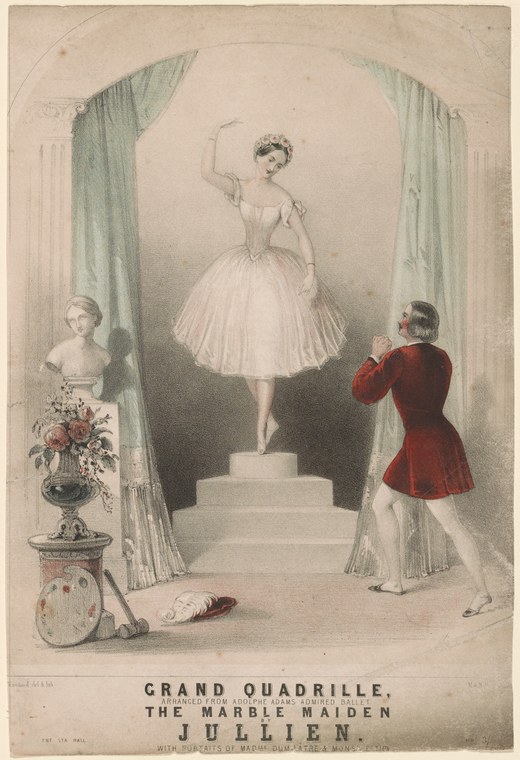
Grand quadrille, arranged from Adolphe Adams admired ballet, The marble maiden by Jullien.: With portraits of Madlle. Dumilâtre & Monsr. Petipa
Unknown artist
- Collection:
- Prints depicting dance
- Source:
- New York Public Library
- Rights:
- Public domain — free to use, share and adapt.
- Recorded as:
- Public Domain
This print shows how Romantic ballet was advertised and remembered: not through documentation of movement but through allegorical images of the ballerina as an ideal figure. The inclusion of both Dumilâtre and Petipa, two major figures of the period, and the careful framing of the ballet's narrative moment, make this a valuable record of what audiences valued in Romantic theater. For choreologists and dance historians, it demonstrates the limitation of prints as historical sources—they show costume, architecture, and theatrical fantasy, but not the actual movement that defined the art.
What you are looking at
A theatrical print depicting a moment from the ballet *The Marble Maiden*, a work choreographed to music by Adolphe Adam. The composition frames a dancer in a white tutu poised on a pedestal at stage center, her body angled in a graceful contrapposto, one arm raised and the other extended. She wears the classical ballet costume of the mid-nineteenth century: fitted bodice and voluminous skirt ending at mid-calf. To the left, a second female figure in pale dress stands before a decorative basket of flowers; to the right, a male dancer in a striking red velvet jacket watches the scene. The setting is a classical interior with tall columns framing a draped archway, suggesting an ancient temple or palace. The whole composition is rendered in delicate color lithography with careful shading to suggest form and volume. This is a star-vehicle image: the central dancer is identified in the title as Mademoiselle Dumilâtre, a celebrated performer of the era.
The dancing
The central ballerina holds a sustained, lightly arched pose suggesting a moment of contemplation or apotheosis—the "marble maiden" of the title, possibly representing a statue come to life. Her weight is balanced, her extended arm elegant but not dynamic; the pose reads as deliberately static, almost sculptural. The male figure on the right (identified as Monsieur Petipa in the title, the celebrated choreographer and performer) watches with an upraised hand, his posture suggesting wonder or supplication. The third figure on the left, less prominent, completes a grouping of three. None of the dancers are in motion; this is a tableau or a moment of emotional stillness rather than a kinetic phrase.
The dance depicted
This is a promotion for a Romantic-era ballet, almost certainly representing a moment from act one or the apotheosis. The ballet *La Statue* (also known as *The Marble Maiden*) was choreographed by Jean-Baptiste-Anatole Petit to music by Adam and premiered in the 1840s. The central image—a dancer posed as a living statue—was a favorite Romantic conceit, playing on the period's fascination with metamorphosis, the uncanny, and the tension between artistic idealization and human feeling. Dumilâtre was one of the great ballerinas of the 1830s-40s; Petipa, already a celebrated male dancer, would become the dominant choreographic figure in imperial Russian ballet. The print captures not actual choreography but a symbolic pose: the moment of recognition or awakening that drives the narrative.
How it was made
This is a hand-colored lithograph, a technology that allowed wide distribution of theatrical imagery in the nineteenth century. The soft modeling of light and shadow—particularly visible in the fabric of the tutu and the architectural framing—shows the subtlety possible in lithographic color work when executed by a skilled hand. The print's delicate palette (pale greens, warm creams, muted reds) and legible detail suggest a theatrical publisher's product intended for sale to ballet patrons and the theater-going public. Such prints were often sold in folios or as single sheets at the theater; this example preserves the printed text below the image identifying the ballet and performers.
About this work
This is a theatrical promotion print for a Romantic-era ballet, most likely from the 1840s, capturing the famous dancer Mademoiselle Dumilâtre in the title role of *The Marble Maiden*. It is not a record of a real choreographic moment but rather an idealized image designed to celebrate the dancer and the ballet's narrative conceit: a statue of a maiden brought to life by love. The print exemplifies the role of lithography in nineteenth-century theater culture, serving as souvenir, advertisement, and image of stardom in an era before photography had displaced the hand-drawn theatrical image. For dance historians, it documents both the aesthetics of Romantic ballet—the emphasis on ethereal, statuary beauty—and the celebrity system that governed the era's theatrical economy.
How to look at it
Look first at the composition's framing: the dancer is isolated on a pedestal, literally elevated, while the two flanking figures serve as witnesses. This is a device common in Romantic ballet prints, emphasizing the ballerina as the object of aesthetic contemplation. Notice the careful differentiation of costume: the ballerina in white, the male dancer in red velvet, the other woman in pale figured silk. These color contrasts would have been immediately readable to a nineteenth-century viewer as markers of character and dramatic hierarchy. The pose itself—graceful but immobile—is not a captured moment of virtuosity (no arabesque, no jump) but rather a moment of emotional or magical significance, which tells you something about what Romantic ballet valued in its public image.
The artist
The artist is not recorded in the catalogue. The print was likely designed by a staff artist working for a Parisian theatrical lithography house, possibly Brandus or another major publisher of theatrical prints in the 1840s. Such prints were often unsigned or bore only a lithographer's mark rather than a choreographer or designer's attribution; they were commercial products in which individual artistry was subordinated to the demands of likeness and theatrical spectacle.
The period
The 1840s saw the height of Romanticism in ballet, when ethereal, otherworldly narratives—often involving supernatural female figures, enchanted sleepers, or magical transformations—dominated the repertory. The period was also the high age of the printed theatrical image: lithography had made color illustration affordable and reproducible, and theatergoers collected prints of their favorite performers and ballets as fans collect photographs today. Adolphe Adam, the composer credited here, was one of the most prolific ballet composers of the era, writing the scores for *Giselle* (1841) and many other major works. The print's aesthetic—the classical interior, the marble pedestal, the idealized femininity—captures the Romantic era's nostalgia for classical form even as it celebrated the supernatural and the magical.
Where it lives
The print is held in the New York Public Library's collection of prints depicting dance. It is a commercial theatrical lithograph, part of a vast nineteenth-century print culture that served the growing urban theater-going public in Europe and North America.
Dance in this work
Questions about this work
Who were Dumilâtre and Petipa?
Mademoiselle Dumilâtre (c. 1821–1862) was a celebrated French ballerina of the Romantic era, known for her technical skill and her roles in major works. Monsieur Petipa (likely referring to Jean-Baptiste-Anatole Petit or a member of the Petipa family) was a renowned male dancer and, later, the dominant choreographic force in Russian imperial ballet. Both were international stars and frequent collaborators in the Paris ballet world.
Is this image an accurate record of what happened on stage?
No. This is an idealized theatrical image designed to promote the ballet and celebrate the lead dancer. It captures the narrative and aesthetic themes rather than actual choreography. Nineteenth-century theater prints were often more symbolic than documentary, emphasizing beauty and spectacle over movement detail.
What is the 'marble maiden' story?
While no complete plot survives in standard sources, the title suggests a Romantic narrative archetype: a beautiful statue or statue-like figure that comes to life, often through the power of love. This theme—the boundary between art and life, the statue as the perfect woman—fascinated nineteenth-century artists and audiences.
What music did Adolphe Adam compose?
Adam (1803–1856) was one of the most prolific and successful ballet composers of the nineteenth century. His most famous score is for *Giselle* (1841), but he wrote over two dozen ballet scores, many of which were international hits. He was also a major composer of opéras comiques and other theatrical music.
More dance artwork





