49 works in this view — arrow keys or swipe to move between them.
Dance in Art
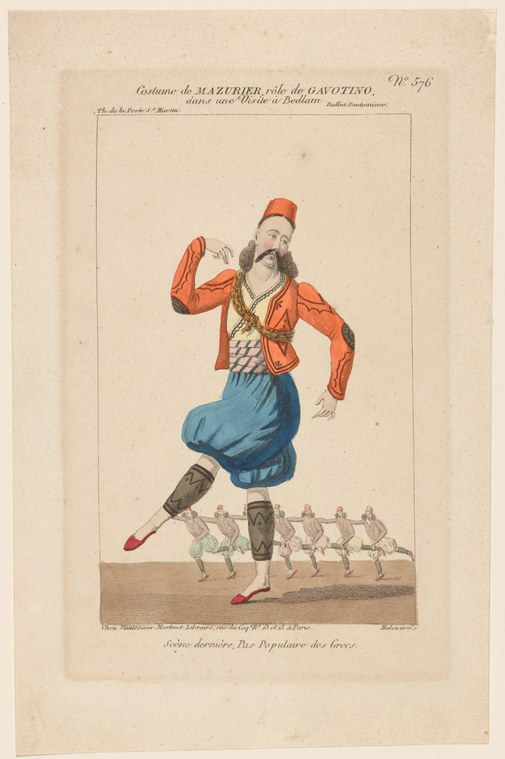
Costume de Mazurier, rôle de Gavatino dans Une visite à Bedlam. Ballet pantomime
Unknown artist
- Collection:
- Prints depicting dance
- Source:
- New York Public Library
- Rights:
- Public domain — free to use, share and adapt.
- Recorded as:
- Public Domain
This print records the costume and movement vocabulary of French pantomime-ballet at a moment when the genre was highly popular and influential across Europe. Mazurier was a celebrated performer whose style influenced later theatrical dance, and this image documents not just clothing but the exaggerated bodily language of his comic art. For dance historians, it is evidence of how theatrical spectacle, costume, and mime interacted in early Romantic-era performance.
What you are looking at
A tall male figure dominates the composition, frozen mid-leap in a theatrical pose of exaggerated energy. He wears a red velvet jacket open at the front, revealing a decorative gold-trimmed vest, and blue breeches gathered at the knee with black stockings and red-heeled shoes. A tall red fez-like hat sits on his head. His left arm is raised and bent, his right leg extended, his torso twisted in a dynamic contrapposto. Below him, rendered much smaller in the background, a line of six or seven identically dressed male figures recede into the distance, all executing the same or similar poses, creating a perspective effect that emphasizes the foreground figure's prominence. The background is plain and light; the figures stand on a thin line suggesting a stage floor. This is a costume design print, documenting a specific role in a theatrical production.
The dancing
The central figure's pose is balletic but exaggerated for comic or theatrical effect: the weight appears to be on the supporting right leg, with the left leg kicked high and behind, the torso inclined forward, and the arms asymmetrically positioned. The figure is not in a closed dance hold with a partner. The smaller figures in perspective repeat this pose, suggesting either a corps de ballet moment or a visual joke about multiplication and uniformity. The costumes—identical and ornate—and the uniform gestures suggest a choreographed ensemble piece rather than social dancing.
The dance depicted
This depicts the costume of a character named Gavatino from a ballet-pantomime titled "Une visite à Bedlam" (A Visit to Bedlam). The character is named after Joseph Mazurier, a French dancer and choreographer known for pantomime and comic roles in the early 19th century. The exaggerated pose, the Orientalist costume elements (the fez, the rich colours), and the theatrical setting suggest a pantomime or comic ballet character—likely a humorous or stock figure. The pose is expressive and grotesque rather than classically balletic, which aligns with pantomime tradition. Bedlam was the famous London lunatic asylum, so the comedy likely derives from absurdity and caricature.
How it was made
This is a hand-coloured engraving or etching, visible from the fine line work, the plate marks, and the selective colouring applied by hand after printing—a common and economical method for theatrical prints of the 1820s–1830s. The technique allowed for rapid circulation of costume designs and cast information to theatre-going audiences, and hand-colouring made the costume details vivid and memorable. The print quality and the style of the inscription (printed text naming the role and artist) indicate this was a commercial theatrical print, likely sold separately or as part of a series documenting productions.
About this work
This is a theatrical costume print documenting a specific performer and character in early 19th-century Parisian pantomime-ballet. It records both the visual spectacle of stage costume and the exaggerated, comic bodily expressiveness of pantomime performance. The character Gavatino, danced by Joseph Mazurier in the ballet "Une visite à Bedlam," is shown in a dynamic, athletic pose that prioritizes theatrical impact over balletic refinement. The print belongs to a tradition of theatre ephemera that preserved the visual memory of celebrated performances before photography. It is a document of how performers moved and dressed, and of what audiences expected from comic and pantomime roles.
How to look at it
Observe the exaggeration of the pose: the raised arm, the kicked leg, the twisted torso, and the asymmetrical balance create an impression of barely contained energy or madness—appropriate for a character in a Bedlam-themed piece. The multiplication of the figure in smaller scale behind him is a witty graphic device that comments on the theatrical convention of the corps de ballet and also suggests something obsessive or pathological about the repetition. The costume—rich in colour and fabric—is the main subject; the pose exists to display it.
The artist
The catalogue does not record the artist or engraver. The inscription indicates this was made to publicize the performance and the role. Such prints were typically commissioned by theatres or published by commercial print publishers in Paris, London, or other theatrical centres, often without attribution to the engraver.
The period
This print dates to the era of French Romantic ballet and pantomime (approximately 1820s–1840s), when Paris was the centre of European theatrical innovation. Pantomime, comic ballet, and narrative-based theatrical dance were at the height of fashion, competing alongside the emerging Romantic ballet aesthetic. Costume was an essential element of theatrical identity, and elaborate or exotic dress (as seen here with the Orientalist elements) was used to signal character type and comedy. Bedlam—the lunatic asylum—was a stock subject for comic and satirical entertainment of the period, appearing in plays, pantomimes, and prints.
Where it lives
This work is held in the New York Public Library's collection of prints depicting dance. It is a commercial theatrical print, likely produced in Paris in the 1820s–1830s and distributed to theatre audiences or sold separately.
Dance in this work
Questions about this work
Who was Joseph Mazurier?
Mazurier was a French dancer and pantomime performer celebrated in the early 19th century for his comic roles and expressive movement. He was known for roles in pantomime-ballets and created a distinctive style that blended dance, mime, and comic exaggeration. This print documents one of his most famous roles.
What was 'Une visite à Bedlam'?
A ballet-pantomime—a theatrical genre that combined narrative, mime, dance, and comic spectacle. Bedlam (the famous London lunatic asylum) was a popular subject for satire and entertainment in this period, and the title suggests the plot involved a visit to a place of absurdity and madness.
Why are there multiple copies of the figure?
This is a graphic device to show depth and perspective, but it also creates a witty visual effect suggesting repetition or multiplication—possibly playing on the idea of theatrical corps work, or reinforcing the comic/absurdist theme of the Bedlam setting.
How was this print made and distributed?
It is a hand-coloured engraving or etching, a standard commercial process for theatre ephemera. Such prints were sold to audiences, hung in theatre lobbies, or circulated as souvenirs, helping to publicize performances and preserve the visual memory of celebrated roles before photography.
More dance artwork





