49 works in this view — arrow keys or swipe to move between them.
Dance in Art
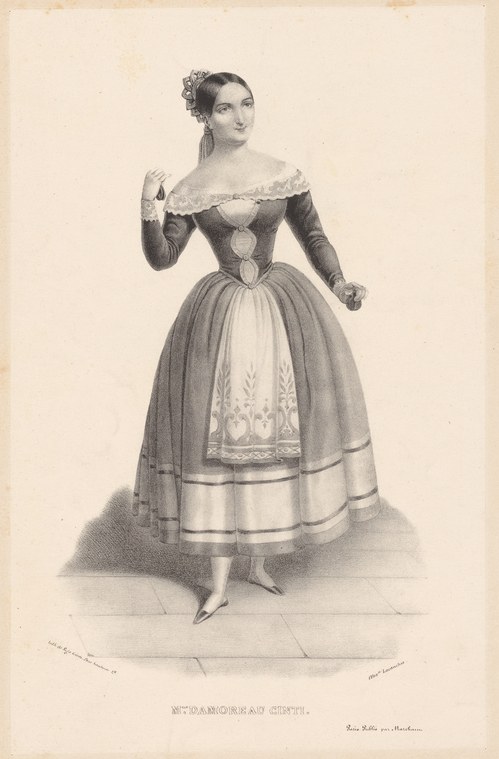
Mme. Damoreau Cinti
Unknown artist
- Collection:
- Prints depicting dance
- Source:
- New York Public Library
- Rights:
- Public domain — free to use, share and adapt.
- Recorded as:
- Public Domain
This image preserves the costume, pose, and presentation style of a known performer from an era when photography was not yet standard, making it primary historical evidence for how Romantic-era dancers dressed and how they were publicly imagined. The lithographic technique allowed such portraits to circulate widely, shaping popular understanding of dance and celebrity in this period.
What you are looking at
A woman in mid-nineteenth-century dress stands alone against a plain background, captured in a moment of performance or display. She wears an off-shoulder dark bodice with a fitted waist, over a voluminous skirt composed of layers: a darker outer skirt and a lighter underskirt embroidered with ornamental designs. Her hair is arranged in the period style, gathered at the back of her head. Her left arm is raised to shoulder height, bent at the elbow with the hand near her chest in a gesture of restraint or appeal; her right arm hangs at her side. Her posture is upright and composed, her gaze directed away from the viewer. The pose suggests a moment frozen mid-action—she stands on the balls of her feet, with her weight shifted slightly forward, suggesting the possibility of movement. The setting is neutral, with a shadow beneath her feet indicating stage lighting or studio arrangement.
The dancing
The single figure stands in an elongated, S-curved posture characteristic of Romantic-era dance presentation. Her raised left arm and lowered right arm create an asymmetrical frame; the lift through her torso and the forward tilt of her head suggest both vulnerability and control. The positioning of her feet and the lightness of her stance indicate trained movement discipline. Her body is oriented three-quarter to the viewer, a compositional choice that emphasizes the line of the figure rather than full frontal presentation.
The dance depicted
This appears to be a portrait of a professional dancer or opera performer, most likely from the 1840s–1850s, captured in a costume and pose typical of Romantic ballet or operatic dance. The off-shoulder neckline and embroidered skirt are consistent with the tulle and silk costumes worn by ballerinas of this period. The pose—poised but not in an active ballet step—suggests a moment of dramatic stillness rather than motion, a convention of theatrical portraiture in which performers were shown in characteristic costume but in a composed, legible pose rather than mid-technique.
How it was made
This is a lithograph, identifiable by the tonal gradations, the soft modeling of light and shadow (particularly visible in the skirt and face), and the characteristic granular quality of the printed surface. The delicate rendering of facial features and fabric textures suggests a hand-drawn original transferred to stone—a technique that allowed for both artistic subtlety and multiple impressions. Lithography was the dominant medium for theatrical portraiture and popular prints in the mid-nineteenth century, making such works widely circulated to audiences and collectors.
About this work
This is a theatrical portrait lithograph of an identified performer—Mme. Damoreau Cinti—in the guise of a Romantic-era opera or ballet dancer. It is a document both of a specific artist and of the conventions by which dancers and singers were presented to the public in the second quarter of the nineteenth century. The work belongs to the substantial genre of theatrical portraiture that records not only the appearance of celebrated performers but also the visual language of Romantic performance—the off-shoulder silhouette, the emphasis on the line of the body, the moment of composed stillness before or after action.
How to look at it
Attend to the lifted posture and the careful asymmetry of the arms—this is not a relaxed pose but a composed moment of theatrical presence. The artist has chosen a pose just short of movement, suggesting potential energy rather than kinetic action. Notice how the skirt is rendered: the darker outer layer and lighter embroidered underskirt create visual depth and suggest the weight and volume of actual fabric, a practical detail that grounds the theatrical fantasy. The direction of her gaze—away from the viewer and downward—is characteristic of Romantic-era performance portraiture, conveying emotional inwardness rather than direct address to the audience.
The artist
The artist is unrecorded in the catalogue, but the style, technique, and subject matter are consistent with the established theatrical lithography workshops of Paris in the 1840s–1850s. Such portraits were often produced by studios rather than individually attributed artists, and many printmakers specialized in theatrical portraiture for the commercial market.
The period
The mid-nineteenth century was the height of the Romantic ballet era, when works like Giselle (1841) and La Sylphide (1832) defined the aesthetic of ethereal, otherworldly femininity. The off-shoulder costume and the emphasis on vertical line in this portrait are visual hallmarks of that moment. Lithographic portraiture of dancers and opera singers was a major industry in Paris, London, and other theatrical centers; such prints were sold as souvenirs, collected by enthusiasts, and used to publicize performances.
Where it lives
This lithograph is held in the New York Public Library's collection of prints depicting dance. The collection gathers theatrical portraiture and dance-related imagery from the eighteenth century onward, documenting the visual representation of performance.
Dance in this work
Questions about this work
Who was Mme. Damoreau Cinti?
Laure Cinti-Damoreau (1801–1863) was a celebrated French mezzo-soprano and dancer, noted for her work in French opera and ballet of the Romantic era. She performed in Paris and across Europe and was among the prominent theatrical artists of the 1830s–1850s.
What is a lithographic portrait and why was it used for theater?
Lithography allowed artists to draw directly on stone; the image was then inked and printed in multiples. For theatrical portraits, this meant that celebrated performers' images could be widely circulated as affordable prints—sold as souvenirs, collected by fans, and used to advertise performances. It was faster and cheaper than engraving but more detailed than woodcut.
What does the costume tell us about the era?
The off-shoulder neckline, tight bodice, and voluminous skirt with embroidered details are hallmarks of 1840s–1850s theatrical costume. The exposed shoulders and the emphasis on the vertical line of the body were considered both fashionable and flattering to dancers, who needed visibility and freedom of movement.
Why is she posed rather than shown mid-leap or mid-step?
Theatrical portraiture conventionally showed performers in composed, legible poses that displayed their costume and bearing rather than attempted to capture the dynamism of performance itself. The pose conveys her role and status while remaining static enough to be clearly rendered in print.
More dance artwork





