49 works in this view — arrow keys or swipe to move between them.
Dance in Art
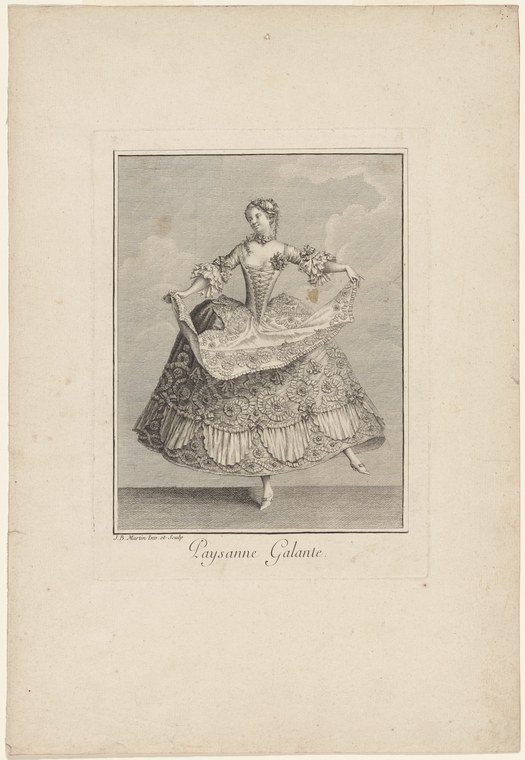
Paysanne galante
Unknown artist
- Collection:
- Prints depicting dance
- Source:
- New York Public Library
- Rights:
- Public domain — free to use, share and adapt.
- Recorded as:
- Public Domain
This engraving is a rare survival of how an 18th-century dancer appeared to an informed eye—what pose the artist chose to immortalize and why. For dancers and choreographers interested in historical technique and the evolution of ballet, it is primary evidence of the physical vocabulary in use and the character conventions within which that vocabulary was deployed. The print also demonstrates the role of visual reproduction in establishing and spreading dance culture before the age of photography.
What you are looking at
A single female dancer is depicted mid-performance in a three-quarter-length engraving. She wears an elaborate mid-18th-century costume: a tight corsetted bodice with decorative embroidery and bows at the shoulders, from which extends a voluminous skirt composed of gathered horizontal tiers or flounces of sheer fabric, creating a bell-like silhouette. Her skirt is caught mid-motion, billowing outward to reveal the movement. She stands on one leg in a lifted pose, her body angled gracefully, with one arm extended and the other raised. Her hair is styled up in the fashion of the period, adorned with a small ornament or feather. The figure is set against a plain background with minimal indication of setting—just a light ground line beneath her feet. The engraving is finely executed with careful cross-hatching to create volume and shadow, particularly in the rendering of the fabric and the delicate modelling of the face and limbs. The inscription at the bottom reads "Paysanne Galante," identifying the character or dance type.
The dancing
The dancer is poised on a single supporting leg with the other leg lifted, suggesting the moment of a jump or an elevated step. Her torso is upright but tilted slightly, creating a graceful line from her head through her raised arm. One arm is extended outward in a gesture of display; the other is positioned to balance the composition. The pose conveys ease and control rather than strain—a characteristic of trained theatrical dance of the period. Her weight appears to be on the ball of the supporting foot, typical of the turned-out, lifted aesthetic of 18th-century theatrical technique.
The dance depicted
This is most likely a theatrical pastoral or comedic dance of the mid-18th century, possibly from the French operatic or ballet tradition. The title "Paysanne Galante"—'the gallant peasant woman'—refers to a character type popular in court entertainment and early ballet, a rustic figure rendered elegant and refined. The costuming and pose suggest a style intermediary between the stiff court dances of the earlier baroque and the developed vocabulary of 18th-century theatrical dance. This is not a peasant in authentic dress but rather an actress or dancer playing a peasant role with sophistication and artifice. The lifted, turned-out legs and the emphasis on vertical extension indicate familiarity with the developing ballet vocabulary of the period, though the character and context suggest performance in an operatic or mixed theatrical context rather than pure ballet.
How it was made
This is an engraving, rendered in fine lines and cross-hatching to create tonal variation and the illusion of three-dimensional form. The technique allows for the delicate rendering of fabric texture and the subtle modelling of the face and limbs. Engravings of this type—single-figure studies of dancers or performers in theatrical costume—were widely circulated throughout Europe in the 18th century as prints, affordable to a broad audience beyond the court. They served as records of successful performances, souvenirs for those who had seen the dancer, and instructional or aspirational images for other performers. The print's fineness and finish suggest it was a commercial product of some care, likely created in Paris or another major artistic centre.
About this work
This engraving documents a moment in 18th-century theatrical dance, preserving both the visual spectacle of a specific character and the physical technique of the period. The work captures the aesthetic of the 'galante' or refined pastoral tradition, in which class was performed through elegance of motion and costuming rather than authenticity. The print is a primary document of how dance was seen, remembered, and circulated in pre-Revolutionary Europe—not as a fleeting event but as an image to be collected, studied, and shared. It belongs in a gallery of dance in art because it reveals what the period valued in a dancer's body and what artists considered essential to capture about theatrical performance: the momentary lift, the fall of fabric, the turn and extension that defined the art.
How to look at it
Attend first to the silhouette: how the artist has used the billowing skirt to convey the energy and lift of the body within it. The flounces catch the movement; they are not merely decorative but are essential to reading the pose as dynamic rather than static. Notice the single-leg support and the lifted height of the other leg—where exactly does the supporting foot press, and how does that invisible anchor organize the whole lifted, extended line of the body? The face and upward gaze are turned away from the viewer; this is not a portrait moment but a moment of performance, where the dancer's attention is elsewhere. The artist has chosen to show neither the beginning nor the end of a movement but a moment of suspension—the essence of the technique.
The period
The mid-18th century saw the rapid professionalization of theatrical dance in France and across Europe. The ballet d'action—narrative dance integrated into opera—was emerging as a distinct form, and the vocabulary of turned-out legs, lifted torsos, and pointed feet was becoming codified. The 'pastoral' or 'galante' tradition, which playfully presented idealized rustic characters in refined settings, was immensely popular in court and commercial theatre. Engravings of individual dancers in celebrated roles were a form of celebrity merchandise, circulating both in France and internationally. This print likely dates to the period when such images were becoming a standard way of documenting and promoting successful performers.
Where it lives
This print is held in the New York Public Library's collection of prints depicting dance. The collection comprises ephemeral images circulated throughout the 18th and 19th centuries—mostly engravings and lithographs, many of them single-figure studies of dancers, characters, or scenes from popular theatrical works. Such prints were inexpensive and widely available, intended for consumption by a broad public rather than collectors of fine art.
Dance in this work
Questions about this work
What is a 'Paysanne Galante'?
'Paysanne Galante' is a character type from 18th-century theatrical entertainment—a peasant woman presented with refinement and elegance rather than realism. The figure was popular in court ballets, operas, and mixed theatrical productions, where social class could be performed and playfully inverted through costume and graceful movement. The character type allowed performers to display technical skill within a narrative or character framework.
How can I tell this is from the 18th century?
The costume, particularly the style of the corset, the construction of the skirt with horizontal tiers of fabric, the arrangement of the hair, and the overall silhouette are all consistent with fashionable dress of the 1730s–1760s. The engraving technique and the style of the lettering support this dating. The physical vocabulary on display—the lifted leg, the turned-out hip, the extended arm—reflects the developing techniques of theatrical dance in that period.
What kind of dance would this performer have done?
The refined lift and extension suggest training in the developing ballet vocabulary, but the character costume and theatrical context indicate the performer worked in opera-ballet or mixed theatrical entertainments rather than pure ballet. Such performers typically danced in act intervals, divertissements, or as characters within larger dramatic works. The movement would have emphasized verticality, turned-out legs, and the display of the body and costume in motion.
More dance artwork





