49 works in this view — arrow keys or swipe to move between them.
Dance in Art
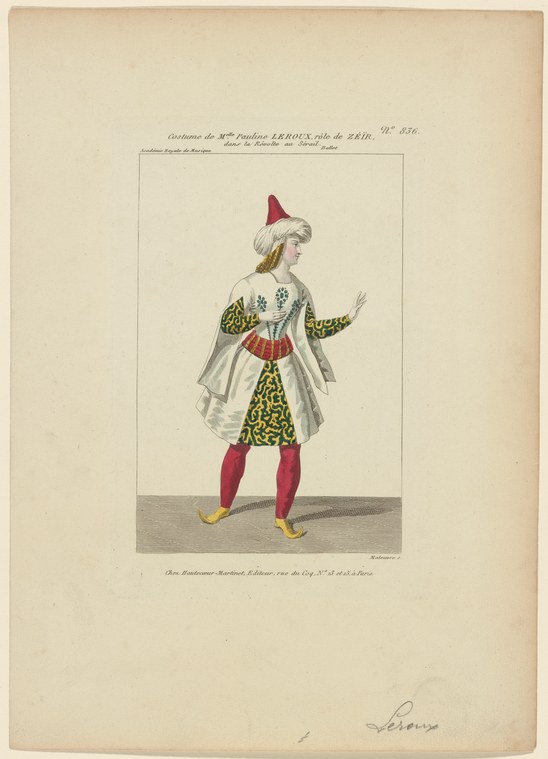
Costume de Melle. Pauline Leroux, rôle de Zéïr, dans La révolte au sérail, ballet, Académie royale de musique
Unknown artist
- Collection:
- Prints depicting dance
- Source:
- New York Public Library
- Rights:
- Public domain — free to use, share and adapt.
- Recorded as:
- Public Domain
Costume plates like this are primary documents of performance practice at a time when no other record of the choreography survives. They show how female dancers inhabited male or exoticized roles, what the body was meant to look like in motion, and how theatre used dress to signal character and place. For anyone studying the visual culture of Romantic ballet, the relationship between European and orientalist aesthetics, or the history of cross-dressed performance, this image is concrete evidence.
What you are looking at
A single figure in theatrical costume stands alone against a plain ground, posed in a moment of animated gesture. The dancer wears a fitted jacket of white silk or linen with bold gold patterning on the sleeves and torso, paired with a red skirt or breeches that extends to mid-thigh. Red silk stockings and yellow-slippered feet complete the ensemble. A tall red cap or turban sits atop pale blonde hair. The figure's right arm is raised in an expressive gesture, the left held at the side; the pose suggests mid-performance energy rather than a static portrait. The simplicity of the setting—a neutral background with only a shadow beneath the feet—focuses all attention on the costume and the body's carriage. This is a costume study, likely a design record or reference sheet for a professional ballet production.
The dancing
A single dancer stands in a relaxed but alert pose, weight apparently evenly distributed. The raised right arm suggests gesture rather than balletic port de bras, with the elbow slightly bent and palm open; the left arm hangs naturally. The stance is upright but unselfconscious, more suited to mime or character dance than to classical ballet's rigid verticality. The figure's gaze is directed across the picture plane rather than downward or upward in the manner of academic ballet training. The silhouette and posture suggest a performer of some physical ease and flexibility, capable of sustained character work.
The dance depicted
This is a costume plate for the role of Zéïr in *La Révolte au sérail*, a ballet performed at the Académie royale de musique (the Paris Opéra) in the early nineteenth century. The title and costume suggest an orientalist subject—Zéïr is a male character name, yet the slender build and features of this figure are feminine. The garments and the style of the image indicate this is a female dancer performing a trouser role or a stylized 'Eastern' character part. The costume mixes European tailoring with orientalist ornament in a manner typical of early Romantic-era ballet's approach to exotic subjects. Without access to the ballet's libretto or performance records, the exact nature of Zéïr's role—whether comic, dramatic, or allegorical—cannot be determined from the image alone.
How it was made
This is a hand-colored engraving or etching, executed with fine line work and finished with watercolor or gouache. The technique allows precise rendering of the costume's structure and ornament—the exact placement of gold brocade, the cut of the seams, the fall of the skirt—making it a working document as much as a presentational image. The quality of line and the controlled use of color suggest this was a professional production, likely executed by a theatre's resident design studio or a specialized engraver. Such costume plates were distributed to performers, set builders, and subscribers to the opera house, serving both as records of actual performance and as advertisements for the spectacle.
About this work
This costume plate documents a role in an early nineteenth-century French ballet, probably from the 1820s or 1830s, when orientalist and exotic subjects dominated the Paris Opéra's repertoire. Mademoiselle Pauline Leroux, a professional ballerina of the period, is recorded as having danced Zéïr in *La Révolte au sérail*. The image shows her in the character's theatrical dress: a hybrid of European cut and orientalist decoration that reflects the ballet world's approach to exoticism. The costume plate's survival and presence in the NYPL collection speaks to the commercial circulation of ballet imagery in the Romantic era, when such prints were collected by theatre patrons and dance enthusiasts across Europe and America.
The work sits within a vast body of nineteenth-century theatrical costume documentation, most of it now fragmentary. These images are vital witnesses to performance history, since the choreography itself is lost and the dancers' bodies survive only in words and pictures. The precision of the rendering—the exact shade of the stockings, the weight of the fabric, the placement of ornament—tells us as much about what early Romantic ballet looked like on stage as any written description.
How to look at it
Notice how the costume is presented frontally and in isolation, in a pose that suggests the performer mid-gesture rather than at rest—the raised arm tells us this is a moment of performance, not a mannequin display. Look at the precision of the ornament on the jacket and skirt, which would have been achieved through embroidery or applied gold brocade and required considerable expense. The stockings and slippers are rendered with equal care, as they were crucial to the line of the leg on stage. The figure's face is individualized rather than idealized, suggesting this is a record of how a particular celebrated performer—Pauline Leroux—actually looked in the role.
The period
This costume plate dates to the early Romantic era in French ballet, roughly 1820–1840, when the Opéra was the dominant institution in European dance. The period saw a explosion of exotic and fantastical subjects on the ballet stage—*La Révolte au sérail* being one of many orientalist ballets that capitalized on French interest in the Ottoman Empire and Eastern luxury. Female dancers regularly performed male roles, not because of gender ambiguity but because the theatre's economics and artistic conventions made such casting normal. At the same time, hand-colored costume engravings had become a standard form of theatrical publicity and a collectable item for the opera-going public, distributed both as loose prints and bound in volumes.
Where it lives
The work is held in the NYPL's Prints collection, which specializes in theatrical and dance imagery. It is catalogued as part of the broader collection of costume studies and performance documentation from the nineteenth-century European stage. The inscription at the bottom attributes the subject to Pauline Leroux and the role to *La Révolte au sérail*, performed at the Académie royale de musique.
Dance in this work
Questions about this work
Who was Pauline Leroux?
A professional ballet dancer of the early nineteenth-century Paris Opéra. Beyond the roles recorded in costume plates and playbills, little is documented about her career, training, or life. She was one of dozens of skilled dancers who populated the Opéra's stage during the Romantic era but left no substantial autobiographical record.
What was *La Révolte au sérail*?
An orientalist ballet performed at the Paris Opéra in the early nineteenth century. Its exact date, librettist, and composer are not established in readily available sources. Like many ballets of the period, it likely combined pantomime, character dance, and spectacular costume to tell a story of intrigue or passion in an exotic setting.
Why would a female dancer play a male role?
In early Romantic ballet, women dominated the stage as performers, and many roles—particularly young male characters, soldiers, or exotic princes—were written for female dancers in trousers. This allowed the theatre to showcase the female body and the supported movements of pointe work while maintaining a narrative of male heroism or adventure.
How were these costume prints made and distributed?
Professional engravers or lithographers working in Paris would receive designs from the theatre, translate them into print form, hand-color them, and sell them both as individual sheets and in bound collections. They were purchased by opera subscribers, dance enthusiasts, and collectors, serving as mementos of celebrated performances and as evidence of what the stage looked like.
More dance artwork





