49 works in this view — arrow keys or swipe to move between them.
Dance in Art
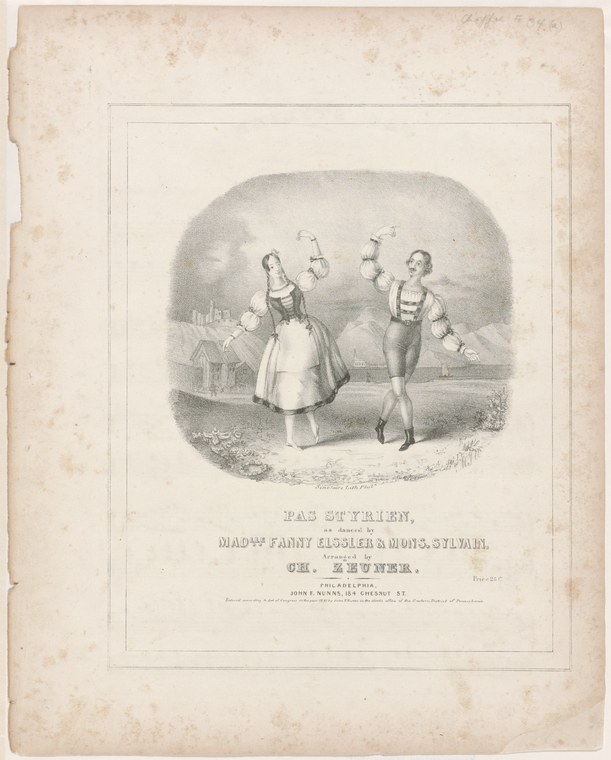
Pas styrien, as danced by Madlle. Fanny Elssler & Mons. Sylvain
Unknown artist
- Collection:
- Prints depicting dance
- Source:
- New York Public Library
- Rights:
- Public domain — free to use, share and adapt.
- Recorded as:
- Public Domain
This print is evidence of the celebrity of Fanny Elssler and the market for dance imagery in the nineteenth century, but more importantly it documents a specific choreographic type—the theatrical rendition of a folk dance—that shaped how European audiences experienced both ballet and national identity. The image shows us what a Styrian waltz looked like when filtered through the bodies and training of professional stage dancers, and therefore how folk forms were transformed when they entered theatrical circulation.
What you are looking at
A woman in a long white dress with a decorated bodice stands center-left, her body angled toward a man in tight breeches, vest, and decorated jacket who strikes a pose to her right. Both figures are caught mid-movement in what appears to be a social dance. The woman's skirt is voluminous and falls to her ankles; the man's posture is sprightly and elevated, suggesting a moment of turning or stepping. The setting is a sparse interior or ballroom space rendered in soft gray tones, with architectural elements barely suggested in the background. The engraving has the characteristic soft hatching and tonal gradation of a mid-nineteenth-century commercial dance print, with a vignette border that softens the composition's edges.
The dancing
The man's weight appears to be on one leg with the other extended or elevated, his torso upright and his arms positioned dynamically—one arm gestures outward. The woman stands in a more grounded position, her posture erect and her skirts arranged in elegant folds. Their spatial relationship suggests a moment of separation within a partnered dance, rather than a closed hold. The woman's gaze is directed toward her partner; his body language is animated and performative.
The dance depicted
The title identifies this as a Pas Styrien as danced by the celebrated ballerina Fanny Elssler and the dancer Sylvain. The Styrian or Styrian waltz (Steirischer) was a regional folk dance of Austria and southern Germany, though by the 1840s it had entered the European ballroom and theatrical repertory as a more refined social dance. The energy and costume here—particularly the man's fitted male dancer's attire rather than civilian dress—suggest a theatrical performance rather than a ballroom scene. Fanny Elssler (1810–1884) was one of the era's most famous ballet dancers, known for her technique and for introducing character dances and national dances to European stages, and this image documents one such specialty number.
How it was made
This is an engraving, likely a commercial print made from a steel or copper plate. The soft modeling of the figures and the fine parallel hatching used to suggest form and shadow are characteristic of reproductive engraving of the 1840s–1850s. The vignette format—with the image fading gradually into the unmarked paper rather than being enclosed by a hard border—was favored for theatrical and celebrity dance prints of this period, lending the figures an ethereal quality. The technique allowed for wide distribution and relatively inexpensive production, making this the kind of image that would have been sold as a souvenir or theatrical memento.
About this work
This engraving documents a specific choreographic moment from the mid-nineteenth-century European stage: the Pas Styrien as performed by two of the era's most celebrated dancers. It is both a record of a transient performance and a commodity—a print made for sale to admirers and theatregoers. The work sits at the intersection of Romantic ballet (represented by Elssler's fame and stature) and the broader nineteenth-century enthusiasm for incorporating folk and national dances into theatrical and ballroom repertories. The image preserves not just the names of the dancers but something of their physical presence and the character of their performance.
How to look at it
The image freezes a moment of separation and display rather than intimate connection: notice the space between the two dancers and the man's theatrical posture, which reads as performance rather than social conversation. The woman's costume—her long skirts and fitted bodice—and the man's professional dancer's attire (not street clothes) signal that this is theatrical rather than ballroom dance. Observe how the engraver has rendered the moment of turning or stepping; the man's lifted leg and dynamic arm position capture energy and elevation, while the woman's grounded stance provides counterbalance.
The artist
The artist is not recorded in the catalogue. The print bears the imprint 'Phila.' (Philadelphia) and a publisher's mark, and appears to have been produced in the United States. The engraver may have worked from a European source image or from direct observation of the dancers' American performances. The style and technique suggest a mid-nineteenth-century commercial reproductive engraver working in the Anglo-American print market.
The period
The 1840s–1850s were the height of Fanny Elssler's career and the Romantic era of ballet, when dancers were celebrated for their technical virtuosity and their ability to embody character and nationality through specialized dances. The Styrian waltz and other regional dances had become fashionable in European ballrooms in the 1820s–1830s, and by the time Elssler was performing, such dances had acquired prestige through their incorporation into ballet and operatic productions. The figure of the professional male dancer partnering a star ballerina was also central to the Romantic ballet's visual and dramatic language.
Where it lives
The print is held in the New York Public Library's collection of prints depicting dance. It was produced in Philadelphia in the United States, likely as a commercial theatrical souvenir or commemorative image for sale to the public.
Dance in this work
Questions about this work
Who was Fanny Elssler?
Fanny Elssler (1810–1884) was an Austrian ballet dancer and one of the most celebrated performers of the Romantic era. She was known for her technical brilliance, her interpretive gifts, and her willingness to incorporate folk dances and character dances into the ballet repertory. She toured extensively in Europe and the United States, and was a major celebrity of her time.
What is a Pas Styrien?
A Pas Styrien (or Steirischer) is a theatrical dance based on the Styrian waltz, a folk dance of Austria and southern Germany. When performed on stage, it retained the waltz frame and tempo but was elevated and refined for professional dancers. It became a popular specialty number or divertissement in ballet and opera productions of the nineteenth century.
How do we know this is a real performance and not imaginative art?
The title identifies the dancers and the specific dance, and Fanny Elssler is documented to have performed such character dances throughout her career. The theatrical costumes and the professional male dancer (Sylvain was a known performer) confirm that this depicts an actual stage performance. The commercial engraving format—with the dancers' names printed below—further confirms it as a memento of a known performance.
More dance artwork





