49 works in this view — arrow keys or swipe to move between them.
Dance in Art
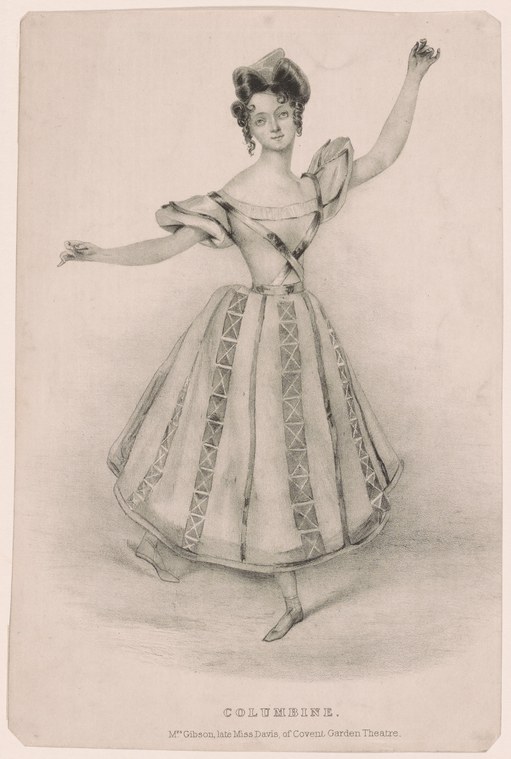
Columbine. Mrs. Gibson, late Miss Davis, of Covent Garden Theatre
Unknown artist
- Collection:
- Prints depicting dance
- Source:
- New York Public Library
- Rights:
- Public domain — free to use, share and adapt.
- Recorded as:
- Public Domain
This print preserves the appearance and movement vocabulary of a working London dancer at a time when women's ballet was at the height of its cultural prestige but before photography could document it. The image is valuable evidence of how Romantic ballet was actually performed: the specific arm positions, the frame of the torso, the relationship between costume and movement, and the theatrical presentation all tell a trained eye how this dancer moved and how her movement differed from later codifications. For historians of Covent Garden theatre, the inscription provides a rare named record of a performer whose work might otherwise be invisible.
What you are looking at
A single female dancer in theatrical dress is captured mid-performance in a three-quarter view. She wears a pale, diaphanous gown with horizontal striped panels in a darker tone that create a structured silhouette, fitted at the waist and flaring into a full skirt that reaches mid-calf. The dress has short puffed sleeves set off the shoulder, revealing her arms and shoulders in the neoclassical manner. Her posture is buoyant and theatrical: one arm is raised overhead with palm open, the other extended at shoulder height with a graceful curve, while her body twists in a spiraling movement. Her head tilts back slightly, and her dark hair is swept up in an elaborate updo typical of early 19th-century fashion. The figure stands on one leg in a balletic position, with the other leg lightly extended, suggesting sustained elevation or a moment of weightless pirouette. The background is plain and neutral, allowing the figure and costume to command attention. The print is executed in fine pencil or engraving, with delicate tonal gradations suggesting candlelight or gaslight playing across fabric and skin.
The dancing
The dancer demonstrates classical balletic vocabulary in her stance and frame. Her weight appears to be supported on a single leg, possibly on demi-pointe, while the other leg is extended or lifted in an open position—neither pressed against the supporting leg nor dramatically high, but graceful and sustained. Her arms follow the curved, open line characteristic of classical ballet's port de bras, with one arm ascending toward a crown fifth or elevated fourth position and the other suspended at shoulder height in second. The torso is upright but energetically twisted, creating a spiral effect from hip to crown that suggests rotation through space rather than static balance. The neck is extended, the face open and expressive, conveying the theatrical presentation expected of a trained solo dancer.
The dance depicted
This is a portrait of theatrical solo dance from the Romantic era of ballet, most likely a role within a ballet d'action or a divertissement number rather than character or national dance. The notation 'Columbine' identifies the character—the maidservant-ingénue of the commedia dell'arte tradition, transformed by Romantic choreography into a lyrical female role. Columbine appears in several early 19th-century ballets and was a standard character role in ballet repertoire; the figure of Mrs. Gibson (identified in the print as 'late Miss Davis, of Covent Garden Theatre') indicates this was a celebrated dancer of the London stage in the 1830s–1840s. The costuming and movement style confirm Romantic-era ballet technique and aesthetic: the ethereal, pale dress, the emphasis on verticality and lightness, the open arm vocabulary, and the spiritual quality of the pose all belong to the period when ballet aspired to represent otherworldly or supernatural femininity. The single-figure format—a portrait of a dancer in character—was a common form of theatrical promotion and memory.
How it was made
This appears to be a fine-line engraving or lithographic print, executed in black ink on paper with the tonal subtlety characteristic of steel-engraving or fine-point etching. The medium allows for precise definition of the dancer's form and the intricate detail of her costume, while also permitting the softer modeling of light and shadow across the figure. The technique was standard for theatrical portraiture during the 1830s–1850s: these prints were published and circulated as souvenirs, collected by theatre patrons, and pasted into scrapbooks. The quality and finish suggest this was a professional commission issued by a London theatre publisher, designed for a wealthy or culturally engaged audience. Such prints served both as advertisements for performances and as mementos of celebrated dancers.
About this work
This is a Romantic-era theatrical print recording a celebrated London dancer in the role of Columbine, a stock character role from commedia dell'arte adapted into classical ballet vocabulary. The image captures the aesthetic and physical language of 1830s–1840s ballet: the ethereal, pale silhouette; the emphasis on weightlessness and verticality; the open, curved arms; and the sense of a trained virtuoso in full control of her form. The inscription preserves the name of the performer—Mrs. Gibson, formerly Miss Davis of Covent Garden—and the character she danced, making this a historical record of an otherwise undocumented theatrical performance. The work belongs in a gallery of dance imagery because it documents not only the appearance of a specific dancer and role but the visual and kinetic ideals of Romantic ballet at its height on the London stage.
How to look at it
Look first at the extremities—the curve of the raised arm, the lift of the head, the extension and suspension of the lower body—and notice how they work together to create a sense of weightlessness and buoyancy rather than grounded force. The artist has chosen to freeze a moment of sustained elevation or light spiraling motion, not a dramatic leap or turn. Notice the care taken with the costume: the horizontal striping, the graduated tone suggesting folds and draping, the way the fabric reads as gossamer and insubstantial. This was a deliberate choice reflecting Romantic aesthetic values. The open, uncrossed arms and the absence of any prop or partner signal that this is a solo moment—a technical and artistic display of the individual dancer's control and extension rather than a moment of dramatic narrative.
The period
The 1830s–1850s were the golden age of Romantic ballet in London, when dancers from the Continental tradition—Marie Taglioni, Fanny Elssler, and a host of their rivals—dominated the London stage at the King's Theatre and Covent Garden. Columbine was a traditional character role, inherited from centuries of commedia dell'arte performance, that was transformed in the Romantic period into a graceful, ethereal female character within longer narrative ballets. The printing and publication of theatrical portrait prints flourished during this era as theatres sought to commemorate celebrated performances and dancers cultivated their own celebrity through circulation of their images. The pale, high-waisted, nearly transparent costume with short sleeves and decorated hem visible here is the canonical Romantic ballet dress of the 1840s–1850s, distinct from both the heavier classical tutus of later decades and the ornate costumes of earlier baroque theatrical dance.
Where it lives
The work is held in the New York Public Library's Prints collection of dance imagery. It is a theatrical souvenir print of the type circulated by London theatre publishers in the mid-19th century, intended for collectors of theatrical portraiture and dancers' admirers.
Dance in this work
Questions about this work
Who was Mrs. Gibson?
The print identifies her as 'Mrs. Gibson, late Miss Davis of Covent Garden Theatre,' indicating she was a performer at one of London's two patent theatres during the 1830s–1850s. No other record of her career appears to survive in standard theatrical histories, making this print one of the few pieces of evidence that she danced professionally.
What is a Columbine?
Columbine is a character from commedia dell'arte—the maidservant and love interest—who was adopted into theatrical dance in the 17th and 18th centuries. In Romantic ballet, she became a graceful, lyrical female solo role, often appearing in longer narrative ballets or divertissement numbers. The role was danced by many celebrated ballerinas of the era.
How was Romantic ballet different from earlier ballet?
Romantic ballet (1830s–1870s) emphasized ethereal, otherworldly femininity and supernatural or exotic themes, contrasted with the technical display and court-based aesthetics of earlier ballet. Dancers performed on the balls of their feet (developing pointe technique), wore pale, gossamer costumes, and moved with a sense of weightlessness and spiritual aspiration. Male dancers were often subordinated to the female soloist.
Why are there horizontal stripes on her skirt?
The striped panels are likely a decorative element of the costume design, common in Romantic-era ballet dress. They may also serve a practical purpose: breaking up the silhouette of the skirt to suggest movement and flow, or to add visual interest and sophistication to an otherwise plain pale dress. The stripes were an element of the performer's theatrical image.
More dance artwork





