49 works in this view — arrow keys or swipe to move between them.
Dance in Art
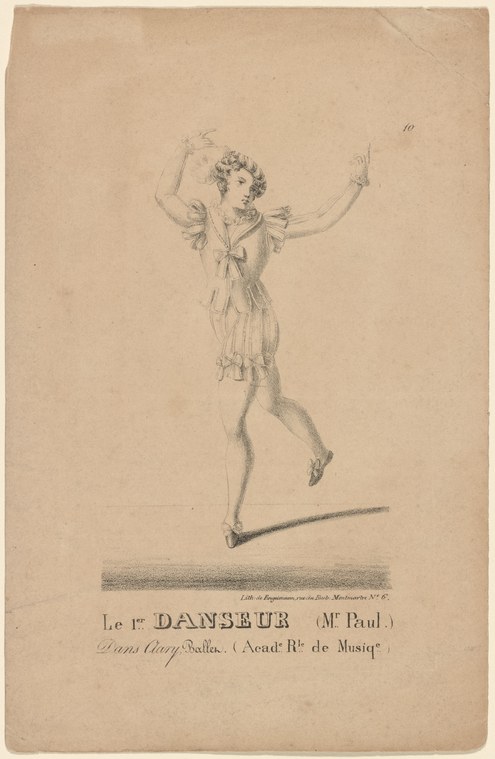
Le 1er danseur Mr. Paul dans Clary, ballet, Acad'e R'le de musique
Unknown artist
- Collection:
- Prints depicting dance
- Source:
- New York Public Library
- Rights:
- Public domain — free to use, share and adapt.
- Recorded as:
- Public Domain
This is direct visual evidence of how principal male dancers moved and presented themselves on the Paris Opera stage in the early Romantic era—a period from which moving images do not exist. The specificity of the costume, the anatomical understanding demonstrated by the artist, and the documentary intention make this an invaluable record of actual performance practice rather than idealized artistic interpretation.
What you are looking at
A single male dancer is depicted in a dynamic, elevated pose against a plain background. He wears early 19th-century stage costume: a fitted jacket with short puffed sleeves, a short skirt or kilt-like garment, and stockings. His hair is styled in the Romantic-era fashion, curled and parted. Both arms are raised high and to the sides in an expansive, joyful gesture. His weight appears to be on one leg while the other is extended or raised, creating an illusion of vertical lift and forward momentum. The figure is rendered in fine graphite pencil, with careful attention to anatomical proportion and the articulation of the limbs. The pose conveys the technical vocabulary of classical male ballet: elevation, épaulement, and the controlled yet exuberant carriage of a principal dancer.
The dancing
A single male figure stands in a lifted, dynamic position with both arms raised to shoulder height or above, the right arm higher and extended further back. His legs are positioned to suggest movement—one appears to carry the weight while the other reaches forward or lifts. The pose demonstrates the balletic vocabulary of the era: high arm carriage, an extended frame, and an emphasis on vertical weightlessness. The body alignment suggests a trained classical dancer comfortable with turnout and sustained elevation.
The dance depicted
This is documented as a portrait of a principal male dancer, Mr. Paul, performing in *Clary*, a ballet produced at the Académie Royale de Musique (the Paris Opera) in the early 19th century. The specific moment captured—a peak moment of elevation with expansive arm gestures—is typical of the male lead roles that dominated Romantic-era ballet. The imagery suggests classical technique in the Parisian tradition, emphasizing verticality, épaulement, and the dramatic presence required of a premier danseur.
How it was made
This is a fine-line engraving or etching executed in graphite pencil on paper, likely a preparatory study or finished print intended for publication and circulation. The technique allows for precise anatomical study and high definition of costume detail. The medium suggests this was intended as a record of performance—a common practice in the 19th century for documenting celebrated dancers and roles, distributed to theatre patrons and dance enthusiasts as a form of performance documentation and publicity.
About this work
This is a graphic study of a celebrated principal dancer of the Paris Opera in the Romantic period, preserved as a formal dance portrait. The work captures not only a likeness but a codified moment of technical and theatrical excellence: the male dancer suspended in an instant of elevation that demonstrates both virtuosity and grace. Such portraits served dual purposes—they documented the achievements of star performers and circulated an ideal of classical male dancing technique to a broad educated audience.
The drawing exemplifies the 19th-century practice of dance documentation through printmaking, a genre that reached across theatre professionals, dance students, and cultivated amateurs. The precision of the line and the anatomical clarity of the rendering suggest this was a work of some production value, likely commissioned or undertaken to preserve a celebrated performance for posterity.
How to look at it
Observe the instant the artist chose: not a moment of arrival or transition, but a suspended peak of elevation—the moment of maximum visual impact and technical difficulty. The raised arms create an open, expansive silhouette that reads clearly even at small scale; the lifted carriage of the torso and the extension of the limbs embody the aesthetic ideals of classical male dancing in this era. The precision of anatomical detail—the placement of weight, the alignment of the spine, the turn of the head—suggests the artist had studied or attended performances closely. This was not a generic 'dancing figure' but a portrait of a specific man in a specific role.
The artist
The artist is not recorded in the catalogue. The quality and precision of the line work, the anatomical knowledge, and the theatrical subject suggest a trained artist working for a Paris publishing house or theatre. The inscription references the Académie Royale de Musique and indicates this was produced as part of a documented record of significant performances and performers.
The period
This drawing belongs to the early Romantic period in European ballet, approximately 1820–1835, when the Paris Opera was the dominant centre of classical dance innovation. The male dancer was at this moment beginning to be displaced by the female dancer as the focus of choreography and audience fantasy, though principal male roles remained technically demanding and prestigious. The period saw the consolidation of classical technique as codified in Parisian tradition, and the creation of detailed movement vocabularies that required careful preservation through notation and visual record. The practice of publishing portraits of celebrated dancers was well established and highly popular among theatre-going society.
Where it lives
The work is held in the New York Public Library's collection of prints depicting dance. It is documented as a study or finished print relating to a performance at the Académie Royale de Musique, with the inscription indicating it was part of a documented record of principal dancers and roles.
Dance in this work
Questions about this work
Who was Mr. Paul and what was *Clary*?
Mr. Paul was a principal male dancer at the Paris Opera in the early 19th century. *Clary* was a ballet produced there, though few records of the work survive beyond this portrait and similar documentation. The print preserves the only visual evidence of how the role was performed.
What is the pose telling us about male ballet technique in this period?
The pose exemplifies the core vocabulary of classical male ballet: elevation (the illusion of weightlessness), épaulement (the carriage and use of the arms and upper body), and turnout (the outward rotation visible in the legs). The suspended, expansive moment chosen suggests the kind of theatrical presence and technical facility required of principal male dancers.
How was this image used?
Prints like this were circulated among theatre patrons, dancers, and dance enthusiasts as records of celebrated performances and to serve as models of proper technique. They were also sold as souvenirs and mementos of performances, much like theatrical photographs later in the 19th century.
What can we learn from the costume?
The short jacket, puffed sleeves, short skirt, and stockings are typical of male ballet costume in the Romantic period, designed to allow visibility of the legs and footwork while maintaining a formal, aristocratic appearance. The costume remained largely consistent across different roles and ballets during this era.
More dance artwork





